
- Reference Number: HEY380/2024
- Departments: Orthopaedics
- Last Updated: 31 October 2024
Introduction
This leaflet has been produced to give you general information about your Hip Replacement surgery. Most of your questions should be answered by this leaflet/booklet. It is not intended to replace the discussion between you and your doctor but may act as a starting point for discussion. If after reading it you have any concerns or require further explanation, please discuss this with a member of the healthcare team caring for you.
What is a Hip Replacement
A hip replacement (or hip arthroplasty) is a surgical procedure, in which the injured or damaged surfaces of the hip are replaced with artificial parts (implants) which are secured to the bone.
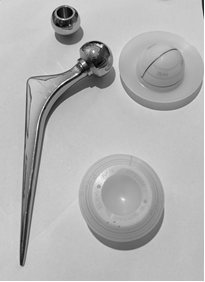
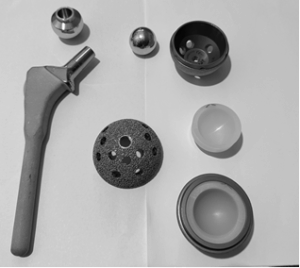
The hip replacement consists of a ‘stem’ that is inserted into the thigh bone (femur) then a ceramic or metal ball is attached to the top of the stem. A metal socket can be fixed to the pelvis with a plastic or ceramic socket liner, or a plastic socket can be directly cemented into the pelvis.
The implants can be attached to the bone using cement or can be cementless and rely on a ‘press fit’.
The type of implant that is used depends on the bone quality and other factors.
The stem can be made of titanium, cobalt chrome or stainless steel, and the plastic is a hard polyethylene that is treated to become very hard wearing.
Cemented Hip Implants Uncemented Hip Implants
Why do I need a Hip Replacement?
Most hip replacements are performed to treat severe pain and/or restricted function related to hip arthritis
Your surgeon will have discussed the options for treating hip arthritis and it is important to try these options first. Hip replacement is a major procedure with a chance of problems and recovery takes several months so it is important that before you resort to surgery you try treatments with less risk.
How do I prepare for the Hip Replacement?
Please read the information leaflet. Share the information it contains with your partner and family (if you wish) so that they can be of help and support. There may be information they need to know, especially if they are taking care of you following this examination.
You will be seen by the surgeon before the operation, and they will discuss the diagnosis, treatment options and risks of surgery. If you agree to go ahead with surgery, you will be placed on the waiting list. You will have a pre assessment appointment with a nurse (and possibly the anaesthetist) a few weeks before the operation. You will have blood tests, swabs, and a heart tracing (ECG). You will be advised about what medications need to be stopped and when to come into the hospital.
Try to stay active before your operation to keep your body and mind healthy
Even a short walk with help exercise your legs, heart and mind.
Try to stop or cut down smoking
Being overweight increases the risk of some complications after surgery especially infection, so if you are overweight try to get down to a healthy weight.
If you are diabetic, it is important that this is well controlled when you have your surgery, your GP can check this and advise you how to control it
There are many programmes designed to help with this, more information is provided at the end of this document.
Do’s and Don’ts before a Hip Replacement
It is important to check when to stop certain medications
You will need to stop blood thinning medication a few days prior to surgery, HRT tablets should be stopped 4 weeks preop, and the contraceptive pill 6 weeks preop.
The pre assessment department at the hospital will let you know more details.
You should not shave your legs for at least 1 week prior to the operation, this will be done in theatre if needed.
You need to be careful not to cut your skin in the weeks prior to the operation, so it is sensible to avoid gardening or DIY to avoid cuts or scratches.
You should eat normally the day before your surgery but have no food after midnight. You can drink clear fluids (water, black tea or coffee) up to 2 hours before surgery. You may be given a specific preop drink to help recovery
Please avoid alcohol and try to stop smoking prior to the operation. Even stopping for a few days is better than nothing.
Try to remain active to maintain the range of movement of your hip and keep your muscles strong, you will need them after surgery.
Leg raises and squats are ideal exercises if you can manage them.
If you are unwell or you cut your skin in the days before the operation you should inform the hospital immediately.
What will happen?
On the day of the operation the surgeon will see you before the surgery, confirm you wish to go ahead and draw a mark on your leg to make sure the correct leg is operated on. If you have any questions, please ask as this is the last chance before the surgery.
You will then be taken to the theatre, and the anaesthetic will be administered.
This is most likely a spinal anaesthetic with or without sedation.
The spinal anaesthetic completely numbs your legs from your belly button downwards and the sedation puts you to sleep.
The spinal anaesthetic means you will not feel anything at all below your waist, and you will not be able to move your legs until a couple of hours after the operation
The sedation means you will not be able to see or hear anything. The sedation will be turned off when the operation finishes and you will wake up. For some patients it is safer to have no sedation, your anaesthetist will discuss this with you.
The sedation does not have side effects, and most patients wake up and feel very well and comfortable. You will also be given anti-sickness medication and drugs to reduce bleeding.
Occasionally a spinal is not possible, or a General Anaesthetic or Epidural is preferred by the anaesthetist.
Your skin will be cleaned with antiseptic solution and covered with clean towels (drapes). The surgeon will make an incision (a cut) on the side of the hip.
The surgeon will shape the inside of the socket in the pelvis and inside of the thigh bone to allow the implants to fit correctly. They will be then attached to the bone with or without cement.
When the surgeon is happy with the position and movements of the hip, the tissue and skin can be closed. This will be done with stitches or clips, and the wound should be checked about 2 weeks after the surgery by nurses at the hospital or at your GP surgery
Drains will not be used, and when you wake up you will have a dressing on the hip but no bandages so that you can move your hip freely.
What happens afterwards?
It is important to drink and eat as soon as possible after the surgery, this will give you energy to recover, increase your blood pressure and help reduce sickness.
You will be given regular painkillers, anti-sickness tablets, blood thinners to reduce the risk of blood clots and laxatives because the painkillers can cause constipation.
It is safe to fully weight bear on your operated leg immediately after surgery but for the first couple of occasions this should be supervised by a nurse or physio.
You will go for an X-ray and have bloods tests after the operation
The physiotherapy team will visit you soon after the operation and will get you out of bed and walking on the same day as the surgery.
It is really important to mobilise as soon as possible after surgery as this reduces the chance of many complications such as blood clots, pressure sores, chest and water infections.
It will feel difficult when you first start weight bearing but very quickly it will become easier and very often by the end of the day of surgery you will be able to walk with sticks without assistance.
The physiotherapists will make sure you can get on and off the bed, to and from the toilet and climb a few stairs before you are discharged.
The nurses will check your vital signs, your wound and that your pain and any sickness are controlled.
You will be expected to pass water before you go home. Very rarely patients require a catheter after surgery.
When will I go home?
Most patients now are safe to be discharged on the day of the operation or the day after.
If you have multiple medical problems or are very frail a longer stay is sometimes needed.
However patients usually are more comfortable in their own home, and it is perfectly safe to be discharged on the day of the surgery or the next day in the vast majority of cases.
What happens when I get home?
You will be discharged with a number of medications to treat pain, sickness, constipation and lower the risk of blood clots. These will be explained to you before you go home.
Most patients are discharged walking with 2 sticks, and most do not require physiotherapy once they are discharged. If the ward physios think this is necessary, it will be arranged.
It is important to take the painkillers regularly for the first couple of weeks, they work much better if taken regularly rather than ‘as and when’.
After a couple of weeks, it is usually possible to stop the strong painkillers (Codeine) but important to continue the mild ones, Paracetamol +/- Ibuprofen.
Codeine often causes constipation and can be addictive so best to stop it after a couple of weeks if possible.
You don’t have to wear the stockings if you are taking the blood thinning medication (Apixaban or Pradaxa).
It is normal to have some pain from the operation site, but it should be tolerable and get better over a period of 3 to 4 weeks. The dressing may become a little stained with blood, this is normal. However, if fluid leaks out of the sides of the dressing, then please contact the hospital ASAP. This could indicate an infection and this needs to be dealt with quickly. It is better to contact the hospital than the GP as the nurses at the hospital are more familiar with post op wounds.
Your leg may become swollen but if you have pain or redness in your calf, you should contact the hospital as this can indicate a DVT
What should I look out for when I get home?
- leakage of fluid from the dressings
- increasing pain not controlled with painkillers
- increasing pain and redness in the calf
IF ANY OF THESE OCCUR, PLEASE CONTACT THE HOSPITAL WHERE YOU HAD YOUR SURGERY
Will I be seen again after my surgery?
You should get your wound checked at about 2 weeks after surgery by a district nurse, practice nurse or at the hospital. The stitches do not need to be removed.
A member of the team will see you within 6 to 12 weeks of surgery to check on your progress.
If you are progressing well then, another appointment may not be necessary.
If you or your surgeon has any concerns, then you might need further appointments and X-rays
It is important that if you have increased pain or any wound problems that you contact the hospital as the surgeon would want to know about this as soon as possible
How long will recovery take?
Full recovery takes 6 to 12 months, but most people feel a big improvement much sooner than that.
Your hip will be painful for the first weeks after surgery, and it is important that you take your painkillers regularly to prevent the pain building up.
It will feel warm and swollen and you may have an area of numbness around the scar.
After about 3 to 4 weeks the pain and swelling will start to improve but it is normal for swelling to persist for 3 to 6 months.
After 6 weeks you will be able to return to driving as long as you can perform an emergency stop and manoeuvre the car safely.
The vast majority of patients return to work after hip replacement. On average it takes 3 months to return to work but occasionally it can take 6 or even 12 months.
Only about 1 in 20 patients do not return to work after hip replacement.
You can return to swimming after 6 weeks and as your walking distance improves you can return to activities like Golf and Gym after 8 to 10 weeks.
The average time to return to an 18-hole round of golf is 4 to 6 months
Most patients don’t need further surgery after their first replacement but if you get pain, swelling and/or leakage from the wound at any time please contact the orthopaedic department at your hospital asap
How long will my hip replacement last?
There is not a very simple answer to this question. The answer depends on your age and other risk factors.
The National Joint Registry shows that about 98% of hip replacements last 5 years, 96% last 10 years, 93% last 15 years and 92 % last 18 years.
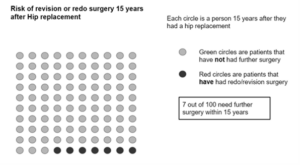
This means that only 1 out of 12 patients who have a hip replacement have a revision operation within 18 years.
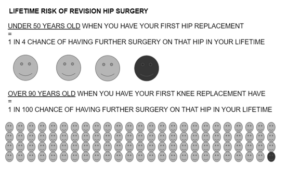
Another way to look at it is to look at the chance of having a redo or revision operation in your lifetime.
If you are under 50 your chance of having a revision operation in your lifetime is about 1 in 4, this chance decreases as you get older so that if you are over 90 when you have a hip replacement the chance of another operation is about 1 in 100.
There are certain risk factors that make redo surgery more likely.
Male gender, other medical problems like heart disease, diabetes, obesity all increase the risk of revision surgery.
Revision surgery is normally a more complex operation than your first replacement with more risk and the outcome is not as reliable. So, avoiding revision surgery is best and it should only be considered if symptoms are severe.
What are the results of hip replacement surgery?
Lots of research has demonstrated that hip replacement is a safe and successful procedure
Overall, 19 out of 20 patients are happy with the result of their operation 1 year after surgery
The graph below shows results of hip replacements performed in this country over the last 10 years.


Can there be any complications or risks?
Hip Replacement surgery is a major operation and there is a risk of a complication
A complication is an unanticipated problem that arises following and is a result of the operation.
Most hip replacement operations are very successful; there are no problems and patients recover well. However, it is important to be aware of the complications that can happen so that you have all the information you need to make the decision before you proceed with surgery.
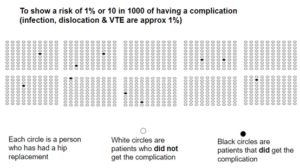
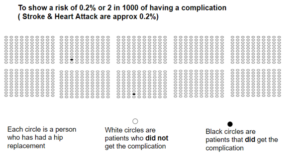
Each of the risks is described in terms of how many patients in 1000 experience the complication
SURGICAL COMPLICATIONS
INFECTION happens about 10 times in every 1000 patients within 1 year of surgery
Early infection can sometimes be treated with antibiotics but often needs surgery to clean the wound. If treatment for infection is delayed or it develops later on, then the new implants often need to be removed and changed. This can require 2 or more surgeries. For this reason, if you think you might have an infection it is vital that you contact the hospital quickly.
DISLOCATION happens to about 7 patients in every 1000 patients within 1 year of surgery
The hip is unlikely to dislocate unless it is put into an extreme position. If the hip dislocates it will become very painful and the leg will become shorter. You will need to come the hospital urgently to get the hip reduced back into the socket. This might require revision surgery.
LEG LENGTH DISCREPANCY – about 10 in 1000 patients
Sometimes the operated leg is slightly longer or shorter than the other leg after the operation. Most patients cope with this well, with or without a shoe raise. Very occasionally it requires more surgery
FRACTURE
- during surgery- happens about 7 times in every 150 hip replacements performed
- lifetime risk – during the ‘life’ of the hip replacement the chance of a fracture is 30 in every 1000 patients. Most fractures happen many years after surgery and are due to a fall. Most require surgery
NERVE DAMAGE – about 2 in every 1000 patients
The sciatic nerve is the most to be injured and this results in foot drop and numbness affecting the lower leg. It recovers fully in about half those affected, and another quarter of patients get partial recovery. Recovery can take up to 2 years.
BLOOD VESSEL DAMAGE – about 1 every 1000 patients. This requires urgent treatment
AMPUTATION about 1 in every 1000 patients
MEDICAL COMPLICATIONS
KIDNEY INJURY this happens about 20 times in every 1000 patients within 30 days of surgery – kidney injury normally gets better over the first few days after surgery but can require intravenous fluids and occasionally is permanent
BLOOD CLOTS (DEEP VEIN THROMBOSIS (DVT) AND PULMONARY EMBOLISM (PE))
This happens about 6 times in every 1000 patients within the first 3 months. You will be given tablets to reduce the risk of DVT, but it is still possible. It presents with pain, swelling, and redness of the calf. If this happens, please contact the hospital urgently
HEART ATTACK this happens about 2 times in every 1000 patients within 30 days of surgery
STROKE this happens about 3 times in every 1000 patients within 30 days of surgery
DEATH – approximately 2 in every 1000 patients die within 3 months of surgery.
Death is not usually related to the operation.
More Information
https://orthoinfo.aaos.org/en/treatment/?topic=JointReplacement
https://www.versusarthritis.org/about-arthritis/treatments/surgery/hip-replacement-surgery/
https://www.nhs.uk/conditions/hip-replacement/
General Advice and Consent
Most of your questions should have been answered by this leaflet, but remember that this is only a starting point for discussion with the healthcare team.
Consent to treatment
Before any doctor, nurse or therapist examines or treats you, they must seek your consent or permission. In order to make a decision, you need to have information from health professionals about the treatment or investigation which is being offered to you. You should always ask them more questions if you do not understand or if you want more information.
The information you receive should be about your condition, the alternatives available to you, and whether it carries risks as well as the benefits. What is important is that your consent is genuine or valid. That means:
- you must be able to give your consent
- you must be given enough information to enable you to make a decision
- you must be acting under your own free will and not under the strong influence of another person
Information about you
We collect and use your information to provide you with care and treatment. As part of your care, information about you will be shared between members of a healthcare team, some of whom you may not meet. Your information may also be used to help train staff, to check the quality of our care, to manage and plan the health service, and to help with research. Wherever possible we use anonymous data.
We may pass on relevant information to other health organisations that provide you with care. All information is treated as strictly confidential and is not given to anyone who does not need it. If you have any concerns please ask your doctor, or the person caring for you.
Under the General Data Protection Regulation and the Data Protection Act 2018 we are responsible for maintaining the confidentiality of any information we hold about you. For further information visit the following page: Confidential Information about You.
If you or your carer needs information about your health and wellbeing and about your care and treatment in a different format, such as large print, braille or audio, due to disability, impairment or sensory loss, please advise a member of staff and this can be arranged.