
- Reference Number: HEY1168/2024
- Departments: Major Trauma
- Last Updated: 30 June 2024
Introduction
This information sheet aims to help you, and those close to you, recognise and understand the process of psychological recovery and the common emotional reactions we experience after something sudden or unexpected impacts our lives (we might call this a traumatic event).
You have been admitted to hospital following a traumatic event and are being cared for by the Hull Major Trauma service. Psychology is part of this service; they can help you process any experiences, responses or feelings that you may have, or help you better understand any changes to your thinking.
If you would like to have some time with a Psychologist, please tell any member of staff and they can arrange a referral for you.
Understanding the effects of traumatic events
The situation you are now in is not normal for you, so you are probably experiencing things that don’t feel normal for you. Your body is processing stress/distress and uncertainty. Here are some examples of things you may notice, and how experiences change over time.
Common emotional and physiological responses include:
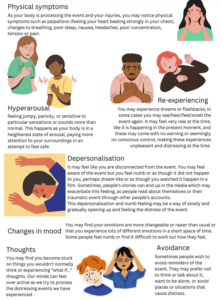
How long might this last?
In most cases these reactions are short-term and will pass after a few days or weeks as your body adjusts, processes the stressful event and recovers. However, sometimes these reactions can last longer depending on your circumstances and emotional responses.
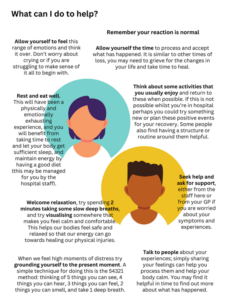
Things you should try to avoid:
- Distracting yourself from thinking about it. For example, by being very active, taking on too much or going back to work very quickly. This again may prevent you from processing what has happened; instead take some time to help you come to terms with any changes.
- Using alcohol or medication to numb. People can try to distract themselves by using alcohol or medication to “numb the pain” and avoid thinking about the traumatic event. Your brain is needing to process the traumatic event and a high level of distraction or avoidance can disrupt this process.
- Bottling up your emotions. We are sometimes taught to manage our emotions and not “let it all out”, but emotions are a physiological natural response to circumstances around you. Allowing ourselves to feel and express them can help give us a sense of relief.
Accessing support after you leave hospital:
If you feel like you would benefit from some emotional wellbeing support after you have left hospital, your local Improving Access to Psychological Therapies (IAPT) NHS Service can continue to help. Here is a list of helpful services and how to contact them:
Urgent Mental Health Support:
If you require urgent mental health support to keep yourself or others safe, you can access this by calling the following services in your local area, or by calling 999 or attending your nearest A&E.
| Crisis Service | Region | Contact details |
| Mental Health Advice and Support Line 24/7 | Hull and East Riding of Yorkshire | tel: 0800 138 0990
https://www.humber.nhs.uk/Services/mental-health-crisis-team.htm Available 24 hours a day, 7 days a week |
| NAViGO Crisis Team | North East Lincolnshire | tel: 01472 256256 (option 3 for mental health) or text ORANGE to 85258
https://www.navigocare.co.uk/am-i-in-crisis/ Available 24 hours a day, 7 days a week |
| North Lincolnshire Access Team (RDaSH NHS Foundation Trust) | North Lincolnshire
|
tel: 01724 382015
Available 24 hours a day, 7 days a week |
| Lincolnshire Crisis Resolution and Home Treatment
(Lincolnshire Partnership NHS Foundation Trust) |
Lincolnshire
Lincoln, Louth, Boston/Skegness/Spalding, Grantham/Sleaford/Stamford |
tel: 0800 015 0211
Mental health support – NHS North Lincolnshire CCG Available 24 hours a day, 7 days a week |
| Crisis Resolution and Intensive Home Treatment (CHRT), Urgent Care Services
(TEWV NHS Trust) |
North Yorkshire | tel: 0800 0516 17
https://www.tewv.nhs.uk/services/crisis-and-intensive-home-treatment-team/ Available 24 hours a day, 7 days a week |
Additional Helpful Numbers
- Mind Info line- tel: 0300 1233393
- Samaritans- tel: 116 123 (free at anytime, from any phone)
- HEADWAY brain injury association tel: 0808 800 2244 or tel: 07395 571398 for Hull & East Riding’s branch (headway.org.uk)
- Limbless Association (Amputee Charity Helpline) – tel: 0800 6440185 (limbless-association.org)
- PAUL for Brain Recovery – tel: 01482 620229 (paulforbrainrecovery.co.uk)
- Day One Trauma – tel: 0300 303 5648 (dayonetrauma.org)
- Cruse Bereavement – tel: 01482 565565 / tel: 0808 808 1677 (cruse.org.uk)
- Spinal Injuries Association – tel: 0800 980 0501 (spinal.co.uk)
- Hull DAP (Domestic Violence) – tel: 01482 318759 (hulldap.co.uk)
- DVAP (East Riding Domestic Violence support) – tel: 01482 396330
- Citizens Advice – tel: 01482 328990 or tel: 0300 3300 888 or tel: 0800 144 8848 (e-advice@hull-eastridingcab.org.uk)
- Hull ReNew (Drug and Alcohol service) – tel: 01482 620013 (hull@cgl.org.uk)
For additional information about services in your locality please contact your GP.
General Advice and Consent
Most of your questions should have been answered by this leaflet, but remember that this is only a starting point for discussion with the healthcare team.
Consent to treatment
Before any doctor, nurse or therapist examines or treats you, they must seek your consent or permission. In order to make a decision, you need to have information from health professionals about the treatment or investigation which is being offered to you. You should always ask them more questions if you do not understand or if you want more information.
The information you receive should be about your condition, the alternatives available to you, and whether it carries risks as well as the benefits. What is important is that your consent is genuine or valid. That means:
- you must be able to give your consent
- you must be given enough information to enable you to make a decision
- you must be acting under your own free will and not under the strong influence of another person
Information about you
We collect and use your information to provide you with care and treatment. As part of your care, information about you will be shared between members of a healthcare team, some of whom you may not meet. Your information may also be used to help train staff, to check the quality of our care, to manage and plan the health service, and to help with research. Wherever possible we use anonymous data.
We may pass on relevant information to other health organisations that provide you with care. All information is treated as strictly confidential and is not given to anyone who does not need it. If you have any concerns please ask your doctor, or the person caring for you.
Under the General Data Protection Regulation and the Data Protection Act 2018 we are responsible for maintaining the confidentiality of any information we hold about you. For further information visit the following page: Confidential Information about You.
If you or your carer needs information about your health and wellbeing and about your care and treatment in a different format, such as large print, braille or audio, due to disability, impairment or sensory loss, please advise a member of staff and this can be arranged.
This leaflet has been produced by the Hull University Teaching Hospitals NHS Trust and is available as a download:
Download the “Major Trauma Psychology Service” leaflet