
- Reference Number: HEY292/2025
- Departments: Nuclear Medicine
- Last Updated: 30 June 2025
Introduction
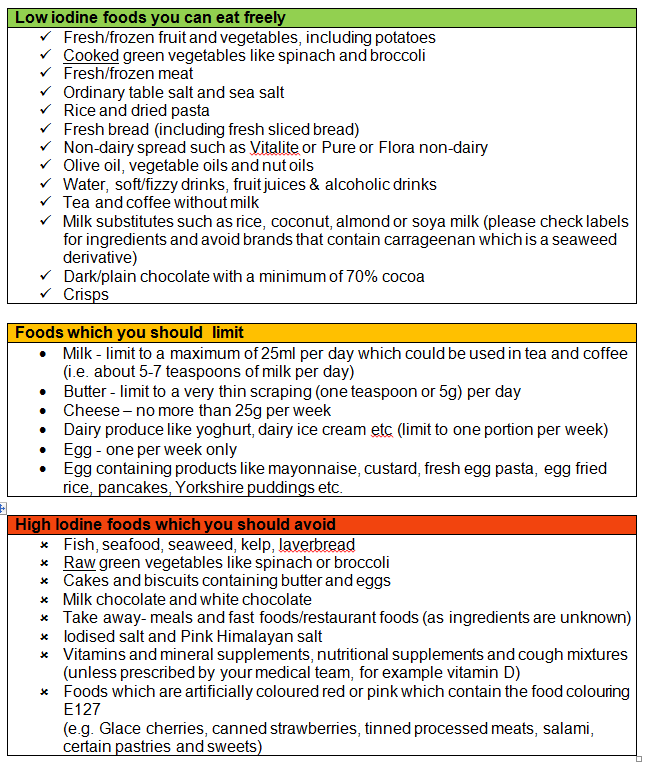
This leaflet has been produced to give you information about ways to reduce the amount of iodine in your diet before your treatment with radioactive iodine
Why do I need to follow this diet?
A diet which is rich in iodine could interfere with your radioactive iodine treatment. A low iodine diet aims to reduce your iodine intake before your treatment and helps to maximise your body’s uptake of the radioactive iodine when you receive your treatment. You do not need to try to follow a no iodine diet.
If you are currently following a diet under medical guidance (e.g. for diabetes or coeliac disease) please discuss this with your thyroid team and/or your dietitian.
Where is Iodine found?
Iodine is found in many foods in varying amounts. It is essential for good health. The richest sources are foods from the sea as well as dairy produce and eggs. In some countries iodine is added to salt but this does not happen in the UK, therefore it is fine to use ordinary table salt, but best to avoid imported food items.
For how long should I follow the low iodine diet?
The diet is for a short time only. Evidence suggests that a duration of two weeks is sufficient.
Please start the low iodine diet two weeks before your appointment.
Should I look on the Internet for further information?
Information on the Internet is not always accurate or relevant to the procedures followed in individual hospitals. For example, a lot of the information on the Internet relating to low iodine diets comes from countries where iodine is routinely added to salt. Therefore it is common to see advice to avoid all foods that contain salt. This is not necessary in the UK.
Should you require further advice on the issues contained in this leaflet, please do not hesitate to contact the Nuclear Medicine Department on tel: 01482 622125.
General Advice and Consent
Most of your questions should have been answered by this leaflet, but remember that this is only a starting point for discussion with the healthcare team.
Consent to treatment
Before any doctor, nurse or therapist examines or treats you, they must seek your consent or permission. In order to make a decision, you need to have information from health professionals about the treatment or investigation which is being offered to you. You should always ask them more questions if you do not understand or if you want more information.
The information you receive should be about your condition, the alternatives available to you, and whether it carries risks as well as the benefits. What is important is that your consent is genuine or valid. That means:
- you must be able to give your consent
- you must be given enough information to enable you to make a decision
- you must be acting under your own free will and not under the strong influence of another person
Information about you
We collect and use your information to provide you with care and treatment. As part of your care, information about you will be shared between members of a healthcare team, some of whom you may not meet. Your information may also be used to help train staff, to check the quality of our care, to manage and plan the health service, and to help with research. Wherever possible we use anonymous data.
We may pass on relevant information to other health organisations that provide you with care. All information is treated as strictly confidential and is not given to anyone who does not need it. If you have any concerns please ask your doctor, or the person caring for you.
Under the General Data Protection Regulation and the Data Protection Act 2018 we are responsible for maintaining the confidentiality of any information we hold about you. For further information visit the following page: Confidential Information about You.
If you or your carer needs information about your health and wellbeing and about your care and treatment in a different format, such as large print, braille or audio, due to disability, impairment or sensory loss, please advise a member of staff and this can be arranged.