
- Reference Number: HEY1161/2023
- Departments: Ophthalmology Department
- Last Updated: 31 December 2023
Introduction
This leaflet has been produced to give you general information. Most of your questions should be answered by this leaflet. It is not intended to replace the discussion between you and the healthcare team, but may act as a starting point for discussion. If after reading it you have any concerns or require further explanation, please discuss this with a member of the healthcare team.
What is sports eyewear?
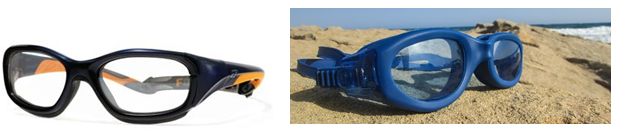
Sports eyewear is an option for anyone involved in sports who wear glasses; particularly people with high prescriptions where removing their glasses can significantly affect their ability to see. Sports eyewear allows clear vision whilst providing protection for your child and others from potential injury. Being able to see well whilst playing sports enables you to move confidently, react quickly and better judge situations, therefore potentially preventing avoidable accidents.
Prescription swimming goggles are an option and can be helpful for children who normally wear glasses and struggle to see without them in the pool.
Can there be any complications or risks?
It is important to ensure sports eyewear fits properly in regards to the frame, nose pads and headband. Having frames which are too large or small on the face may increase the risk of injury. Your Optometrist (optician) will be able to help ensure you have the right fit.
How do I prepare for playing sports?
You should seek advice from your orthoptist / optician in regards to whether protective sports eyewear would be appropriate for your child. Not all children will benefit from wearing sports eyewear.
It may be possible for your child to wear their normal glasses as long as the frame is plastic and nose pads are non-adjustable. The glasses frame should cover the eyes and be worn with a sports band around the back of the head. Children’s lenses are typically made of polycarbonate which is a light, impact resistant material.
How do I prepare for swimming?
Your child may find it difficult to navigate around a swimming pool without their glasses on. Prescription swimming goggles can help with this. Often basic lens powers can be purchased ready made in prescription swimming goggles, but for exact prescription requirements they may need to be specifically ordered. Your optician will be able to give you more information and advise you on the best goggles to help your child make the most of swimming.
You should seek advice from your orthoptist /optician in regards to whether protective prescription swimming goggles would be appropriate for your child. Not all children will benefit from wearing prescription swimming goggles.
Will these glasses be covered by the NHS glasses voucher?
No, unfortunately these will need to be purchased at your own cost. When your child is prescribed glasses by the department you will have been given a copy of your child’s prescription. This can be used to provide the information of your child’s prescription.
Should you require further advice on the issues contained in this leaflet, please do not hesitate to contact the Orthoptic Department on tel: 01482 816605.
General Advice and Consent
Most of your questions should have been answered by this leaflet, but remember that this is only a starting point for discussion with the healthcare team.
Consent to treatment
Before any doctor, nurse or therapist examines or treats your child, they must seek your consent or permission. In order to make a decision, you need to have information from health professionals about the treatment or investigation which is being offered to your child. You should always ask them more questions if you do not understand or if you want more information.
The information you receive should be about your child’s condition, the alternatives available for your child, and whether it carries risks as well as the benefits. What is important is that your consent is genuine or valid. That means:
- you must be able to give your consent
- you must be given enough information to enable you to make a decision
- you must be acting under your own free will and not under the strong influence of another person
Information about your child
We collect and use your child’s information to provide your child with care and treatment. As part of your child’s care, information about your child will be shared between members of a healthcare team, some of whom you may not meet. Your child’s information may also be used to help train staff, to check the quality of our care, to manage and plan the health service, and to help with research. Wherever possible we use anonymous data.
We may pass on relevant information to other health organisations that provide your child with care. All information is treated as strictly confidential and is not given to anyone who does not need it. If you have any concerns please ask your child’s doctor, or the person caring for your child.
Under the General Data Protection Regulation and the Data Protection Act 2018 we are responsible for maintaining the confidentiality of any information we hold about your child. For further information visit the following page: Confidential Information about You.
If you need information about your child’s (or a child you care for) health and wellbeing and their care and treatment in a different format, such as large print, braille or audio, due to disability, impairment or sensory loss, please advise a member of staff and this can be arranged.