
- Reference Number: HEY1153/2023
- Departments: Ophthalmology Department
- Last Updated: 31 December 2023
Introduction
This leaflet has been produced to give you general information. Most of your questions should be answered by this leaflet. It is not intended to replace the discussion between you and the healthcare team, but may act as a starting point for discussion. If after reading it you have any concerns or require further explanation, please discuss this with a member of the healthcare team.
What is Low Vision?
People are considered to have low vision when their sight is reduced despite being able to use both eyes together and having their most up to date glasses in place. Low vision can affect both adults and children, and can be the result of a number of conditions. Low vision can affect your ability to do simple day to day tasks including reading, cooking and certain hobbies.
Why do I need an assessment?
You will already have seen the Ophthalmology (eye specialist) team who will have provided you with a diagnosis and a plan for any possible treatment which is aimed at maintaining the vision you have. The clinician you have seen has arranged an appointment for you to attend the Low Visual Aid (LVA) clinic as they feel you will benefit from this. The clinic is designed to help support you and to discuss how to make the most of your vision. If you feel you do not require this support at present, you can decline an appointment and this will not affect your treatment. You can request an appointment in the LVA clinic at any time. These clinics are held at both Hull Royal Infirmary and the East Riding Community Hospital in Beverley.
Can there be any complications or risks?
The LVA appointment is not invasive and so there will be no complications or risks related to the assessment.
If you choose not to have an assessment you may be missing out on additional help such as magnifying aids which may make day to day activities such as reading and writing easier. There is no cost to you for this service.
How do I prepare for the appointment?
Please ensure you bring your most up to date glasses to the appointment. It would be useful if you could think about what tasks in your daily life you find the most difficult to help guide the clinician (orthoptist) on what support would be most useful.
It would be helpful to bring with you an example of any specific tasks you want to do to try out with equipment. Examples are knitting, model work, and embroidery.
What will happen at the appointment?
You will need to book in at the Eye Clinic reception who will ask you to take a seat in a specific area of the waiting room. The orthoptist will collect and guide you into the clinical room. They will ask some questions regarding what you understand about your eye condition, what difficulties you are having and what specific things you want to be able to do (e.g. hobbies).
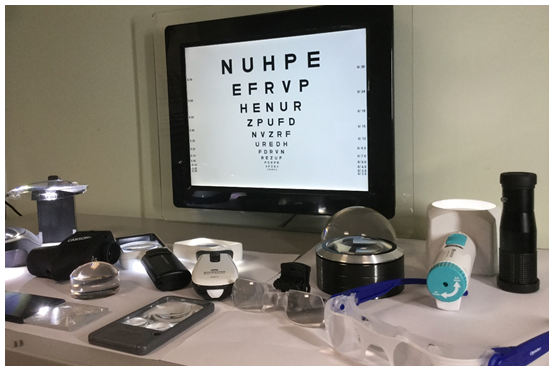
The orthoptist will test your near and distance vision with any glasses you wear and select a suitable strength of magnifier to try if this is appropriate. They will be able to guide you to the designs that will be best for what you want to do. You will be given the opportunity to try out different types and styles of magnifiers to decide which ones you prefer.
The orthoptist will give you advice and guidance on how to get the best out of your vision. They may be able to provide handy tips on how to overcome some of the difficulties you are finding because of your low vision.
What will happen afterwards?
At the end of the appointment, you may be loaned equipment you have found useful during the assessment. This will be a long-term loan from the department and you can keep the equipment for as long as you find it helpful. We would request that you return any magnifiers you are not using.
There will be no need for you to attend the clinic again if you are happy with what you have been issued. You will be given a contact telephone number to call if you have any problems with the equipment or if you feel that you would like a review of the equipment issued. This request can also be made when you are attending for an eye clinic appointment.
How to look after the equipment I have been given?
How to clean the magnifier lens
You need to be very careful not to use cleaners or solvents that you would use for cleaning glass as this can damage a magnifying lens. If the lens is just dusty, you simply need to use a moistened soft cloth with warm water and gently wipe the lens surfaces. If your magnifying lens is very dirty due to such things as finger prints, oily residue, then use a similar process but add a small amount of mild detergent soap to a moistened soft cloth. This process will lift and remove the debris from the lens, then gently dry the lens surface.
How to clean the magnifier handle/frame
You can use soap or mild detergent on a cloth to clean the handle and frame of the magnifier. Please do not submerge the handle in water as this will damage the electrical components.
Warning: Do not leave your magnifier in direct sunlight when not in use. It can be a fire risk.
Should you require further advice on the issues contained in this leaflet, please do not hesitate to contact the Orthoptic Department on tel: 01482 816605.
General Advice and Consent
Most of your questions should have been answered by this leaflet, but remember that this is only a starting point for discussion with the healthcare team.
Consent to treatment
Before any doctor, nurse or therapist examines or treats you, they must seek your consent or permission. In order to make a decision, you need to have information from health professionals about the treatment or investigation which is being offered to you. You should always ask them more questions if you do not understand or if you want more information.
The information you receive should be about your condition, the alternatives available to you, and whether it carries risks as well as the benefits. What is important is that your consent is genuine or valid. That means:
- you must be able to give your consent
- you must be given enough information to enable you to make a decision
- you must be acting under your own free will and not under the strong influence of another person
Information about you
We collect and use your information to provide you with care and treatment. As part of your care, information about you will be shared between members of a healthcare team, some of whom you may not meet. Your information may also be used to help train staff, to check the quality of our care, to manage and plan the health service, and to help with research. Wherever possible we use anonymous data.
We may pass on relevant information to other health organisations that provide you with care. All information is treated as strictly confidential and is not given to anyone who does not need it. If you have any concerns please ask your doctor, or the person caring for you.
Under the General Data Protection Regulation and the Data Protection Act 2018 we are responsible for maintaining the confidentiality of any information we hold about you. For further information visit the following page: Confidential Information about You.
If you or your carer needs information about your health and wellbeing and about your care and treatment in a different format, such as large print, braille or audio, due to disability, impairment or sensory loss, please advise a member of staff and this can be arranged.