
- Reference Number: HEY114/2026
- Departments: Infection Prevention and Control
- Last Updated: 28 February 2026
Introduction
This leaflet has been produced to give you general information. Most of your questions should be answered by this leaflet. It is not intended to replace the discussion between you and the healthcare team, however may act as a starting point for discussion.
If after reading it, if you have any concerns or require further explanation, please discuss this with a member of the healthcare team.
The importance of hand hygiene?
This leaflet has been produced to give you information about hand hygiene. It explains the different ways to clean your hands and how, by simply washing your hands you can help to reduce infections in hospital, both for yourself and others.
Hands are used every day for many different tasks and as a result of contact with other people, equipment or surroundings they can become contaminated. Hands are therefore frequent carriers in the spread of a wide variety of germs, some of which could cause infection.
Hands may look clean but germs, which are not visible to the human eye, are always present. Cleaning the hands to remove these germs will help to prevent them from being transferred to others. This means that effective hand hygiene plays a very important role in infection prevention and control and in reducing the risk of infection in health care settings
Types of Hand Hygiene
Hand Washing
Hand washing with soap and water is the most frequent way of cleaning the hands in the hospital. This is sufficient for general social contact and most clinical care activities. Hand washing can be used to maintain personal hygiene and should always be used when hands are visibly dirty.
It is important to wash your hands:
- If your hands are obviously dirty
- Before eating or handling food
- After using the toilet
- After changing nappies
- If you are a patient and have diarrhoea and/or vomiting
- If you are visiting a patient who is experiencing diarrhoea and/or vomiting
- If you are a patient and have any symptoms of coughs or influenza (flu)
- If you are visiting a patient who has any symptoms of coughs or influenza
Hand Sanitiser
This is a quick and convenient and alternative to hand washing for already physically clean hands which are not visibly contaminated with dirt or organic material, especially when soap and water for hand washing is not readily available.
When dealing with diarrhoea and vomiting illnesses, soap and water should always be used. In this case, the use of hand sanitiser is NOT recommended.
Hand washing sinks or hand sanitiser dispensers are located at the entrances to each ward and on all wards and clinical areas as well in many public areas of the hospital. Hand sanitiser is usually situated at strategic locations within the clinical area near to where patient care is given.
Good hand hygiene habits are mandatory for staff but patients and visitors are also encouraged to make use of these provisions in order to reduce the risk of infectious germs being transferred around the hospital on their hands. It also reduces the risk of an infection being transmitted to the individual themselves.
It is especially important to wash your hands with soap and water before entering and when leaving a ward or clinical area where there are patients experiencing symptoms of diarrhoea and vomiting.
Guidelines for Hand Hygiene
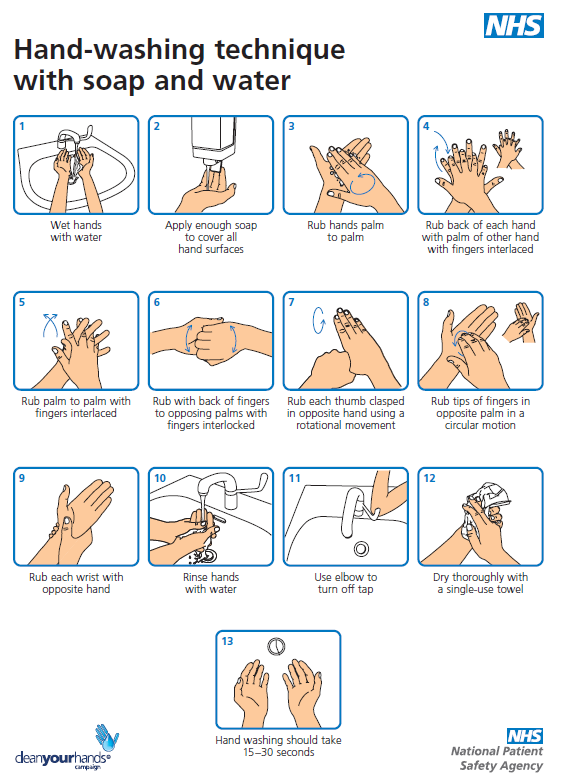
Hand washing technique
- A good hand washing technique involves wetting the hands under warm running water before applying liquid soap.
- The hands should be rubbed together for 15 to 20 seconds so that the soapy water comes into contact with all surfaces of each hand, (See figure 1).
- It is important to wash under any rings and it is advisable to remove wristwatches before washing.
- Hands should be rinsed thoroughly and then dried with paper towels.
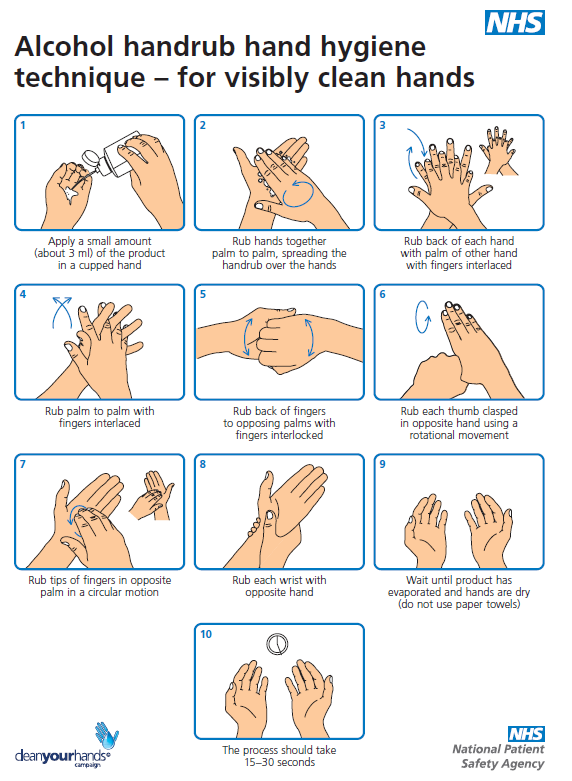
Using hand sanitiser
- Hands should be free of visible dirt
- Enough hand sanitiser should be used to completely cover all the surfaces of each hand.
- The hands should be rubbed together until the solution has evaporated.
Moisturiser
Using a non-perfumed hand moisturiser will protect your hands from any drying effects of hand cleansing. This is especially important if the weather is cold when skin is more prone to chapping.
Cleaning your hands is the single most important factor in helping to reduce healthcare associated infections.
It is everyone’s responsibility, staff, patients and visitors, to use appropriate hand hygiene in order to reduce the risk of contracting or spreading infection.
Patients should not be afraid to ask staff if they have cleaned their hands before undertaking treatment or care.
Who can I contact with any queries or concerns I may have?
If you, your family or carers have any questions or concerns surrounding VRE. Please contact Hull University Teaching Hospitals Infection Prevention and Control Team (IPCT) via the below contact routes:
Telephone: tel: 01482 623967
Between 8am to 4pm
Email: hyp-tr.huth-ipc@nhs.net
Please use the space below to write any questions you may have for your clinical team or infection prevention control team.

This leaflet was produced by the Infection Prevention and Control Department, Hull University Teaching Hospitals NHS Trust and will be reviewed in 2029.
General Advice and Consent
Most of your questions should have been answered by this leaflet, but remember that this is only a starting point for discussion with the healthcare team.
Consent to treatment
Before any doctor, nurse or therapist examines or treats you, they must seek your consent or permission. In order to make a decision, you need to have information from health professionals about the treatment or investigation which is being offered to you. You should always ask them more questions if you do not understand or if you want more information.
The information you receive should be about your condition, the alternatives available to you, and whether it carries risks as well as the benefits. What is important is that your consent is genuine or valid. That means:
- you must be able to give your consent
- you must be given enough information to enable you to make a decision
- you must be acting under your own free will and not under the strong influence of another person
Information about you
We collect and use your information to provide you with care and treatment. As part of your care, information about you will be shared between members of a healthcare team, some of whom you may not meet. Your information may also be used to help train staff, to check the quality of our care, to manage and plan the health service, and to help with research. Wherever possible we use anonymous data.
We may pass on relevant information to other health organisations that provide you with care. All information is treated as strictly confidential and is not given to anyone who does not need it. If you have any concerns please ask your doctor, or the person caring for you.
Under the General Data Protection Regulation and the Data Protection Act 2018 we are responsible for maintaining the confidentiality of any information we hold about you. For further information visit the following page: Confidential Information about You.
If you or your carer needs information about your health and wellbeing and about your care and treatment in a different format, such as large print, braille or audio, due to disability, impairment or sensory loss, please advise a member of staff and this can be arranged.