
- Reference Number: HEY019/2025
- Departments: Pharmacy, Trustwide - Adult
- Last Updated: 31 July 2025

Further Supplies
When you are discharged from hospital, the hospital pharmacy will ensure you have an appropriate supply of all your medications.
Your GP surgery will ensure your medications records are reviewed and updated.
When you require a further supply of your medications, check what medications you still have at home before re-ordering.
Precautions
NEVER share your medications with anyone else, they are prescribed only for YOU.
NEVER take medications from an unlabelled container.
NEVER transfer medications from one container into another.
KEEP medication out of reach and sight of children.
BE AWARE the medicines supplied by your local pharmacy MAY look different from those supplied by the hospital pharmacy.
CAUTION when using ALL skin emollient products. DO NOT smoke or go near naked flames or go near anyone smoking or using naked flames. Change clothing and bedding regularly, products dried on them can catch fire easily and is a potential fire hazard.
CAUTION if you are taking a medication that may make you sleepy. If this happens DO NOT DRIVE or use tools or machines. It is an offence to drive while under the influence of drugs.
Further information is available at the following website: https://www.gov.uk/drug-driving-law
Useful contact numbers
NHS 111
You can call 111 when you need medical help fast, but it is not a 999 emergency. NHS 111 is available 24 hours a day, 365 days a year. Calls are free from landlines and mobile phones.
Tel:111
NHS Website www.nhs.uk
Provides online information and guidance on all aspects of health and healthcare, to help you make decisions about your health. Web:
For Free NHS Quit Smoking Support
Download the NHS ‘Quit Smoking App’
Alternatively, you can call the free Smokefree Helpline on Tel: 0300 123 4044
The pharmacy opening hours are available on the Trust website www.hey.nhs.uk/pharmacy/
How should your medicines be used?
Take your medicine in the way your doctor has told you to.
Follow the printed instructions on the label carefully. If this is unclear or differs to the way the doctor has told you, contact the pharmacy using the details on the pharmacy label.
Ask your doctor, nurse or pharmacist to explain anything that you do not understand.
Your community pharmacy will be able to give you advice, support and provide a wide range of services after you leave hospital
How to store your medicines
Keep medication in the containers they were supplied in.
Please follow any instructions on how to keep your medication which may appear on the label or container e.g. store in the fridge.
Store medication in a dry place, out of direct sunlight and avoid humid/warm conditions e.g. Do not store medicines on top of a fridge.
Re-Admission into hospital
If you need to go back into hospital, remember, if possible, to take an up-to-date list of your current medication along with the medications themselves.
Why is it important to bring these with you?
- If you have your medicines with you, there is a reduced risk of missed or delayed doses.
- You will be able to take your own brand of medicines, that you are familiar with.
- If we know what you are already taking, it will help us to make sure you are prescribed your existing medicines accurately, and to prescribe any new medicines to you safely.
- If your prescription changes while you are in hospital, we will be able to safely dispose of any unwanted medicines with your permission and supply you any new medication prescribed.
Disposal and Recycling of medicines
PLEASE take unused, out of date or changed medications, including controlled drugs and unused injectables, to your local community pharmacy for safe disposal. Contact your local council to arrange collection of sharps bins and other clinical/hazardous waste. Cancer treatments/chemotherapy tablets/capsules/injections should be returned to the hospital pharmacy where they were dispensed or to your local community pharmacy
NEVER dispose of your unused or unwanted medicines down the sink, toilet or in a domestic waste bin.
Different Recycling Schemes:
- Complete the Cycle – Available in many local pharmacies and GP surgeries, this is the first national recycling and recovery scheme for respiratory inhalers.
- Boots Recycling Scheme – The scheme supports blister pack disposalthrough specialised recycling bins in over 700 UK stores. Customers can contribute to sustainability and earn Advantage Card points by participating.
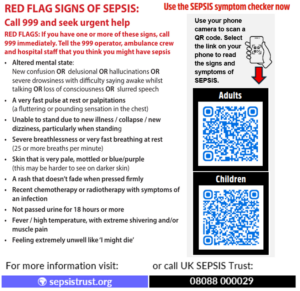
Could it be SEPSIS?
What is SEPSIS? Sepsis is a very serious illness. It happens when your body has an infection, and your immune system overreacts, or struggles to fight the infection. This can make your organs (like your heart, lungs, kidneys, or brain) stop working properly. If sepsis is not found and treated quickly, it can be life‑threatening.
What causes SEPSIS? Any infection in the body, like a chest infection, a urine infection, a sore or wound, or even a tummy bug, can lead to sepsis. Bacteria causes most cases of sepsis, but it can also be caused by viruses (like flu or COVID‑19), and sometimes by fungi or parasites (like malaria).
Early treatment saves lives. Call your GP or 111 immediately if you’re concerned. Call 999 if you are very concerned, or if there’s a delay in talking to your doctor.
For more information visit: www.sepsistrust.org
or call UK SEPSIS Trust on Tel: 08088000029
General Advice and Consent
Most of your questions should have been answered by this leaflet, but remember that this is only a starting point for discussion with the healthcare team.
Consent to treatment
Before any doctor, nurse or therapist examines or treats you, they must seek your consent or permission. In order to make a decision, you need to have information from health professionals about the treatment or investigation which is being offered to you. You should always ask them more questions if you do not understand or if you want more information.
The information you receive should be about your condition, the alternatives available to you, and whether it carries risks as well as the benefits. What is important is that your consent is genuine or valid. That means:
- you must be able to give your consent
- you must be given enough information to enable you to make a decision
- you must be acting under your own free will and not under the strong influence of another person
Information about you
We collect and use your information to provide you with care and treatment. As part of your care, information about you will be shared between members of a healthcare team, some of whom you may not meet. Your information may also be used to help train staff, to check the quality of our care, to manage and plan the health service, and to help with research. Wherever possible we use anonymous data.
We may pass on relevant information to other health organisations that provide you with care. All information is treated as strictly confidential and is not given to anyone who does not need it. If you have any concerns please ask your doctor, or the person caring for you.
Under the General Data Protection Regulation and the Data Protection Act 2018 we are responsible for maintaining the confidentiality of any information we hold about you. For further information visit the following page: Confidential Information about You.
If you or your carer needs information about your health and wellbeing and about your care and treatment in a different format, such as large print, braille or audio, due to disability, impairment or sensory loss, please advise a member of staff and this can be arranged.
This leaflet has been produced by the Hull University Teaching Hospitals NHS Trust and is available as a download:
Download the “General Information Leaflet About Your Prescribed Medication On Discharge” leaflet