
- Reference Number: HEY1227/2021
- Departments: Maternity Services, Neonates
- Last Updated: 31 May 2021
Why have we received this leaflet?
This leaflet is for parents or parents to be of extremely premature babies. It explains the risks of an extremely premature birth and answers questions commonly asked by parents and relatives. This leaflet only explains the risk and complications for babies born below 27 weeks gestation. These risks are less common in babies born at 27 weeks and above.
Making decisions together
Decisions about treatment and care are best when they are made together. Your healthcare team should give you clear information, discuss your options and listen carefully to your views and concerns. They should also discuss with you early in pregnancy whether you could be at risk of preterm labour and explain the care you will be offered. Make sure you know the signs of preterm labour to look out for and explain the possible problems that could affect your baby. We will also discuss the care they are likely to need after they are born and give you a chance to talk to a specialist about care. If you do not understand the information you are given please ask your healthcare team for further explanation.
Who will you see to discuss your and your baby’s care with?
The maternity and neonatal teams (specialist baby doctors and nurses) will discuss the possibilities and outcomes with you (providing they is sufficient time prior to the baby being born) and you will have the opportunity to express your thoughts and ask any questions that you may have.
What does extremely prematurely mean?
A pregnancy usually lasts for about 40 weeks (gestation). This is usually worked out from an ultrasound scan at around 12 weeks (your dating scan).
Babies born extremely prematurely are so small and fragile that they do not always survive. Their lungs and other organs are not mature enough for them to adapt to life outside the womb. Such tiny babies may show signs of life for a short time after birth but even with the very best neonatal care, they cannot survive for more than a few minutes or hours.
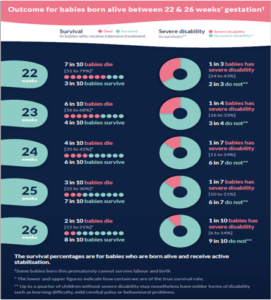
Babies born after 22 weeks may survive labour and either vaginal (normal) or caesarean birth. The doctors and midwives will talk to you about the most appropriate care for your baby this may be an admission to the neonatal unit or comfort care. However, some extremely premature babies sadly die despite maximum supportive care and babies that survive can have lifelong disabilities. The likelihood of death or disability reduces as the pregnancy advances. Babies born before 25 weeks are significantly at risk for these lifelong problems.
The doctors and midwives will talk to you about what they would expect for your baby if born early. In some situations, there are difficult decisions to be made about how to care for your baby before and after birth. The right decision will be different for each family. This is why it is important that you are fully informed about your options and you are able to discuss with your doctors and midwives what you wish for your baby.
Should you require further advice on the issues contained in this advice sheet, please do not hesitate to contact the Maternity Service Department tel: 01482 602623.
General Advice and Consent
Most of your questions should have been answered by this leaflet, but remember that this is only a starting point for discussion with the healthcare team.
Consent to treatment
Before any doctor, nurse or therapist examines or treats you, they must seek your consent or permission. In order to make a decision, you need to have information from health professionals about the treatment or investigation which is being offered to you. You should always ask them more questions if you do not understand or if you want more information.
The information you receive should be about your condition, the alternatives available to you, and whether it carries risks as well as the benefits. What is important is that your consent is genuine or valid. That means:
- you must be able to give your consent
- you must be given enough information to enable you to make a decision
- you must be acting under your own free will and not under the strong influence of another person
Information about you
We collect and use your information to provide you with care and treatment. As part of your care, information about you will be shared between members of a healthcare team, some of whom you may not meet. Your information may also be used to help train staff, to check the quality of our care, to manage and plan the health service, and to help with research. Wherever possible we use anonymous data.
We may pass on relevant information to other health organisations that provide you with care. All information is treated as strictly confidential and is not given to anyone who does not need it. If you have any concerns please ask your doctor, or the person caring for you.
Under the General Data Protection Regulation and the Data Protection Act 2018 we are responsible for maintaining the confidentiality of any information we hold about you. For further information visit the following page: Confidential Information about You.
If you or your carer needs information about your health and wellbeing and about your care and treatment in a different format, such as large print, braille or audio, due to disability, impairment or sensory loss, please advise a member of staff and this can be arranged.