
- Reference Number: HEY1268/2021
- Departments: Gynaecology
- Last Updated: 31 July 2021
Introduction
This leaflet has been produced to give you general information if you are considering medications to help with overactive bladder symptoms. Most of your questions should be answered by this leaflet. It is not intended to replace the discussion between you and the healthcare team, but may act as a starting point for discussion. If after reading it you have any concerns or require further explanation, please discuss this with a member of the healthcare team.
What are anticholinergic medications?
Anticholinergics are commonly used medications to help with a variety of conditions like overactive bladder, Chronic Obstructive Pulmonary Disease (COPD), asthma, Parkinson’s disease, dizziness and motion sickness.
Common side effects of overactive bladder medications include dry mouth, blurred vision, urinary retention, constipation and drowsiness as well as headache, nausea, palpitations, racing heart, urinary disorders and vomiting. Confusion and angioedema (swelling of skin in the face, tongue, arms or legs) are rare side effects.
What is anticholinergic burden (ACB)?
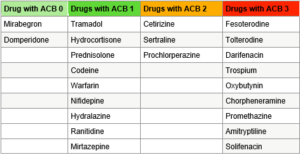
Anticholinergic burden is the cumulative effect on an individual of taking one or more medications with anticholinergic activity.
The ACB effects are proportionate to the dose and duration of exposure. ACB score of 3 or more may increase the risks of cognitive impairment, functional impairment, falls and mortality in older adults (> 50 to 65 years). Increased doses and long duration of use are associated with increased risk of dementia. Long term effects of anticholinergics on cognition is unknown. Examples of common medications with ACB scores are given below.
What can I do to prevent the adverse effects?
- Inform your doctor about any long-term health conditions including dementia and the regular medications that you are taking, at the time of starting any medications for overactive bladder. Your doctor will consider alternate medication or treatment.
- Make the best use of bladder training and pelvic floor exercises.
- Consider stopping the medications as soon as possible and inform your doctor of any new side effects like confusion etc.
- If you are on the bladder medications and require any new medications started, please inform your doctor.
Where can I get further information?
Following websites will give you more information.
- http://www.acbcalc.com/
- https://www.sehd.scot.nhs.uk/publications/DC20150415polypharmacy.pdf
- https://www.prescqipp.info/our-resources/bulletins/bulletin-253-anticholinergic-burden/
- nice.org.uk Multimorbidity and polypharmacy
- NICE guidance on the management of urinary incontinence in women (NICE NG123)
- NICE guidance on dementia (NG97)
- NICE guidance on falls in older people (CG161)
General Advice and Consent
Most of your questions should have been answered by this leaflet, but remember that this is only a starting point for discussion with the healthcare team.
Consent to treatment
Before any doctor, nurse or therapist examines or treats you, they must seek your consent or permission. In order to make a decision, you need to have information from health professionals about the treatment or investigation which is being offered to you. You should always ask them more questions if you do not understand or if you want more information.
The information you receive should be about your condition, the alternatives available to you, and whether it carries risks as well as the benefits. What is important is that your consent is genuine or valid. That means:
- you must be able to give your consent
- you must be given enough information to enable you to make a decision
- you must be acting under your own free will and not under the strong influence of another person
Information about you
We collect and use your information to provide you with care and treatment. As part of your care, information about you will be shared between members of a healthcare team, some of whom you may not meet. Your information may also be used to help train staff, to check the quality of our care, to manage and plan the health service, and to help with research. Wherever possible we use anonymous data.
We may pass on relevant information to other health organisations that provide you with care. All information is treated as strictly confidential and is not given to anyone who does not need it. If you have any concerns please ask your doctor, or the person caring for you.
Under the General Data Protection Regulation and the Data Protection Act 2018 we are responsible for maintaining the confidentiality of any information we hold about you. For further information visit the following page: Confidential Information about You.
If you or your carer needs information about your health and wellbeing and about your care and treatment in a different format, such as large print, braille or audio, due to disability, impairment or sensory loss, please advise a member of staff and this can be arranged.