
- Reference Number: HEY1636/2026
- Departments: Physiotherapy
- Last Updated: 31 May 2026
Introduction
This leaflet has been produced to give you general information about your injury and to back up the information you were given at your virtual fracture clinic telephone appointment. After reading it you have any concerns or require further explanation, please contact a member of the team using the details at the end of the leaflet.
What is a soft tissue injury of the knee?
The knee is a complex joint which is designed to cope with large stresses. Its stability relies mainly on:
- Ligaments – which are strong bands of tissue that connect one bone to another and help hold the knee joint together
- Meniscus – This is the cartilage tissue which acts as a shock absorber in the knee joint
- Muscles – which surround the knee joint
Any one or a combination of these structures can be injured.
What are the symptoms?
Symptoms can vary depending on the structure that is injured. Acute knee injuries may cause:
- Pain, swelling and / or bruising
- Locking (an inability to straighten the knee)
- Giving way
What if I need pain relief?
To manage your pain, over the counter pain relief can be taken such as paracetamol or ibuprofen.
However, if you have allergies or conditions which prevent the use of pain relieving or anti-inflammatory medication or are taking medication(s) for other conditions – please seek advice from your doctor or a pharmacist before taking any pain relief.
What should I do in the first 72 hours after the injury?
Initial treatment aims to control the pain and swelling in the knee by following the PRICE principle.
P Protection
If necessary, you will be given crutches to help you take some weight off the injured knee.
R Rest
Complete rest is not advisable, but it is important that you prevent putting the knee under strain in the early stages of healing.
I Ice
Ice will help reduce the pain in your knee and so should be applied for 15 to 20 minutes before performing the exercises below. This will help to reduce the swelling.
There are many different ways in which ice can be applied however it is believed crushed ice, in the form of frozen peas for example, is the most effective. Whichever method you choose it is important that you wrap the ice in a damp towel, in order to prevent it from ‘burning’ the skin.
Please Note:
- Only use an ice pack on areas that have normal skin sensation i.e. where you can feel hot and cold
- Do not apply ice to an open wound
- Do not apply an ice pack to an area that has poor circulation
- When you apply ice to your skin, check the skin every five minutes and stop using it if:
- the area becomes white, blue or blotchy
- the area becomes excessively painful, numb or tingles
C Compression –
Compression is used to control the swelling and support the knee. You may have been given a tubigrip bandage to help control the swelling.
The tubigrip should be removed if you develop any signs of poor circulation such as tingling, numbness, blueness of the foot and increasing pain. It should also be removed whilst you are asleep as you cannot monitor for these symptoms.
E Elevation –
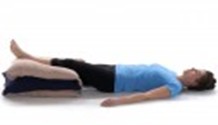
The leg should be elevated above the heart for as much as possible and you should avoid long periods where the leg is not elevated. This will help to reduce and prevent the swelling of the knee.
What not to do
Consuming alcohol, massaging the injured area and applying heat can all be detrimental in the early stages of healing and therefore should be avoided in the first 72 hours. It is important to note that smoking may also delay the healing process
For further advice on stopping smoking, please see the ‘Quit smoking’ information page on the NHS website or use the following QR code

When can I start driving again?
You should only return to driving when you are able to:
- Comfortably bend and straighten your knee
- Safely control the pedals
- Perform an emergency stop without pain or hesitation
You should not drive while using crutches or if pain affects your ability to control the pedals. If you are unsure whether you are safe to drive, speak to your healthcare professional or check with your insurance provider.
Sleeping advice
Knee injuries can sometimes make it difficult to find a comfortable sleeping position. The following suggestions may help:
- Sleep on your back with your leg supported on a pillow placed under your calf or heel to help reduce swelling. Try to avoid keeping a pillow directly under the knee for long periods, as this may keep the knee slightly bent and make it more difficult to fully straighten it later.
- Sleep on your uninjured side with a pillow between your knees for comfort and support.
Avoid positions that place excessive pressure or twisting on the injured knee. - Keeping the leg slightly elevated may help reduce swelling and discomfort during the night but try to allow the knee to rest in a relaxed, straight position where possible.
Rehabilitation and Recovery
If you follow this basic advice your injury should take around six weeks to heal. However, everyone recovers from injuries at different rates, and it is dependent on the severity of the injury, the soft tissue that was involved and the presence of any other medical problems.
The following is a rough guide to recovery:
- First few days – Pain and swelling gradually reduce with rest, ice and elevation
- 1 to 2 weeks – Walking becomes easier, knee movement begins to improve
- 4 to 6 weeks – Most people can return to normal daily activities
- Up to 3 months – Some people may continue to experience mild swelling or stiffness before full recovery.
After 72 hours it is important you regularly practice the following exercises which will help you to regain full function, flexibility and strength. These will also reduce the risk of the injury occurring again.
It is normal to feel some discomfort when performing the exercises. Gentle movement helps to prevent stiffness and supports healing. Mild discomfort is acceptable, but pain should settle shortly after completing the exercises.
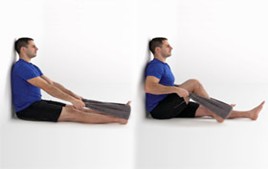
Find a friction free surface, for example a wooden floor or a tray placed on your bed, so that your foot, in a sock, can slide easily.
Sit down and stretch your legs straight out in front of you. Now slide your foot up towards your bottom by bending your knee.
You may want to wrap a scarf around your heel so that you can assist by pulling with your hand to bend your knee further.
Sit on the floor or bed with your legs straight in front of you.
Tighten your thigh muscle by pushing the back of the knee downwards and raising your heel slightly.
Hold for five seconds.
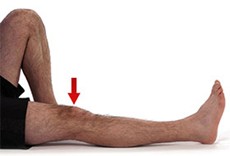
Each exercise should be repeated 10 times, three to four times per day.
As the knee improves you will find that you are able to stand and walk for longer. At this stage you should add in this next set of exercises.
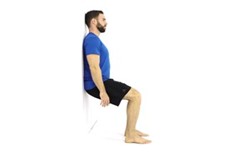
Lean against a wall with your feet hip width apart.
Now bend both knees so that you slide down the wall.
When you feel that your heels begin to lift off the floor, stop, hold five seconds and then return to the starting position.
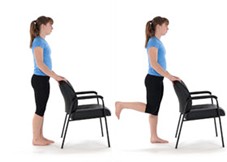
Stand facing a chair and hold on for support.
Keeping your knees together, lift the heel of the injured leg up behind you towards your bottom
Hold for five seconds and gently lower.
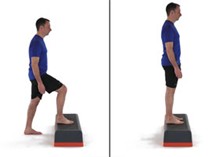
Stand facing a step and hold on to a firm support if required.
Place the foot of the injured leg on the step and step up
Now place the foot of the uninjured leg on the floor and step down.
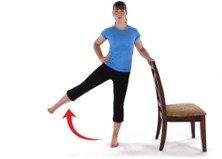
Stand on your injured leg and balance. To begin with you may need to hold on to something solid to prevent you from falling over.
As you improve try doing functional activities such as washing the dishes or cleaning your teeth while you are standing on the one leg.
Try to hold your balance for up to 30 seconds.
Each exercise should be repeated 10 times, three times per day.
All photos with kind permission of ©Physiotec™
When can I return to normal activities?
Returning to activities too quickly may delay healing, so it is important to build activity levels up gradually.
If you participate in an active hobby then it is advisable that you do not return to this until you have full strength, full range of movement and you can walk briskly without experiencing pain and swelling.
If you play a sport, you can practice sports specific activities; like dribbling or jumping. Build up these exercises gradually, in order to help regain strength and flexibility, before returning to full training sessions and competition.
Do I require a follow up?
Do I need to be referred to Physiotherapy?
If the fracture clinic team feel you need to be seen by the Physiotherapy team, you will be directly referred to physiotherapy from fracture clinic and if this is the case, you will have been informed of this in your telephone call following your Virtual Fracture Clinic appointment. You will receive a letter or phone call to book this appointment within 2 weeks of the referral being made.
If you have not received one within this time, please contact the physiotherapy department on Tel: 01482 674880 between the hours 8.00am to 4.00pm Monday to Friday. If there is no answer, please leave a message and your call will be returned with the same working day.
Most of the time however, a referral to Physiotherapy is not needed, but if you have any concerns, are unable to follow the advice in this leaflet, or if you still have reduced movement, strength or function, East Riding GP patients can contact the East Riding MSK Physiotherapy service on Tel: 01377 208300. Alternatively, you can complete a self-referral form on https://www.chcpmsk.org.uk/self-referral-form-introduction. Hull GP patients should call Tel: 01482 300003 to self-refer.
Do I need a Fracture Clinic follow up appointment?
You will have been informed at your telephone appointment if a follow up appointment in clinic is required. If this is not the case, you have been placed on a Patient Initiated Follow Up (PIFU) pathway. This means you will not have another appointment to be seen in fracture clinic.
If, however you have any problems or further queries relating to this injury within the next six weeks, you can contact us on Tel: 01482 674378 during clinic hours 9.00am to 4.30pm Monday to Friday. Please do not choose an option and when prompted leave a message if there is no answer and we will aim to get back to you within the same working day. If you have not needed to contact us in the six weeks after your injury, you will be discharged and should seek advice from your GP.
When to seek further help?
Seek urgent medical attention if you experience:
- The leg or foot becoming cold, pale, or blue
- Numbness, tingling, or increasing weakness in the leg or foot
- Rapidly increasing swelling in the knee or leg
- Signs of infection, such as fever or increasing redness, warmth, or swelling around the knee
Please contact the fracture clinic if:
- Your pain is worsening rather than gradually improving
- You are unable to stand, bear weight, or walk on the injured leg
- Your knee locks or becomes stuck and you cannot fully straighten or bend it
- Swelling is not improving as expected
- You have any concerns about your recovery or your treatment plan
The fracture clinic team will assess your symptoms and advise you if further medical assessment or attendance at the Emergency Department is required.
Your feedback matters to us…
To ensure we deliver a safe and quality service and to help us understand the experience you have of the care you receive from our staff we would value your thoughts about the service you received.
You may be contacted as part of our quality assurance programme which is where we visit our teams and staff and talk to them about the care they provide to our patients or at any time during or after you have needed our services.
To collect this feedback, we would contact you using the registered telephone number we hold in your care record. This feedback will be strictly anonymous and whilst we will share the feedback as part of the process, we will not share any details which may identify you.
We will never ask you any personal questions about your health during these telephone calls.
If you do not wish to speak to us, please say this when we call, we do not want you to feel pressured
General Advice and Consent
Most of your questions should have been answered by this leaflet, but remember that this is only a starting point for discussion with the healthcare team.
Consent to treatment
Before any doctor, nurse or therapist examines or treats you, they must seek your consent or permission. In order to make a decision, you need to have information from health professionals about the treatment or investigation which is being offered to you. You should always ask them more questions if you do not understand or if you want more information.
The information you receive should be about your condition, the alternatives available to you, and whether it carries risks as well as the benefits. What is important is that your consent is genuine or valid. That means:
- you must be able to give your consent
- you must be given enough information to enable you to make a decision
- you must be acting under your own free will and not under the strong influence of another person
Information about you
We collect and use your information to provide you with care and treatment. As part of your care, information about you will be shared between members of a healthcare team, some of whom you may not meet. Your information may also be used to help train staff, to check the quality of our care, to manage and plan the health service, and to help with research. Wherever possible we use anonymous data.
We may pass on relevant information to other health organisations that provide you with care. All information is treated as strictly confidential and is not given to anyone who does not need it. If you have any concerns please ask your doctor, or the person caring for you.
Under the General Data Protection Regulation and the Data Protection Act 2018 we are responsible for maintaining the confidentiality of any information we hold about you. For further information visit the following page: Confidential Information about You.
If you or your carer needs information about your health and wellbeing and about your care and treatment in a different format, such as large print, braille or audio, due to disability, impairment or sensory loss, please advise a member of staff and this can be arranged.