
- Reference Number: HEY305/2025
- Departments: GI Physiology
- Last Updated: 31 August 2025
Introduction
This leaflet has been produced to give you general information about your treatment. Most of your questions should be answered by this leaflet. It is not intended to replace the discussion between you and your healthcare professional but may act as a starting point for discussion. If after reading it you have any concerns or require further explanation, please discuss this with a member of the healthcare team caring for you.
What is PTNS?
Faecal urgency or incontinence can be managed with various treatment options. After consultation with a healthcare professional, PTNS (Percutaneous Tibial Nerve Stimulation) may be considered as a potential approach.
Neuromodulation uses low voltage electrical stimulation to enhance nerve function. The tibial nerve influences the pelvic floor and anal muscles, stimulating this nerve may help improve bowel function.
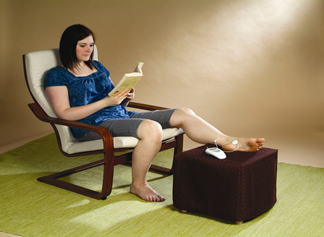
A thin electrode (acupuncture needle) is temporarily inserted near the ankle for treatment. This electrode is connected to a battery-powered device placed next to the ankle. The device is activated and adjusted based on individual response, typically resulting in a gentle vibration sensation in the foot.
Each session lasts 30 minutes and is conducted in a hospital setting. The initial phase generally involves 12 weekly treatments, followed by an evaluation of treatment response. Improvement is commonly observed after 8 or 9 sessions. If effective, maintenance sessions are usually scheduled as two treatments every six months.
Why do I need PTNS
PTNS is used for people with faecal urgency or incontinence, usually after other treatments have failed. It stimulates the tibial nerve to help improve anal and pelvic floor function, which can reduce symptoms.
Can there be any complications or risks?
The primary risks associated with this procedure are related to the use of a needle or mild electrical current. Potential side effects include discomfort, pain, redness, numbness near the needle insertion site and minor bleeding upon needle withdrawal. These symptoms, if they occur, are generally brief. Individuals with heart pacemakers or other battery implants are not eligible for this treatment.
How do I prepare for PTNS?
Please review this information leaflet. You may share these details with your partner and family if desired, so they are informed and able to provide support.
No preparation is necessary prior to this procedure and no recovery time is required afterwards. You may wish to bring reading material for the procedure to reduce boredom.
What will happen?
A member of the GI Physiology Department team will see you and explain the procedure before it begins. It is not necessary to undress; however, access to your bare feet and ankles will be required. One ankle will be selected for the procedure.
An electrode (acupuncture needle) will be placed in the ancle and connected to an external stimulation device. You will sit quietly for 30 minutes until the end of the treatment.
Picture of a patient having treatment: –
What happens afterwards?
After the procedure you will be able to return home or to work immediately with no after effects.
Should you require further advice on the issues contained in this leaflet, please do not hesitate to contact the Department of GI Physiology on telephone number tel: 01482 624036.
General Advice and Consent
Most of your questions should have been answered by this leaflet, but remember that this is only a starting point for discussion with the healthcare team.
Consent to treatment
Before any doctor, nurse or therapist examines or treats you, they must seek your consent or permission. In order to make a decision, you need to have information from health professionals about the treatment or investigation which is being offered to you. You should always ask them more questions if you do not understand or if you want more information.
The information you receive should be about your condition, the alternatives available to you, and whether it carries risks as well as the benefits. What is important is that your consent is genuine or valid. That means:
- you must be able to give your consent
- you must be given enough information to enable you to make a decision
- you must be acting under your own free will and not under the strong influence of another person
Information about you
We collect and use your information to provide you with care and treatment. As part of your care, information about you will be shared between members of a healthcare team, some of whom you may not meet. Your information may also be used to help train staff, to check the quality of our care, to manage and plan the health service, and to help with research. Wherever possible we use anonymous data.
We may pass on relevant information to other health organisations that provide you with care. All information is treated as strictly confidential and is not given to anyone who does not need it. If you have any concerns please ask your doctor, or the person caring for you.
Under the General Data Protection Regulation and the Data Protection Act 2018 we are responsible for maintaining the confidentiality of any information we hold about you. For further information visit the following page: Confidential Information about You.
If you or your carer needs information about your health and wellbeing and about your care and treatment in a different format, such as large print, braille or audio, due to disability, impairment or sensory loss, please advise a member of staff and this can be arranged.