
- Reference Number: HEY1539/2025
- Departments: Physiotherapy
- Last Updated: 31 January 2025
Introduction
Your child’s Physiotherapist has assessed your child as requiring a standing frame to support your child’s development. Use of a standing frame can help:
- Strengthen bones
- Relax stiff muscles and strengthen floppy muscles
- Provide an alternative position for play and activities
- Improve joint flexibility
- Support normal development of the hips
- Children to interact with their friends at the same height
Contact Numbers tel: 01482 674539 or tel: 01482 674532 (Monday to Friday 8am to 4pm)
Set up and review information
Name………………………………
DOB………………………………….. Date of initial set up …………………….
| 6 months | 12 months | 18 months | |
| Review Date | |||
| Therapist signature |
Please contact us tel: 01482 674532 to arrange your 6 monthly reviews or, if you feel the stander is no longer fitting correctly, please do not hesitate to contact us earlier than this.
Available standing frames
Please scan the QR code for more information and access to the user manual. Your therapist will highlight your child’s standing frame in the box below
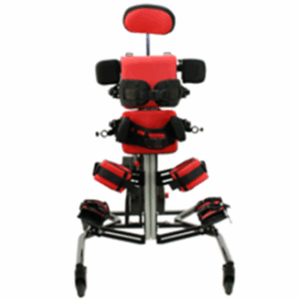

Timoteos Ella by Leckey
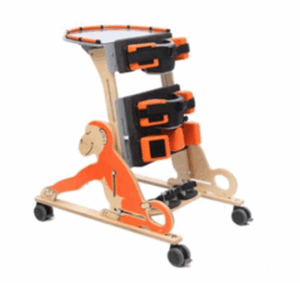

Monkey stander by Jenx/Jiraffe
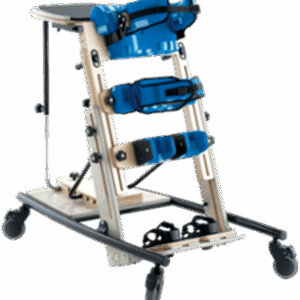

Prone stander by Leckey
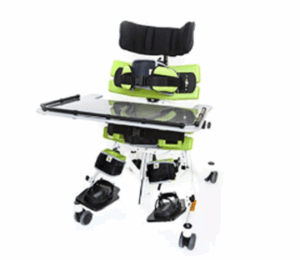

Multistander by Jenx/Jiraffe


New! Stander by Rifton
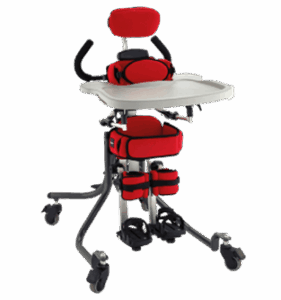

Squiggles + stander by Leckey
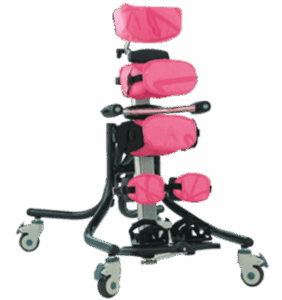

Squiggles stander by Leckey
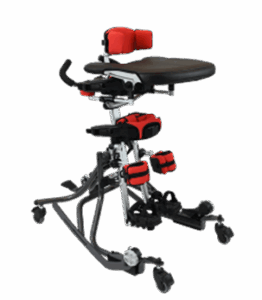

Squiggles TT by Leckey
There are other standing frames available, and your Physiotherapist would provide further information if your child was issued something different to the above.
TOP TIP:
Take a photo of your child in the standing frame when the stander is first set up. If the position does not look the same when you are using it, contact your physiotherapist to discuss.
Putting your child into the standing frame
- Position the standing frame, apply the brakes and open all the straps.
- Prepare the child for standing
- Explain to the child what you are going to do.
- Some children will be lifted or hoisted onto the stander by parents if it is a ‘supine stander’ and others can place their feet on the foot plates in sitting and be supported into standing from sitting. Your therapist will advise on the correct technique for your child.
- Fasten and secure all straps, starting with the pelvis/hip strap.
- Check your child is in a good symmetrical position checking spine, pelvis, knees and feet
- Fasten feet straps
- Once child is safely in the stander, review the standing position again
- Length of time child is in standing is dependent on advice from physiotherapist and the tolerance of the child.
Removing your child from the standing frame
- Check brakes are on
- Explain to the child what you are going to do.
- If a supine stander, bring the standing frame into a lying position, undo the straps and lift or hoist your child out.
- If a prone/upright stander, undo the straps while supporting your child to maintain a standing position then assist the child out either by lifting them out or encouraging them to sit down and remove their feet from the footplates.
Additional Information
- Check that the child is wearing their correct orthotics/footwear.
- Always make sure that the child is supervised while in the standing frame.
- Some upset is normal, especially if the equipment is new, however if your child does not settle after 5 to 10 mins then remove them from the standing frame.
- Please only use the standing frame on a flat surface and check it is all in working order before use.
- Build your child’s time in the stander up as tolerated, aiming for 45 to 60 minutes daily. This can be split into 2 smaller sections throughout the day if needed.
Note: This piece of equipment should only be used by the person it was supplied for and not adjusted by anyone unless advised by the physiotherapist.
If you have any concerns about this piece of equipment, please contact your physiotherapist immediately on tel: 01482 674532
The standing frame manufacturer can be contacted for advice.
Your local reps contact details are:
Name: ……………………………… Contact number: ……………………………
General Advice and Consent
Most of your questions should have been answered by this leaflet, but remember that this is only a starting point for discussion with the healthcare team.
Consent to treatment
Before any doctor, nurse or therapist examines or treats you, they must seek your consent or permission. In order to make a decision, you need to have information from health professionals about the treatment or investigation which is being offered to you. You should always ask them more questions if you do not understand or if you want more information.
The information you receive should be about your condition, the alternatives available to you, and whether it carries risks as well as the benefits. What is important is that your consent is genuine or valid. That means:
- you must be able to give your consent
- you must be given enough information to enable you to make a decision
- you must be acting under your own free will and not under the strong influence of another person
Information about you
We collect and use your information to provide you with care and treatment. As part of your care, information about you will be shared between members of a healthcare team, some of whom you may not meet. Your information may also be used to help train staff, to check the quality of our care, to manage and plan the health service, and to help with research. Wherever possible we use anonymous data.
We may pass on relevant information to other health organisations that provide you with care. All information is treated as strictly confidential and is not given to anyone who does not need it. If you have any concerns please ask your doctor, or the person caring for you.
Under the General Data Protection Regulation and the Data Protection Act 2018 we are responsible for maintaining the confidentiality of any information we hold about you. For further information visit the following page: Confidential Information about You.
If you or your carer needs information about your health and wellbeing and about your care and treatment in a different format, such as large print, braille or audio, due to disability, impairment or sensory loss, please advise a member of staff and this can be arranged.