
- Reference Number: HEY1627/2026
- Departments: Neurology and Neurosurgery
- Last Updated: 31 May 2026
Introduction
This leaflet has been produced to give you general information about your follow up. Most of your questions should be answered by this leaflet. It is not intended to replace the discussion between you and your medical team but may act as a starting point for discussion. If after reading it you have any concerns or require further explanation, please discuss this with a member of the healthcare team caring for you.
What is Patient-Initiated Follow-Up (PIFU)
A patient-initiated follow-up (PIFU) means that we will not routinely make you another follow up appointment. Instead, you are being given the option to contact us if you require follow up, within a set time frame which we will write down for you in this booklet. In the past, patients have been followed up at regular intervals, approximately two weeks after their spinal fracture and eight weeks after their spinal fracture. For some people this is reassuring but for others this is not particularly helpful and can be a source of stress and inconvenience. For this reason, PIFU is used to give you more control over your care and gives you access to advice when you need it.
How does PIFU work?
If PIFU is suitable for you, your physiotherapist will discuss it with you at your first appointment. If you are satisfied with this, then the decision will be made jointly with you, to add you to a PIFU pathway. This means you can contact us for a review, if you feel it is needed, up to the date discussed with you at your first appointment. The date is written in this booklet for you. If you feel like you need a review, you will be able to contact the service directly to discuss your follow up needs. If you do not contact the service by the date shown, you will be discharged back to your GP who can re-refer you if needed in the future.
There are several benefits to PIFU:
- PIFU gives you control over your follow up and helps to personalise your care.
- Coming to hospital for an outpatient appointment can be expensive and time consuming, particularly for people with transport challenges or those who rely on family to get them to appointments. Reducing unnecessary appointments helps to overcome this challenge.
- PIFU helps the NHS reduce its carbon footprint.
- PIFU reduces unnecessary outpatient appointments which helps the NHS to use resources more effectively.
When should I call for a PIFU?
You can call to make an appointment if:
- You are not recovering as expected from your spinal fracture
- You are experiencing a worsening of symptoms related to your spinal fracture
When should I NOT call for a PIFU?
There are some things which are not suitable for asking for a PIFU appointment:
- If your concern is about a different injury or condition
- If the agreed time has lapsed (please contact your GP)
- If you need urgent medical advice, you should contact your GP or NHS111
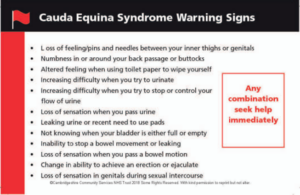
There is a condition, Cauda Equina Syndrome, which is a rare but serious condition.
If you are experiencing any of the symptoms outlined below, you SHOULD NOT wait for a PIFU follow up appointment to be booked, you should attend the Emergency Department/Accident and Emergency immediately.

How do I call for a PIFU?
Please contact the administration team on the number below, they will not give clinical advice, but they will book you a telephone appointment with the clinical team. You will be booked into a telephone appointment slot so that you can discuss your condition with a neurosurgical physiotherapist.
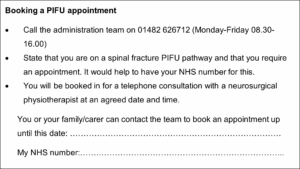
During the telephone consultation with the physiotherapist, you will be able to share your concerns, and you will be asked some specific questions about your symptoms and your recovery. At the end of the telephone consultation there are several possible outcomes:
- You may be offered a further period of PIFU
- You may be offered a face-to-face appointment at Hull Royal Infirmary
- You may be referred to outpatient physiotherapy locally
- You may be discharged to your GP
The outcome of the telephone consultation will be decided with you. If you do need a face-to-face appointment this will be booked by the administration team.
What if I don’t need a PIFU appointment?
You do not have to book an appointment if you feel it is not required. If you do not contact us to book an appointment within the time specified, the PIFU will expire and you will be discharged back to the care of your GP. We will not contact you to book a PIFU appointment – it must be initiated by you.
General Advice and Consent
Most of your questions should have been answered by this leaflet, but remember that this is only a starting point for discussion with the healthcare team.
Consent to treatment
Before any doctor, nurse or therapist examines or treats you, they must seek your consent or permission. In order to make a decision, you need to have information from health professionals about the treatment or investigation which is being offered to you. You should always ask them more questions if you do not understand or if you want more information.
The information you receive should be about your condition, the alternatives available to you, and whether it carries risks as well as the benefits. What is important is that your consent is genuine or valid. That means:
- you must be able to give your consent
- you must be given enough information to enable you to make a decision
- you must be acting under your own free will and not under the strong influence of another person
Information about you
We collect and use your information to provide you with care and treatment. As part of your care, information about you will be shared between members of a healthcare team, some of whom you may not meet. Your information may also be used to help train staff, to check the quality of our care, to manage and plan the health service, and to help with research. Wherever possible we use anonymous data.
We may pass on relevant information to other health organisations that provide you with care. All information is treated as strictly confidential and is not given to anyone who does not need it. If you have any concerns please ask your doctor, or the person caring for you.
Under the General Data Protection Regulation and the Data Protection Act 2018 we are responsible for maintaining the confidentiality of any information we hold about you. For further information visit the following page: Confidential Information about You.
If you or your carer needs information about your health and wellbeing and about your care and treatment in a different format, such as large print, braille or audio, due to disability, impairment or sensory loss, please advise a member of staff and this can be arranged.