
- Reference Number: HEY1197/2025
- Departments: Emergency Department, Physiotherapy
- Last Updated: 30 June 2025
Introduction
This leaflet has been produced to give you general information about how to use elbow crutches. You have been provided with elbow crutches to help you walk safely whilst allowing you to protect your injured leg. It will take a little time to get used to the crutches and so it is important you try not to rush.
Your clinician will advise you on whether you can put weight through the affected leg whilst using the crutches; this will depend on the type of injury you have sustained. It is very important you follow this advice to give you the best chance of recovery.
The section below gives a step-by-step guide on to how to use the elbow crutches depending on what weight you are allowed to put through the affected leg.
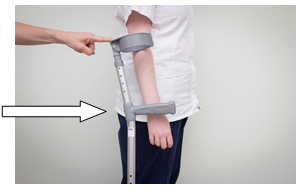
What is the correct crutch height?
| The clinician you see will ensure the elbow crutches are the correct height for you. It is important you do not adjust this height as it may affect your posture and lead to pain elsewhere.
|
 |
Sitting and Standing
To ensure you do not injure your shoulders or elbows it is important that you remove your arms from your crutches before standing up or sitting down
Standing up
- Place your crutches opposite each other to create a H shape with the handles and place one hand on the crutch handles
- Place you other hand onto the chair arm
- Push yourself up into standing, keeping your foot off the floor if you have been advised that you need to be Toe Touch weight bearing or Non-Weight bearing (see below)
- Once standing, place your arms into the cuffs of the crutch
- Now move the crutches into a walking position slightly ahead of feet either side of the legs
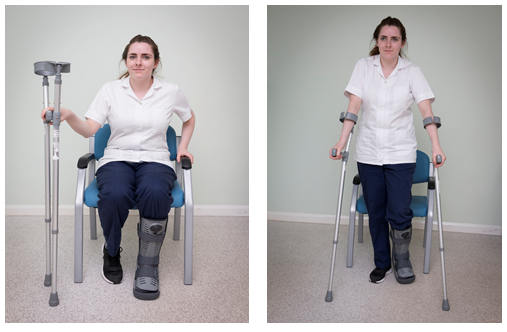
Sitting down
- Ensure the chair is lined up right behind you
- Take your arms out of the crutch and put both crutches together at one side of your body making the H shape as you did to stand up
- Place one hand on the H and the other on the chair arm
- Lower yourself down again keeping your foot off the floor if you have been advised that you need to be Toe Touch Weight Bearing or Non-Weight Bearing
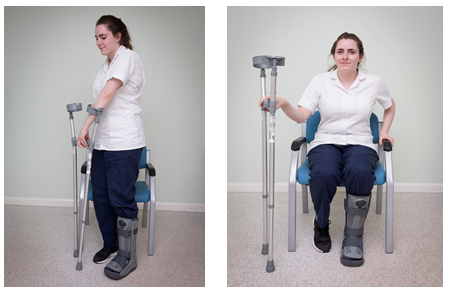
Non-Weight Bearing
Non-weight bearing (NWB) means you should NOT put any weight through the affected leg when attempting to stand, walk, sit down or negotiate steps and stairs.
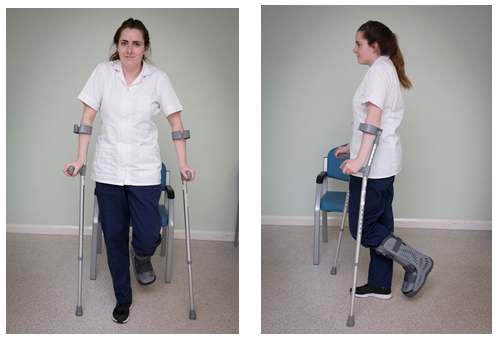
- Stand up on the unaffected leg keeping your affected foot off the floor
- Once in standing place both crutches one step in front of you, level with each other and bend the knee of your affected leg to ensure it stays off the ground.
- Take your body weight through your upper limb using the crutches
- Hop forwards with your unaffected leg so that your body is level or just behind the crutches
- Steady yourself and repeat
Toe touch weight bearing
Toe touch weight bearing (TTWB) means the tips of your toes can rest on the floor but you still should not put any weight on them when attempting to stand, walk, sit down or negotiate steps and stairs.
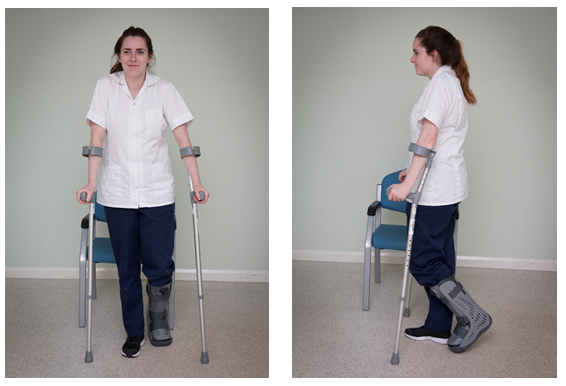
- Use the same technique as for NWB but instead of holding your knee bent, let the toes of your affected leg touch the floor
- Toe Touch Weight Bearing is essentially to help promote balance when using crutches
Heel weight bearing
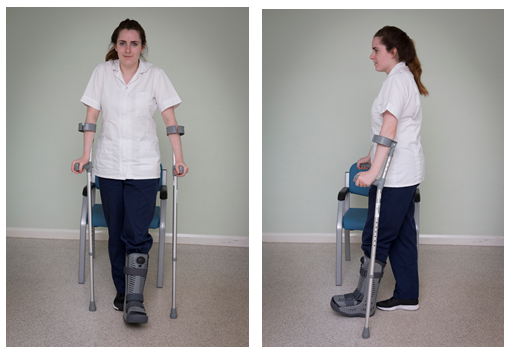
Heel weight bearing (HWB) means you can place weight through your heel only when attempting to stand, walk, sit down or negotiate steps and stairs.
- Stand up on the unaffected leg keeping the weight through the affected heel only
- Once standing, place both crutches one step in front of you, level with each other.
- Put the affected leg forward first striking the heel to the floor, level or just behind the level of the crutches. Ensure you keep your toes off the floor
- Now put weight through your upper body using your crutches and bring the unaffected leg level with affected leg
- Steady yourself and repeat
Partial weight bearing
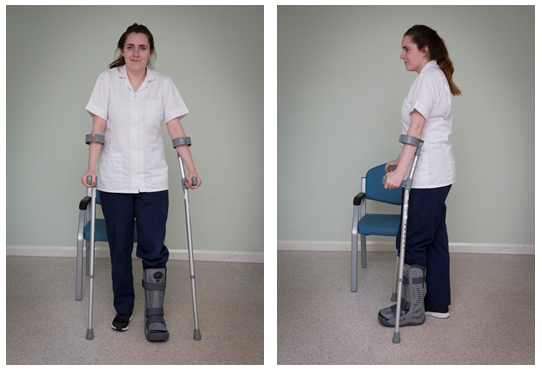
Partial weight bearing (PWB) means that you can put some weight on your affected leg; you will have been advised how much by the clinician that you saw.
- Stand up with weight on both feet but favouring your unaffected side.
- Once standing, place both crutches one step in front of you, level with each other.
- Put the affected leg forward first striking the heel to the floor, level or just behind the level of the crutches.
- As you transfer your weight to the toes of your affected leg, take weight through your upper body using the crutches and then bring the unaffected leg level with affected leg.
- Steady yourself and repeat
Full weight bearing or weight bearing as tolerated
Full weight bearing (FWB) or Weight Bearing as Tolerated (WBAT) / As Pain Allows (APA)
- Stand up with equal weight on both feet.
- Once standing, place both crutches one step in front of you, level with each other.
- Put the affected leg forward first striking the heel to the floor, level or just behind the level of the crutches. Take as much weight on your affected leg as you can.
- As you transfer your weight to the toes use the crutches to prevent you limping and bring the unaffected leg level with affected leg
- Steady yourself and repeat
- The photographs above for partial weight bearing also demonstrate this technique
Progressing to one crutch
When fully weight bearing or weight bearing as tolerated, it is possible for you to progress to one crutch to help you walk, if you feel able to do so. There are some photographs over the page to demonstrate the process.
- Stand up with the crutch on the side of the unaffected leg
- Once standing, place the crutch one step in front of you to the side of your unaffected leg
- Put the heel of the affected leg level or just behind the level of the crutches.
- As you take weight on to the toes of the affected leg put some weight on the crutch and step the unaffected leg through
- Repeat the process
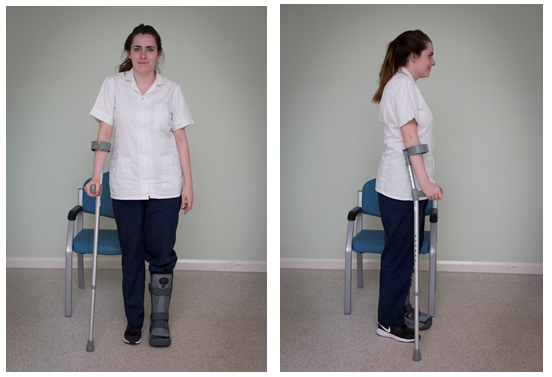
Note: Your walking pattern should be as normal as possible using one crutch. If you find that you are leaning heavily on the crutch it may be that you are not ready to progress to one crutch as yet.
Stairs
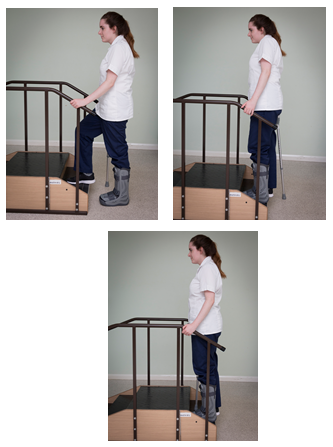
When climbing the stairs you should follow the pattern below:
- Stand close to the handrail and hold with one hand. Use one crutch in the other hand.
- If Full Weight Bearing, Partial Weight Bearing or Heel Weight Bearing, step up with your good leg first, supporting the affected leg by taking weight through your upper limb on the handrail and crutch
- If Non-Weight Bearing or Toe Touch Weight Bearing this will necessitate a hop onto the step with the unaffected leg taking your full weight through your upper body using handrail and crutch
- Your affected leg should be brought onto the step behind the unaffected leg. If you are Non-Weight Bearing or Toe Touch Weight Bearing no weight should be put through the affected leg & if Partial Weight Bearing or Heel Weight Bearing, weight bearing should be the level that has been advised
- The crutch should then be placed on the same step to allow for repeat of process
- Ensure the crutch is firmly on the step so that it cannot slip back off the edge.
- Repeat until you reach the top
- If there is no handrail available both crutches can be used utilising the same technique
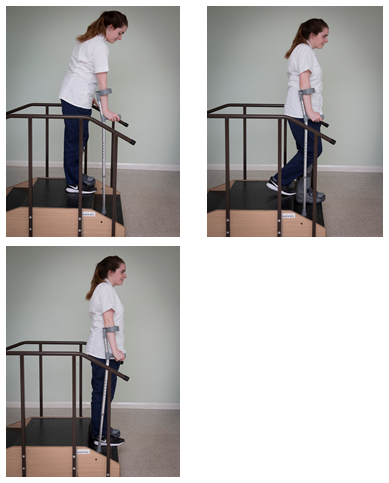
When coming down the stairs you should follow the pattern below:
- Stand close to the handrail and hold with one hand. Use one crutch in the other hand.
- Put the supporting crutch or crutches down onto the next step first, ensuring that the crutch is firmly on the step so that it cannot slip forward off the edge.
- If Full Weight Bearing, Partial Weight Bearing or Heel Weight Bearing use your upper body and the support of the handrail and crutch to take your weight, placing you affected leg onto the same step. Ensure you only take the level of weight advised through your affected limb supporting as needed with your upper body
- Place unaffected leg onto the same step
- If Non-Weight Bearing or Toe Touch Weight Bearing no weight should be taken through the affected leg hence a hop down onto the lower step will be required using the upper body to take your full body weight through handrail and crutches
- Repeat until you reach the bottom
- If there is no handrail available both crutches can be used utilising the same technique with one crutch in each hand
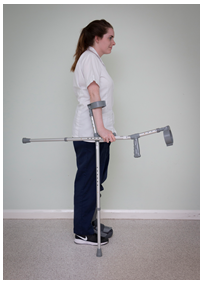
Carrying the second crutch up and downstairsIf you have someone available to you it is usually easier if they carry the second crutch up or down the stairs for you If this is not possible you can hold the second crutch in the same hand as the supporting crutch by making a cross with it at the handle |
 |
General Safety
Safety checks you should complete regularly:
- Check the rubber ends on your crutches regularly for signs of them wearing or becoming smooth.
- Check that all the gold or silver buttons on your crutches (that adjust the height of the crutches) are sticking firmly out of the metal and are not pushed in.
- Also check for any other signs of wear on the handles, cuffs or crutch poles themselves
- If any of these issues are noted then this could affect your safety and you should contact the hospital for replacement as soon as possible
Other safety tips
- Only use the crutches as you were instructed by the prescribing clinician
- Ensure you wear well fitted full shoes or slippers where able
- Remove all obstacles including rugs and other trip hazards around the home
- Take care in wet or icy conditions
- Take care when carrying bags. A rucksack worn over both shoulders is the safest way to carry anything you need as this will ensure you are equally balanced
Who to contact if you have any further questions
If you have any problems with your crutches or have any queries then please contact the department in which your crutches were issued using the switchboard telephone line tel: 01482 875875.
General Advice and Consent
Most of your questions should have been answered by this leaflet, but remember that this is only a starting point for discussion with the healthcare team.
Consent to treatment
Before any doctor, nurse or therapist examines or treats you, they must seek your consent or permission. In order to make a decision, you need to have information from health professionals about the treatment or investigation which is being offered to you. You should always ask them more questions if you do not understand or if you want more information.
The information you receive should be about your condition, the alternatives available to you, and whether it carries risks as well as the benefits. What is important is that your consent is genuine or valid. That means:
- you must be able to give your consent
- you must be given enough information to enable you to make a decision
- you must be acting under your own free will and not under the strong influence of another person
Information about you
We collect and use your information to provide you with care and treatment. As part of your care, information about you will be shared between members of a healthcare team, some of whom you may not meet. Your information may also be used to help train staff, to check the quality of our care, to manage and plan the health service, and to help with research. Wherever possible we use anonymous data.
We may pass on relevant information to other health organisations that provide you with care. All information is treated as strictly confidential and is not given to anyone who does not need it. If you have any concerns please ask your doctor, or the person caring for you.
Under the General Data Protection Regulation and the Data Protection Act 2018 we are responsible for maintaining the confidentiality of any information we hold about you. For further information visit the following page: Confidential Information about You.
If you or your carer needs information about your health and wellbeing and about your care and treatment in a different format, such as large print, braille or audio, due to disability, impairment or sensory loss, please advise a member of staff and this can be arranged.