
- Reference Number: HEY1109/2026
- Departments: Maternity Services
- Last Updated: 31 May 2026
Introduction
This leaflet has been produced to give you general information about shoulder dystocia. It is not intended to replace the discussion had between you and your doctor but may act as a starting point for discussion. If after reading it you have any concerns or require further explanation, please discuss this with our health care team.
What is shoulder dystocia?
Shoulder dystocia is a complication of vaginal birth, where the baby’s head is born but the shoulder gets stuck behind the mother’s pubic bone, delaying delivery. It is considered a medical emergency, meaning lots of members of the obstetric and midwifery team will need to rush into the room to help deliver the baby swiftly and safely.
How common is shoulder dystocia?
Shoulder dystocia is rare, only occurring in 1 in 150 vaginal births (0.7%). In most cases it cannot be predicted, so it cannot be easily prevented.
In 2025, at Hull Women and Children Hospital, the incidence of shoulder dystocia was 38 out of 4265 vaginal births.
What are the common risk factors?
Though it can happen to anyone who opts for a vaginal birth, a higher risk of shoulder dystocia is associated with diabetes, being overweight, induction of labour, having a long labour, requiring a forceps or ventouse (instrumental) delivery, or having had shoulder dystocia in a previous pregnancy.
If you have diabetes or have developed diabetes in your pregnancy you will usually be offered early induction of labour or a planned caesarean section.
The ‘Big Baby Trial’ was a study that investigated the benefits and harms of early induction of labour to reduce the risk of shoulder dystocia in mothers with big babies above the 90th centile (from ultrasound scan measurements). The findings implied that induction of labour before 39 weeks of pregnancy reduces the risk of shoulder dystocia, which is why your doctor may offer you induction, if you are in this situation.
However, we do recognise that ultrasound scans have a margin for error and may not always predict your baby’s weight correctly every single time. We also know that most babies >4.5kg can be delivered safely with no difficulty in delivering the shoulders, and ½ of shoulder dystocia events can occur in babies of normal weight. At Hull Women and Children’s Hospital, out of the 38 cases of shoulder dystocia in 2025, only 10% of the babies were >90th weight centile.
These statistics are included in the leaflet to help give you some information that will better inform your decision making.
Explain risks or complications involved in the procedure and include statistics if possible. This could be based on patient information that has already been produced by the respective Royal College, NICE or Department of Health Guidelines.
What happens if shoulder dystocia occurs?
We class shoulder dystocia as an obstetric emergency, so it is important we get the right help for you and your baby as quickly as possible.
It might feel scary but remember that all of our labour and delivery team are trained in managing this condition and will be there to support you and your baby throughout.
- The emergency bell will be activated
- A team of midwives, obstetricians (mum doctors) and paediatricians (baby doctors) will arrive in your room
- You will asked to stop pushing
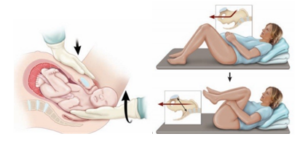
- We will help to reposition you to give your baby as much space as possible in your pelvis. This position involved you lying on your back, with your legs pushed upwards and outwards. It is known as the McRobert’s Manoeuvre (see picture)
- The majority of babies will be born successfully simply by carrying out this position change
- We may need to apply pressure just above your pelvic bone to help release your baby’s shoulder
- We may consider making a cut, called an episiotomy, to enlarge the vaginal opening and allowing access for some other manoeuvres.
- If baby’s shoulder still hasn’t been delivered, an obstetrician will need to put their hand into the vagina to manually free the baby’s shoulder with special manoeuvres
Should you require further advice on the issues contained in this leaflet, please do not hesitate to contact your midwife or doctor
General Advice and Consent
Most of your questions should have been answered by this leaflet, but remember that this is only a starting point for discussion with the healthcare team.
Consent to treatment
Before any doctor, nurse or therapist examines or treats you, they must seek your consent or permission. In order to make a decision, you need to have information from health professionals about the treatment or investigation which is being offered to you. You should always ask them more questions if you do not understand or if you want more information.
The information you receive should be about your condition, the alternatives available to you, and whether it carries risks as well as the benefits. What is important is that your consent is genuine or valid. That means:
- you must be able to give your consent
- you must be given enough information to enable you to make a decision
- you must be acting under your own free will and not under the strong influence of another person
Information about you
We collect and use your information to provide you with care and treatment. As part of your care, information about you will be shared between members of a healthcare team, some of whom you may not meet. Your information may also be used to help train staff, to check the quality of our care, to manage and plan the health service, and to help with research. Wherever possible we use anonymous data.
We may pass on relevant information to other health organisations that provide you with care. All information is treated as strictly confidential and is not given to anyone who does not need it. If you have any concerns please ask your doctor, or the person caring for you.
Under the General Data Protection Regulation and the Data Protection Act 2018 we are responsible for maintaining the confidentiality of any information we hold about you. For further information visit the following page: Confidential Information about You.
If you or your carer needs information about your health and wellbeing and about your care and treatment in a different format, such as large print, braille or audio, due to disability, impairment or sensory loss, please advise a member of staff and this can be arranged.