
- Reference Number: HEY1440/2024
- Departments: Dietetics, Nutrition Support, Renal Service
- Last Updated: 29 February 2024
Introduction
You have been asked to fill in a food diary by your renal dietitian, to help assess the nutritional content of your diet and your fluid intake.
HOW TO COMPLETE YOUR 3 DAY FOOD DIARY
- Please write down everything you have to eat and drink over 3 days. Choose 2 weekdays, between Monday to Friday (include 1 dialysis day if you are on haemodialysis) and a weekend day, Saturday OR Sunday.
- Record all food, drinks and snacks taken throughout the day, rather than waiting until the end of the day.
- Fill in as much detail as you possibly can e.g. brand names, cooking methods. If an item contains a combination of foods, break it down (see example food diary).
- Remember to record the amount or quantity of foods and drinks, use weights or household measures where possible.
- Put any additional comments on the blank pages at the back of this booklet.
- Once your food diary is completed please return it to your dietitian at the following address, or give to one of the nursing staff to return it for you. You can also return it using the message service on Patients Know Best.
Renal Dietitians, 2nd Floor, Alderson House, Hull Royal Infirmary, Anlaby Road, HULL HU3 2JZ
The following guide shows you how to complete a day’s intake for your food diary. Remember to only include the amount actually eaten, especially if you do not finish a meal e.g. half a slice of toast.
| Name of Food/Drink | Description/Preparation | Amount |
| Name of food or drink, eg chicken, apple, cheese chocolate, biscuit, tea and squash | Brand names e.g. Kellogs, Hovis and Heinz
Type – e.g. full fat milk, semi-skimmed and soya/oat milk Low fat or full fat spread or butter Full sugar, no added sugar Cooking methods, ie. baked, fried, air-fried, grilled, boiled, steamed or toasted Any added salt, sugar, butter and oil |
Household measures, weights or use reference objects
e.g. teacup, tablespoon, teaspoon, grams or ounces, palm size or handful Amount eaten – ate all / ate half |
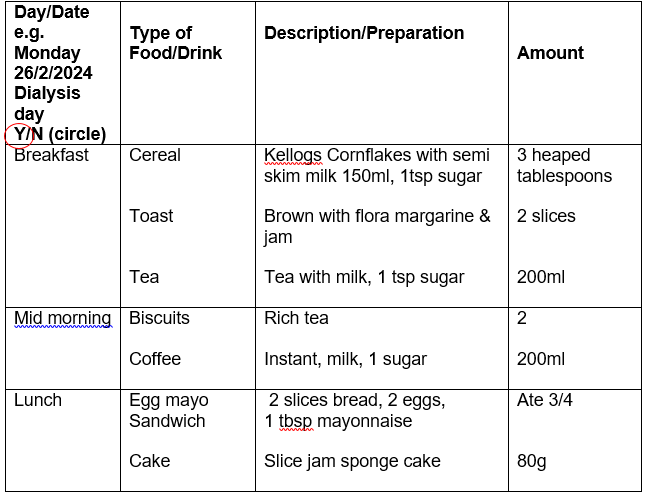
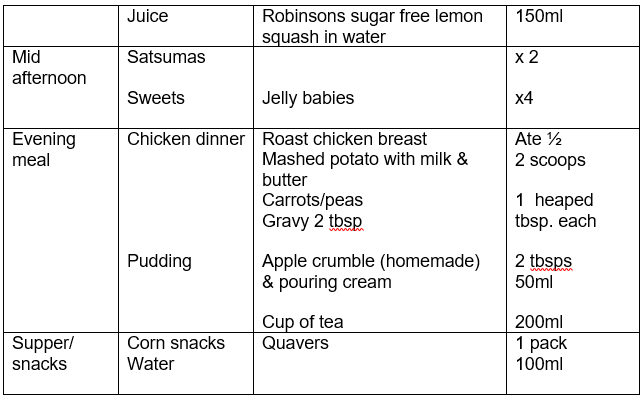
You will be given a food diary sheet to fill in
General Advice and Consent
Most of your questions should have been answered by this leaflet, but remember that this is only a starting point for discussion with the healthcare team.
Consent to treatment
Before any doctor, nurse or therapist examines or treats you, they must seek your consent or permission. In order to make a decision, you need to have information from health professionals about the treatment or investigation which is being offered to you. You should always ask them more questions if you do not understand or if you want more information.
The information you receive should be about your condition, the alternatives available to you, and whether it carries risks as well as the benefits. What is important is that your consent is genuine or valid. That means:
- you must be able to give your consent
- you must be given enough information to enable you to make a decision
- you must be acting under your own free will and not under the strong influence of another person
Information about you
We collect and use your information to provide you with care and treatment. As part of your care, information about you will be shared between members of a healthcare team, some of whom you may not meet. Your information may also be used to help train staff, to check the quality of our care, to manage and plan the health service, and to help with research. Wherever possible we use anonymous data.
We may pass on relevant information to other health organisations that provide you with care. All information is treated as strictly confidential and is not given to anyone who does not need it. If you have any concerns please ask your doctor, or the person caring for you.
Under the General Data Protection Regulation and the Data Protection Act 2018 we are responsible for maintaining the confidentiality of any information we hold about you. For further information visit the following page: Confidential Information about You.
If you or your carer needs information about your health and wellbeing and about your care and treatment in a different format, such as large print, braille or audio, due to disability, impairment or sensory loss, please advise a member of staff and this can be arranged.