
- Reference Number: HEY1538/2025
- Departments: Physiotherapy
- Last Updated: 31 January 2025
Plagiocephaly
Plagiocephaly is a medical term for head flattening which is produced by pressure on the baby’s skull when lying in the same position for prolonged periods of time or can occur through labour. Newborn babies have very soft skulls which are susceptible to being moulded or flattened. It should be noted that this is cosmetic and does not cause any pressure on the brain or cause any development problems.
What causes it?
- Head turning preference to one side – this may be the babies preferred sleep position.
- Tight neck muscles which limit the baby turning their head fully.
- Lack of tummy time experienced throughout the day – please note babies should still sleep on their back.
- Position in the womb or a difficult labour.
- Babies that are premature have softer skulls and are more susceptible to moulding, especially if they spend long periods of time in hospital and are too poorly to be moved.
Interventions
The sooner the intervention starts for your baby the better the outcome as skull remoulding can take place over a period of months. As soon as your baby learns to move and takes pressure off the flattened part of their skull their head shape can begin to improve. In severe cases a degree of flattening may remain but not to a noticeable extent when they are older.
Aims of Physiotherapy
Advice for parents
- Repositioning your baby during both sleep and awake times will encourage your baby to rest their head on the non-flat area to promote even weight distribution and remodelling.
- Always place your baby on its back to sleep.
- When your baby is awake and lying on their back supervised you can position their head in the middle using a small rolled up towel.
- When playing with toys encourage your baby to look at toys on the opposite side to their preference.
- Tummy time is very important, it is a good position for your baby to practice lifting their head and develop strength in their back and neck muscles.
- Position your baby the opposite way around in their crib/ cot so they are looking at you from the opposite direction (away from the preferred side).
- Position any seating from the opposite direction so they can look at you from the opposite direction (away from the preferred side).
- If you usually breast or bottle feed from a particular side, swap to the opposite side if you can encourage your baby to look away from their preferred side.
Helmets
The benefits of specialist helmets remain controversial and is not supported or recommended by the Association of Paediatric Chartered Physiotherapy.
Exercises to complete as advised by your physiotherapist
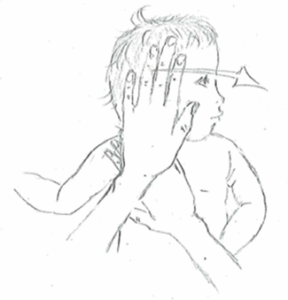
Place one hand on your child’s chest. Place the other hand on the side of your child’s face. Gently but firmly turn the head away from their preferred side.
If your child has a flattening on the right side of the head and prefers to look right – do this stretch turning the head to the left
If your child has a flattening on the left side of the head and prefers to look left – do this stretch turning the head to the right
Turn the head only to the point of resistance, hold for 10 seconds, and release.
General Advice and Consent
Most of your questions should have been answered by this leaflet, but remember that this is only a starting point for discussion with the healthcare team.
Consent to treatment
Before any doctor, nurse or therapist examines or treats your child, they must seek your consent or permission. In order to make a decision, you need to have information from health professionals about the treatment or investigation which is being offered to your child. You should always ask them more questions if you do not understand or if you want more information.
The information you receive should be about your child’s condition, the alternatives available for your child, and whether it carries risks as well as the benefits. What is important is that your consent is genuine or valid. That means:
- you must be able to give your consent
- you must be given enough information to enable you to make a decision
- you must be acting under your own free will and not under the strong influence of another person
Information about your child
We collect and use your child’s information to provide your child with care and treatment. As part of your child’s care, information about your child will be shared between members of a healthcare team, some of whom you may not meet. Your child’s information may also be used to help train staff, to check the quality of our care, to manage and plan the health service, and to help with research. Wherever possible we use anonymous data.
We may pass on relevant information to other health organisations that provide your child with care. All information is treated as strictly confidential and is not given to anyone who does not need it. If you have any concerns please ask your child’s doctor, or the person caring for your child.
Under the General Data Protection Regulation and the Data Protection Act 2018 we are responsible for maintaining the confidentiality of any information we hold about your child. For further information visit the following page: Confidential Information about You.
If you need information about your child’s (or a child you care for) health and wellbeing and their care and treatment in a different format, such as large print, braille or audio, due to disability, impairment or sensory loss, please advise a member of staff and this can be arranged.