
- Reference Number: HEY1642/2026
- Departments: Physiotherapy
- Last Updated: 31 January 2026
Parent information booklet to support children who are delayed walking
Factors to consider if your child is delayed in walking
We are asked to see many babies who are not walking before 18 months. It is important to understand that babies walk at different rates. This can be for various reasons.
If your child is not yet walking it is important to consider the factors below:
- They need opportunities and a safe space to move around on the floor.
- The average age to achieve walking is between 8 and 18 months.
- A baby may walk later if they commando crawl, bottom shuffle or have more flexible joints.
- The use of baby walkers is not advised, and some studies have shown use of them can delay walking. There is more information regarding this further down in the booklet.
- All children develop at different rates and should not be compared to siblings or friends.
This leaflet includes some activities you can do with your child to support them with their development. It also includes information on footwear, baby walkers and when to seek more support from a healthcare professional.
On your marks…
Playing on the floor is important. It will help your child strengthen their muscles, learn about their body and explore their environment. Help your child to move in and out of the positions in these activities. Do them slowly to let your child do as much as possible.
- Moving from lying to sitting
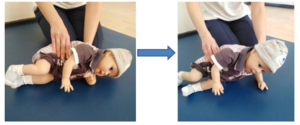
Aim: to move from a lying position into a sitting position
Activity: assist the child from lying on their back, to rolling onto their side. From side lying encourage them into a side sitting position by pushing through their arm. You may need to place a hand on their hip to stabilise them. You can help further by placing one hand under their chest and one hand to stabilise hips. Allow your child to push up with their arms and hands. Please see the photos below.
- Moving from sitting to lying
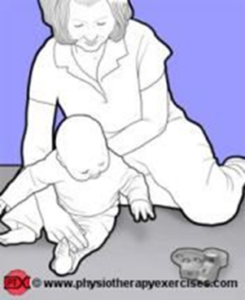
Aim: to improve the ability to transfer sitting to lying.
Activity: position your child in sitting on the floor. Place or hold objects just beyond of arm’s length. Encourage your child to reach for the objects and assist them to transfer into lying.
- Playing in a crawling position
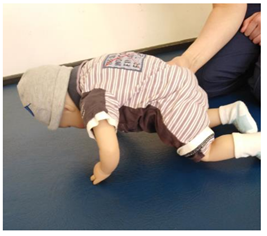
Your child might need some support under their tummy at first to help them stay in a crawling position. When they can do this themselves, encourage them to reach for a toy or roll a ball/ push a toy car.
Aim: to encourage weight bearing through arms and legs ready for crawling. This will improve core stability.
Activity: Encourage your child to move into a crawling position on their hands and knees as shown in the photo. You may need to assist your child into this position. Encourage them to push through their hands and straighten their elbows to maintain this position. Their knees should remain under their hips.
You may need to support your child around their trunk or hips to help them hold this position. Try getting your child to hold this position for around 5 to 10 minutes intermittently whilst playing games or activities.
- Weight bearing through feet:
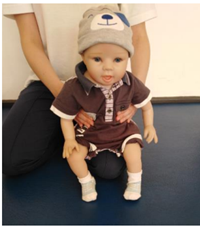
Aim: to increase weightbearing through feet in preparation for standing.
Activity: sit your child on your knee with their feet flat on the floor. Try not to let them lean back on you. Encourage them to reach forward to the floor for toys. This begins to put weight through their feet to get ready for standing up. You can also put your hands on their knees to help gently put some weight though their feet.
Get set…
Standing
The following activities are to help your child develop their standing.
- Standing from your knee or a small stool
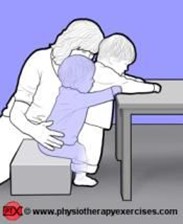
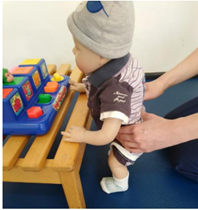
Encourage them to stand up to see toys on a small table or sofa in front. Support their arms and encourage them to stand up as shown. Try not to pull them up.
- Play in kneeling
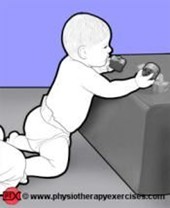
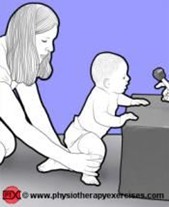
Encourage your child to kneel at a surface to play.
From this position you can then encourage your child to pull to stand through half kneeling like in the picture below. You might need to guide them up to begin with.
- Standing at furniture
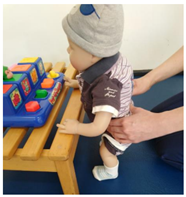
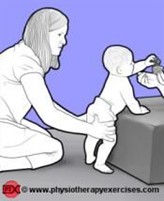
Encourage standing at furniture using both of their hands for support. Once they can do this, hold toys for them to reach up and to the side. This will help them to use their tummy and back muscles and develop their muscles for standing.
- Cruising
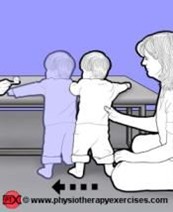
Encourage your child to side step along a surface for toys or items that interest them. To begin with, you may have to guide them from their hips. Remember to practise moving to both sides.
- Moving between surfaces
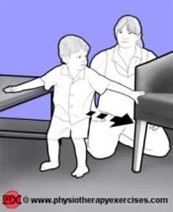
Once your child’s cruising has improved, encourage them to move between surfaces. Start with small gaps. This can be between two chairs or from a sofa to a small table. This will encourage them to step out to the side and start to challenge their standing balance.
- Standing on their own
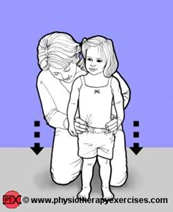
Practise standing with your support without holding onto furniture. Support their hips or hold their arms from the front. As they become steadier, try holding them less firmly or try ‘letting go’ for a few seconds.
Scan these QR codes with your phone to open some videos which give examples of the above activities:


Go!
- Use a push along toy
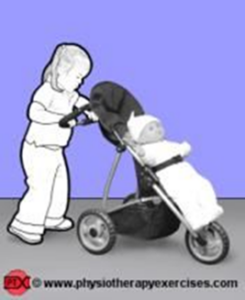
At first you may need to hold the toy steady so that it is not too far in front.
- Hold your child’s hands from the front.
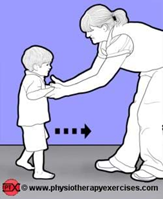
Guide them forwards to encourage stepping.
- Stepping between surfaces
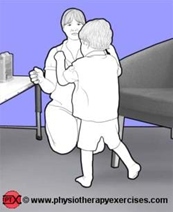
Make the gaps bigger between furniture and encourage your child to step between them. This could be from a sofa to a push along toy or from the sofa to a parent/carer.
Trips and Falls
Falling is part of normal development. Children will often fall up to 17 times an hour. Their balance and walking skills will improve with practise.
Encourage:
- short bursts of walking
- walking on different surfaces e.g. grass, stones, sand
- activities such as soft play, going to the park, swimming etc
Footwear
Young children who are not yet walking do not usually need shoes. Once your child is walking, you should make sure you buy the correct footwear for them.
Scan this QR code with your phone for more information on suitable footwear:

Baby Walkers
Physiotherapists and other Health Professionals do not recommend the use of baby walkers. There are two main reasons for this:
Safety – even under supervision there are high numbers of accidents reported every year including:
- falling down stairs
- head injuries
- burns, scalds
- trapped arms / legs
Delayed development – some studies have shown that baby walkers might actually delay standing and walking. Contrary to popular belief, they do not teach a child to walk. They can cause a child to walk on their toes which may continue when they walk independently.
If you are using a baby walker:
- Your child should have good head control and ideally be able to sit up by themselves
- Make sure both feet are flat on the floor, not on their toes
- Never leave your child unattended
- Never use near steps or open doors e.g., Patio windows
- Avoid use near open fires, cookers, radiators and trailing wires
- Check floor is free of objects that could cause tipping
- Your child can move at up to 7mph, faster than you can react
- Use for a maximum of 20 minutes at a time
Scan this QR code with your phone for more information on suitable baby walkers:

When to seek further advice from a health professional
Does your child have difficulty moving their arms or legs? Do they appear stiff or floppy?
Are they moving one side of their body more than other?
Are they unable to stand with both feet flat?
Are there significant concerns with delay in other areas of development? E.g. their play, language development, fine motor skills etc.
Please contact your Health Visitor or GP if you have any concerns.
This leaflet was made in conjunction with Physiotherapy staff at Humber Teaching NHS Foundation Trust.
We hope that you have found this leaflet helpful. Please ensure that common sense prevails when following any of the activities we have suggested.
Do not hesitate to contact us if you have any questions about any of the information or activities or would like this booklet in a larger print.
**Please note Reference List available on request
We would like to thank NHS Lanarkshire for sharing their resources and good work with us to develop this document.
Your feedback matters to us
To ensure we deliver a safe and quality service and to help us understand the experience you have of the care you receive from our staff we would value your thoughts about the service you received. You may be contacted as part of our quality assurance programme which is where we visit our teams and staff and talk to them about the care they provide to our patients or at any time during or after you have needed our services.
To collect this feedback, we would contact you using the registered telephone number we hold in your care record. This feedback will be strictly anonymous and whilst we will share the feedback as part of the process, we will not share any details which may identify you.
We will never ask you any personal questions about your health during these telephone calls. If you do not wish to speak to us, please say this when we call, we do not want you to feel pressured.
General Advice and Consent
Most of your questions should have been answered by this leaflet, but remember that this is only a starting point for discussion with the healthcare team.
Consent to treatment
Before any doctor, nurse or therapist examines or treats your child, they must seek your consent or permission. In order to make a decision, you need to have information from health professionals about the treatment or investigation which is being offered to your child. You should always ask them more questions if you do not understand or if you want more information.
The information you receive should be about your child’s condition, the alternatives available for your child, and whether it carries risks as well as the benefits. What is important is that your consent is genuine or valid. That means:
- you must be able to give your consent
- you must be given enough information to enable you to make a decision
- you must be acting under your own free will and not under the strong influence of another person
Information about your child
We collect and use your child’s information to provide your child with care and treatment. As part of your child’s care, information about your child will be shared between members of a healthcare team, some of whom you may not meet. Your child’s information may also be used to help train staff, to check the quality of our care, to manage and plan the health service, and to help with research. Wherever possible we use anonymous data.
We may pass on relevant information to other health organisations that provide your child with care. All information is treated as strictly confidential and is not given to anyone who does not need it. If you have any concerns please ask your child’s doctor, or the person caring for your child.
Under the General Data Protection Regulation and the Data Protection Act 2018 we are responsible for maintaining the confidentiality of any information we hold about your child. For further information visit the following page: Confidential Information about You.
If you need information about your child’s (or a child you care for) health and wellbeing and their care and treatment in a different format, such as large print, braille or audio, due to disability, impairment or sensory loss, please advise a member of staff and this can be arranged.