
- Reference Number: HEY1494/2024
- Departments: Paediatrics, Physiotherapy
- Last Updated: 31 July 2024
ERB’s Palsy
What is ERB’s Palsy?
ERB’s Palsy may be seen after a difficult delivery especially when there has had to be assistance delivering the shoulder. There are other risk factors including; breech presentation, higher birth weight and prolonged labour. During delivery the nerves that supply the arm can be injured. Your baby is left with partially or completely reduced movements of their arm, depending on the severity of the damage to the nerves.
ERB’s Palsy can also be known as Obstetric Brachial Plexus Injury
How long will it take to recover?
This is difficult to predict, but approximately 85 out of every 100 babies (85%) have a full recovery. Mild cases recover within one to eight weeks. The more complicated the injury, the longer the recovery period. Some of these injuries will require more extensive treatment at St James’ Hospital in Leeds, your therapist will advise on this if needed.
How can ERB’s Palsy be treated?
Erb’s Palsy is an injury, so to begin with it needs rest to recover. This means keeping your baby’s arm supported and moving their shoulder as little as possible for the first 5 days. After these 5 days, you will be given an appointment with the Paediatric therapy team to commence treatment.
Aim of Physiotherapy and Occupational Therapy
Advice for parents
- Do not be afraid to handle and touch your baby’s arm, this will help to stimulate the nerves, gentle massage can be helpful.
- The arm should be moved gently for washing and dressing. When dressing, start with the affected arm and when undressing start with the unaffected arm.
- When handling, feeding and cuddling the baby, the affected arm should be supported.
- When picking up your child, do not pick them up from under their arms.
- Support your child’s arm with a rolled-up towel to keep the arm in a neutral position when they are lying on their back, when awake and supervised.
The above advice should be followed from the birth of the baby.
After 5 days the nerve has been rested enough to allow gentle exercises to begin.
The aims of therapy will be:
- To prevent your baby’s muscles from becoming tight.
- To prevent your baby’s joints becoming stiff.
- To encourage active movement and to improve strength.
- To continue to stimulate the feeling in your baby’s arm.
- To advise, educate and support parents on the appropriate management.
Home Stretch Programme
Lie baby on his/her back for all these stretches. Please only commence these once you have seen your therapist and they have demonstrated them to you.
- Bend elbow to 90° and keep the elbow tucked into side by holding the upper arm to his/her side. Roll the arm outwards and down towards the bed. Hold chest steady with the other hand.
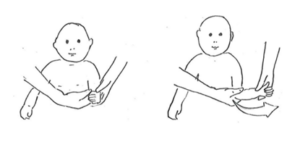
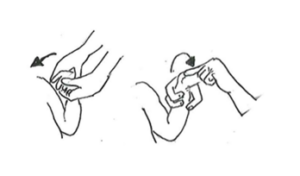
- Hold arm above and below the elbow, straighten and bend the elbow.
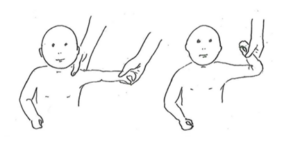
- Hold elbow bent with one hand supporting above the elbow and the other hand around the wrist. Turn palm upward and then turn downwards.
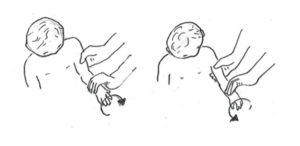
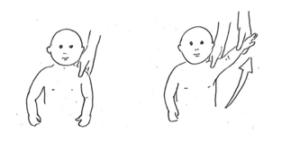
- Hold forearm and gently stretch arm above head – a) Firstly stretching arm forwards. b) Secondly stretching arm outwards.
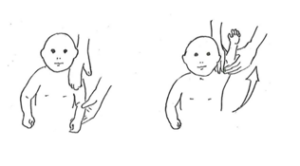
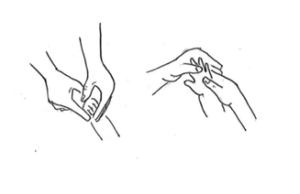
- Hold your baby’s wrist and stretch out their fingers, gently move the wrist forwards and back. Then with the wrist relaxed bend and straighten the fingers.
Do not overstretch your baby’s joints. Ask your therapist if you are not sure. Compare movement with the unaffected side.
Activities
From approximately one week and beyond:
In the sitting or lying positions the following activities can be encouraged to help the baby to use the affected arm as much as possible.
- Encourage the baby to put two hands together, two hands on the breast or bottle during feeding or to suck fingers of the affected arm.
- Encourage your baby to explore and grasp textured baby toys.
- Help your baby to explore their own hair, face, body, hands, legs and feet, assisting the elbow bending movement if baby cannot help with this.
- Reaching out to “bat” at toys forwards, upwards and outwards, helping the baby’s arm as necessary.
- Holding small rattles and toys – will initially need to be placed in the babies hands.
There is a family support group which you may wish to contact:
Tel: 02476413293 Email: info@erbspalsygroup.co.uk
This leaflet was produced by the Children’s Physiotherapy & Occupational Therapy Department, Hull University Teaching Hospitals NHS Trust and will be reviewed in July 2027.
General Advice and Consent
Most of your questions should have been answered by this leaflet, but remember that this is only a starting point for discussion with the healthcare team.
Consent to treatment
Before any doctor, nurse or therapist examines or treats your child, they must seek your consent or permission. In order to make a decision, you need to have information from health professionals about the treatment or investigation which is being offered to your child. You should always ask them more questions if you do not understand or if you want more information.
The information you receive should be about your child’s condition, the alternatives available for your child, and whether it carries risks as well as the benefits. What is important is that your consent is genuine or valid. That means:
- you must be able to give your consent
- you must be given enough information to enable you to make a decision
- you must be acting under your own free will and not under the strong influence of another person
Information about your child
We collect and use your child’s information to provide your child with care and treatment. As part of your child’s care, information about your child will be shared between members of a healthcare team, some of whom you may not meet. Your child’s information may also be used to help train staff, to check the quality of our care, to manage and plan the health service, and to help with research. Wherever possible we use anonymous data.
We may pass on relevant information to other health organisations that provide your child with care. All information is treated as strictly confidential and is not given to anyone who does not need it. If you have any concerns please ask your child’s doctor, or the person caring for your child.
Under the General Data Protection Regulation and the Data Protection Act 2018 we are responsible for maintaining the confidentiality of any information we hold about your child. For further information visit the following page: Confidential Information about You.
If you need information about your child’s (or a child you care for) health and wellbeing and their care and treatment in a different format, such as large print, braille or audio, due to disability, impairment or sensory loss, please advise a member of staff and this can be arranged.