
- Reference Number: HEY1495/2024
- Departments: Paediatrics, Physiotherapy
- Last Updated: 31 July 2024
What is Metatarsus Adductus?
It is a common presentation in newborn babies where the forefoot turns inwards and can affect one or both feet.
The condition is usually caused by the position the baby has been laid in during the pregnancy.
Some common predisposing factors include:
- Multiple pregnancy
- Large baby
- Breech presentation
- Decreased water in utero
All these factors determine how much the baby can move around and therefore how much they can change the position of the feet.
At birth it may be noticed by a parent or midwife, or it maybe picked up when the feet are examined during the newborn baby examination by the Antenatal ward staff.
Metatarsus Adductus feet are correctable by gently stretching the feet and they will be able to be moved throughout their full range. This position should resolve by itself within the first few months.
It maybe helpful to give your baby some time out of their clothing to allow them to kick and stretch their feet. When they are in clothing ensure it is not too tight around their feet, so they have enough room to move.
Stretches
Gentle stretches can help correct the position and should be performed regularly throughout the day, ideally when your baby is settled and relaxed.
The following stretches should be easy to perform and should not cause any pain to your baby. However, your baby may get upset due to the fact that their foot is being held still, but they should quickly settle after the stretch.
Each stretch should be held for 20 to 30seconds.
Stretch 1. Gently stretch your babies’ forefoot out towards the little toe, ensuring the movement is from the forefoot and not the ankle
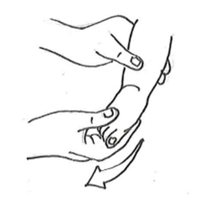
Stretch 2. Gently stroke or tickle the outside of your babies’ foot to encourage them to actively move the foot outwards.
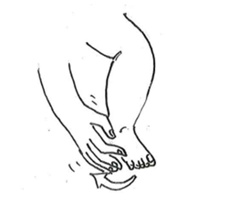
You should gradually notice your baby holding the foot in a more neutral position over the next few weeks.
Information
Your baby maybe referred for a routine hip ultrasound scan as there is a very small risk of associated hip problems. You can mention any concerns about your babies’ foot at this appointment and an assessment can be arranged.
You should request further assessment if you are concerned that your babies’ foot seems painful to stretch or if the foot feels stiff or if it is not fully flexible.
Some babies rest their feet in an inwards position as long as it is flexible when stretched there is no need to be concerned, and it should fully resolve within a few months.
This leaflet was produced by the Children’s Physiotherapy & Occupational Therapy Department, Hull University Teaching Hospitals NHS Trust and will be reviewed in July 2027.
General Advice and Consent
Most of your questions should have been answered by this leaflet, but remember that this is only a starting point for discussion with the healthcare team.
Consent to treatment
Before any doctor, nurse or therapist examines or treats your child, they must seek your consent or permission. In order to make a decision, you need to have information from health professionals about the treatment or investigation which is being offered to your child. You should always ask them more questions if you do not understand or if you want more information.
The information you receive should be about your child’s condition, the alternatives available for your child, and whether it carries risks as well as the benefits. What is important is that your consent is genuine or valid. That means:
- you must be able to give your consent
- you must be given enough information to enable you to make a decision
- you must be acting under your own free will and not under the strong influence of another person
Information about your child
We collect and use your child’s information to provide your child with care and treatment. As part of your child’s care, information about your child will be shared between members of a healthcare team, some of whom you may not meet. Your child’s information may also be used to help train staff, to check the quality of our care, to manage and plan the health service, and to help with research. Wherever possible we use anonymous data.
We may pass on relevant information to other health organisations that provide your child with care. All information is treated as strictly confidential and is not given to anyone who does not need it. If you have any concerns please ask your child’s doctor, or the person caring for your child.
Under the General Data Protection Regulation and the Data Protection Act 2018 we are responsible for maintaining the confidentiality of any information we hold about your child. For further information visit the following page: Confidential Information about You.
If you need information about your child’s (or a child you care for) health and wellbeing and their care and treatment in a different format, such as large print, braille or audio, due to disability, impairment or sensory loss, please advise a member of staff and this can be arranged.