
- Reference Number: HEY1598/2025
- Departments: Physiotherapy, Therapies
- Last Updated: 30 September 2025
Introduction
This leaflet has been produced to give you general information about the symptoms and management of your injury. Most of your questions should be answered by this leaflet. It is not intended to replace the discussion between you and your doctor but may act as a starting point for discussion. If after reading it you have any concerns or require further explanation, please discuss this with a member of the healthcare team who has been caring for you.
What is a Mallet Finger?
A mallet finger is where the tip of your finger becomes bent towards your palm and you are unable to straighten it.
It is usually caused by an injury to the end of the finger which causes it to bend further than normal. This results in a tear of the tendon that would usually straighten the end of the finger (either bony or soft tissue).
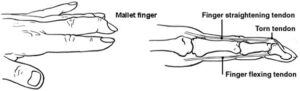
Reproduced with the kind permission of Patient.co.uk
Sometimes the tendon will not tear but a small piece of bone it attaches to will be pulled off the finger (Soft tissue Mallet). The result will be the same as the tendon is unable to pull on the bone (Bony Mallet).
What are the symptoms
Due to the tear in your tendon (soft tissue or bony mallet) your finger may become painful and swollen. You will be unable to straighten the end of your finger.
How is it treated?
A splint will have been fitted to the tip of your finger which will keep the tip of your finger straight. This allows the tendon /bone to stay together and heal. This will take 8 weeks for a soft tissue mallet and 6 weeks for a bony mallet.
You have a …………………mallet injury and therefore, need to keep the splint in place for …………weeks.
The splint should fit securely, not cause any soreness, and not become loose or fall off. The splint should be worn at all times, including when you are in bath/shower and when you are in bed, during this first period of continuous splinting.
If the end joint bends during the continuous splinting period, it will slow the healing. You will need to re-start splinting again from the beginning. If you do not follow these instructions your ability to straighten the end of your finger may not return to normal.
It is important to note that smoking will delay the healing process and so should be minimised if possible.
Recovery Period
This is only a guide and may vary according to individual injuries. It is very important at this stage that you do not force or stretch the tip of your finger.
Bony Mallet
| 0 to 6 weeks | Wear the splint at all times. Do exercises in the splint |
| 6+ weeks | The splint to be worn at risk (Hand Therapist will explain on the tasks that can cause risk) and when sleeping for a further 2 weeks |
| 8+ weeks | Gradually weaning from splint. Progress at this point depends on finger position. |
| 10+ weeks | Return to contact sports and heavy lifting. |
Soft Tissue Mallet
| 0 to 8 weeks | Wear the splint at all times. Do exercises in the splint |
| 8+ weeks | The splint to be worn at risk (Hand Therapist will explain on the tasks that can cause risk) and when sleeping for a further 2 weeks. |
| 10+weeks | Gradually wean from splint. Progress at this point depends on finger position. |
| 12+ weeks | Return to contact sports and heavy lifting. |
Hygiene
The splinted finger must be always kept clean and dry. If the skin becomes wet inside the splint, it will become very sore. It’s important to wash both your finger and the splint at least once a day, following these instructions:
- Keep your finger flat on the table, cut the strapping, and slide the splint off your finger.
- Always keep the end joint straight by keeping your finger flat on the table. Wash and dry your finger and the splint, keeping your finger supported on the table, using soap and water. You may find it easier if someone helps you to do this each day. Any movement of the end of the finger will delay healing and may even cause permanent damage.
- Slide the splint back over the end of finger, keeping the finger straight
- Replace the strapping – this should cover the whole splint but not the middle joint of the finger.
Exercises
Week 1 -Week 6 or 8
Your splint should only restrict movement at the top joint and not at the middle joint of the finger. It is important you continue to move the middle joint of the finger.
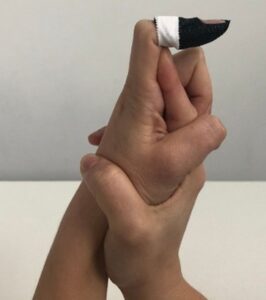
Support the finger as shown, and bend and straighten middle finger joint 10 times. Repeat this exercise 3 to 4 times per day.
After 6 or 8 weeks
Hand Therapist will review and will advise the further exercises.
What to expect?
Most mallet injuries heal well with splinting alone. The aim of splinting is to return the end joint to as near normal as possible. It is common for there to be a slight loss of full extension at the end joint of your finger at the completion of treatment.
It may take a few months for the swelling and tenderness to settle as well as the redness over the back of the finger. You may also find the skin of the finger may become more sensitive. You can massage the skin with a light moisturiser to help desensitise the skin.
Bony mallet injuries may leave a bump/deformity over the end joint of the finger. You may not regain full normal or pre-injury movement in the end joint of your finger. This generally doesn’t affect the overall function of the hand.
If you do not comply with the use of the splint and the length of time it should be worn, then it is likely that the ability to straighten the end of your finger will not return.
Painkillers
To manage your pain, it is advised that you regularly take painkillers which can be bought cheaply over the counter. If you have allergies or conditions which prevent the use of painkilling or anti-inflammatory medication, please seek advice from a pharmacist or your General Practitioner.
Is there anything I should avoid?
- Do not try to examine how much your finger has healed by bending it.
- Do not wear rings on the affected finger. If the finger is swollen it may well affect your circulation and interfere with the healing process.
- Do not try to alter your splint yourself.
- Do not remove the splint for anything other than to clean the finger and splint as described in the hygiene section.
- Do not consume alcohol, massage the injured area or apply heat as all can be detrimental in the early stages of healing.
- Avoid sports for at least 8 weeks
If you find, as the swelling settles, your splint becomes too large for your finger contact your Hand therapist on the number at the back of this leaflet to discuss.
Outcome
If you do not comply with the use of the splint and the length of time it should be worn, then it is likely that the ability to straighten the end of your finger will not return.
Treatment in this way is successful for a mallet finger in 3 out of 4 people. Some patients may be left with a slight bend; however, this will not usually affect the function of the finger and no further medical input is required.
Contact details
If, following the 12-week splinting period described earlier in this leaflet, the finger remains slightly bent and interferes with your ability to function normally you should contact the telephone number noted below and request to speak with the named clinician that assessed you.
Telephone: 01482622296 Clinician Name………………………………
Should you require further advice on the issues contained in this leaflet, please do not hesitate to contact the Hand Therapy Unit on Tel: 01482622296
Images taken by Medical Photographer, Plastic Surgery, NHS Humber Health Partnership
General Advice and Consent
Most of your questions should have been answered by this leaflet, but remember that this is only a starting point for discussion with the healthcare team.
Consent to treatment
Before any doctor, nurse or therapist examines or treats you, they must seek your consent or permission. In order to make a decision, you need to have information from health professionals about the treatment or investigation which is being offered to you. You should always ask them more questions if you do not understand or if you want more information.
The information you receive should be about your condition, the alternatives available to you, and whether it carries risks as well as the benefits. What is important is that your consent is genuine or valid. That means:
- you must be able to give your consent
- you must be given enough information to enable you to make a decision
- you must be acting under your own free will and not under the strong influence of another person
Information about you
We collect and use your information to provide you with care and treatment. As part of your care, information about you will be shared between members of a healthcare team, some of whom you may not meet. Your information may also be used to help train staff, to check the quality of our care, to manage and plan the health service, and to help with research. Wherever possible we use anonymous data.
We may pass on relevant information to other health organisations that provide you with care. All information is treated as strictly confidential and is not given to anyone who does not need it. If you have any concerns please ask your doctor, or the person caring for you.
Under the General Data Protection Regulation and the Data Protection Act 2018 we are responsible for maintaining the confidentiality of any information we hold about you. For further information visit the following page: Confidential Information about You.
If you or your carer needs information about your health and wellbeing and about your care and treatment in a different format, such as large print, braille or audio, due to disability, impairment or sensory loss, please advise a member of staff and this can be arranged.