
- Reference Number: HEY020/2025
- Departments: Ophthalmology Department
- Last Updated: 30 June 2025
Introduction
This leaflet has been produced to give you general information about your procedure. Most of your questions should be answered by this leaflet. It is not intended to replace the discussion between you and the healthcare team but may act as a starting point for discussion. If after reading it you have any concerns or require further explanation, please discuss this with a member of the healthcare team.
What is an Intravitreal Injection?
Intravitreal injections are medicines that are injected directly into the vitreous humour (the clear, gel-like substance inside the eye) to treat various retinal diseases.
There are two main groups of drugs commonly used in intravitreal injections:
1 Anti-VEGF (Anti-Vascular Endothelial Growth Factor) agents
These medications block VEGF, a protein that promotes the growth of abnormal blood vessels and increases vascular permeability.
Common Anti- VEGF drugs include-.
- Ranibizumab (Lucentis)
- Ranibizumab biosimilar (We use Ximluci)
- Aflibercept (Eylea)
- Brolucizumab (Beovu) (no longer used in the department)
- Faricimab (Vabysmo)
- Bevacizumab (Avastin)(unlicensed)
- Bevacizumab gamma (licensed)
2 Steroids
These reduce inflammation and vascular leakage, helping to decrease retinal swelling.
Common intravitreal steroids include-
- Dexamethasone (Ozurdex)
- Fluocinolone (Iluvien)
- Triamcinalone (Kenalog) (unlicensed)
These drugs usually need to be given as a course of treatment., How often the injections need to be given will vary depending on the drug that is being used and the eye disease that you have. Anti-VEGF drug injections will probably need repeating 4 weekly at the start of the treatment course (Lucentis, Ximluci, Eylea, Faricimab, Avastin). Steroid based injections (Ozurdex, Iluvien) may need to be repeated every 3 to 6 months for Ozurdex or less frequently for Iluvien. The exact treatment plan will depend on the eye disease and how well your eye is responding. It is therefore essential that you keep any eye clinic appointments that you are asked to attend.
The injection is given with a very fine needle through the white part of the eyeball in to the cavity of the eye. This procedure is usually carried out as an outpatient visit or as a day-case procedure (iluvien and sometimes Ozurdex).
Why do I need a course of Intravitreal Injections?
Common diseases treated with this type of injection include
- Wet age-related macular degeneration
- Diabetic macular oedema (leakiness due to diabetic eye disease),
- Retinal vein occlusion (blocked blood vessels in the retina causing leakiness),
- Uveitic macular oedema (inflammation)
- Myopic choroidal neovascularization (CNV) (Short-sighted related abnormal blood vessel growth)
- Uveitic choroidal neovascularization (CNV) (abnormal new vessel growth caused by eye inflammation)
- Neovascular glaucoma (abnormal vessel growth affecting drainage of fluid inside the eye and causing a form of glaucoma (high pressure) in the eye)
Your doctor will have discussed other treatment options with you and will have explained the advantages and disadvantages of all the treatments available to you. These treatment options will vary depending on:
How many injections will I be given?
Anti VEGF
We follow a ‘Treat and Extend’ approach for treating with Anti-VEGF injections for most diseases. The goal of this approach is to stabilize your eye condition with an initial series of injections, and then gradually extending the interval between treatments, depending on how your eye responds. We start with a loading dose of one injection every 4 weeks and once your eye condition is stabilized, we gradually increase the interval between the injections. This personalised approach helps reduce the number of injections over time while maintaining control of the disease. Because this is a customized approach, the number of injections vary from patient to patient and the injection interval varies from visit to visit.
There are a small number of circumstances where we may suggest a shorter course of injections or even a single injection. The planned treatment course for your eye condition will be explained to you at the visit to see the doctor
Steroid group
These medicines are injection on ‘as and when needed’ basis. The need for repeat treatment depends on how your condition responds and will be assessed during follow-up visits.
Who should not have intravitreal injections?
You should not be given anti-VEGF if you have any of the following conditions:
- Allergy to anti-VEGF or any of its ingredients
- If you have an infection in or around either eye or severe infection anywhere in your body
- If you are trying to become pregnant, are already pregnant, or are breastfeeding
Anti-VEGF should be used with caution in patients with the following conditions:
- If you have had a heart attack or stroke in the last three months. If you have had a heart attack or stroke within the last 3 months, we will arrange an urgent consultation with a doctor to discuss the potential risks/ benefits of injection treatment in your specific circumstance.
Can there be any complications or risks?
As with any medical procedure, there is a small risk of complications following anti VEGF treatment. Complications that might occur can be from the injection procedure itself or from the drug. For most patients, the benefit of the treatment outweighs the small risk of injection injury.
Serious risks
Each injection, regardless of the drug injected carries a less than 1:1000 risk of a complication, which may severely and permanently reduce the sight in the eye injected. These very rare serious risks are-
- Infection inside the eye
- Blockage of the main artery to the eye
Other rare serious complications include:
- Bleeding inside the eye
- Damage to the lens in the eye
- Immune reaction to the drug known as immunogenicity
- Inflammation in the eye
- Retinal detachment
- Retinal tear
- Cataract formation and raised eye pressure (Steroid implant)
Common side-effects
Discomfort during and after injection,
Bruising of the white of the eye,
An increase in eye pressure
Floaters (moving black dots in your vision).
Systemic side effects
Studies have found no evidence that anti-VEGF or steroid injections interfere with other health conditions or medications you may be taking.
Anti-VEGF should be used with caution in patients with the following conditions:
- If you have had a heart attack or stroke in the last three months. If you have had a heart attack or stroke within the last 3 months, we will arrange an urgent consultation with a doctor to discuss the potential risks/ benefits of injection treatment in your specific circumstance.
Pregnancy and breast-feeding
If you are pregnant or planning to become pregnant, please discuss this with your doctor before your intravitreal injection treatment. Anti-VEGF medicines should not be used during pregnancy. Women of child-bearing potential should use effective contraception during their treatment and for at least three months after the last intravitreal injection. If you do become pregnant whilst undergoing intravitreal injections, please inform your doctor immediately. Anti-VEGF medicines are not recommended during breast-feeding because it is not known whether the medicine passes into human milk. Ask your doctor for advice before treatment.
How do I prepare for the Intravitreal Injection?
- Please read the information leaflet. Share the information it contains with your partner and family (if you wish) so that they can be of help and support.
- Before the injection you may continue with your daily activities as normal; this includes continuing with all routine medication and eye drops. You may eat and drink as normal prior to the injection.
- You must not drive to the appointment as you will be having dilating drops in the eye under-going the injection treatment and these drops blur the vision for up to six hours.
- If you intend to travel abroad, we advise that you receive your injection no later than one week before you travel where this is practical.
What will happen?
- On the day of the injection, you will need to report to the reception desk either on the ground floor or first floor of Eye Hospital within the grounds of Hull Royal Infirmary. You will then be directed to the waiting area.
- A nurse will verify your medical details including any recent changes to your health or medication so please bring a list of any new medication with you.
- You will have a vision test and dilating drops (identical to those used in the Eye clinic) will be put in the eye/s to be injected. These take 20-30 minutes to work and will blur your vision for several hours particularly for close work.
- You will then have an OCT scan of both eyes performed.
- You will then be transferred to the injection suite where you will receive anaesthetic drops into the eye to numb the eye.
- The injection is performed with you lying on a couch where we will cover the face around the eye with sterile drapes. Once the eye is numb, you will receive antiseptic eye drops called povidone-iodine into the eye, to minimise the risk of infection.
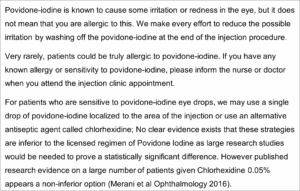
- A small clip (speculum) will be used to keep the eye open. The injection site is marked with callipers, and your eye is stabilised with forceps or a cotton bud. A few seconds later, the injection is given. In rare cases, the injecting clinician might use antibiotic drops after your injection to prevent infection. Your vision is assessed post injection by checking you can see hand movements or can count fingers.
- Almost immediately you will feel well enough to return to the waiting area, you can then sit for a while if you wish before going home.
Who will perform the injection treatment?
These injections will be given either by a trained registered nurse or a doctor
Please be aware that the Eye Department is a teaching unit and that some of the injections in whole or part can be carried out by resident (trainee) eye doctors.
We cannot give a guarantee that a particular person will perform the procedure. The person giving you your injection, will however, have appropriate training and experience.
What happens afterwards?
- Do not drive for 6 hours after the injection as your vision will be blurred by the dilating drops.
- It is normal for your eye to feel slightly gritty, uncomfortable or watery and the white of the eye may be red for a day or so after the injection. This should settle within 2 days.
- Please do not rub your eye after the injection – there is a risk of you causing a scratch to the surface of the eye whilst the numbing drops are still working. The eye can be gently cleaned or dabbed using a ‘clean tissue’. You should dispose of the used tissue and use a fresh new tissue each time you clean the eye.
- You should avoid getting water and shampoo or soap into your eye for 48 hours after injection. Wash your hair “salon style” during this time. You should also avoid swimming for 48 hours after the injection.
- If your eye feels gritty after the injection, lubricating “dry eye” eye drops can help to make the eye feel more comfortable. You should use a new bottle after each injection to minimise the risk of infection in the eye. We recommend you arrange a repeat prescription of these lubricating drops from your doctor.
- Some patients notice floating dots or shadows in the eye being treated straight after the injection, these should gradually fade over the next 2 days. If you have had treatment with Iluvien or Ozurdex the floating rod will take a few weeks to fade away.
All these symptoms should steadily improve on a daily basis.
If you experience:
- INCREASING PAIN OR ACHE IN THE EYE
- PUS or DISCHARGE
- SUDDEN DECREASE or CHANGE IN VISION
- AN INCREASING NUMBER OF BLACK DOTS (FLOATERS) OR FLASHES OF LIGHT
- INCREASED SENSITIVITY TO LIGHT
Please CONTACT THE DEPARTMENT IMMEDIATELY via the phone numbers below. These symptoms may be a sign of infection or inflammation in the eye which is a serious complication. Serious complications must be treated quickly to minimise damage to the eye.
If you suspect you have any of the above symptoms, please contact us:
Monday-Friday 9.00am to 5.00pm: tel: 01482 608788.
Evenings, weekends and Bank Holidays: tel: 01482 604346 (Please listen to full voice message on how to access emergency out of hours service).
It is very important that you keep all appointments for review and treatment.
Depending on the drug injected you will be given a follow-up appointment either for review in the clinic or for a further injection, this will vary according to your eye condition and will have been explained at your consultation with more detailed information given.
Should you require further advice on the issues contained in this leaflet, please do not hesitate to contact the Ophthalmology Department tel: 01482 816658 or tel: 01482 608788
General Advice and Consent
Most of your questions should have been answered by this leaflet, but remember that this is only a starting point for discussion with the healthcare team.
Consent to treatment
Before any doctor, nurse or therapist examines or treats you, they must seek your consent or permission. In order to make a decision, you need to have information from health professionals about the treatment or investigation which is being offered to you. You should always ask them more questions if you do not understand or if you want more information.
The information you receive should be about your condition, the alternatives available to you, and whether it carries risks as well as the benefits. What is important is that your consent is genuine or valid. That means:
- you must be able to give your consent
- you must be given enough information to enable you to make a decision
- you must be acting under your own free will and not under the strong influence of another person
Information about you
We collect and use your information to provide you with care and treatment. As part of your care, information about you will be shared between members of a healthcare team, some of whom you may not meet. Your information may also be used to help train staff, to check the quality of our care, to manage and plan the health service, and to help with research. Wherever possible we use anonymous data.
We may pass on relevant information to other health organisations that provide you with care. All information is treated as strictly confidential and is not given to anyone who does not need it. If you have any concerns please ask your doctor, or the person caring for you.
Under the General Data Protection Regulation and the Data Protection Act 2018 we are responsible for maintaining the confidentiality of any information we hold about you. For further information visit the following page: Confidential Information about You.
If you or your carer needs information about your health and wellbeing and about your care and treatment in a different format, such as large print, braille or audio, due to disability, impairment or sensory loss, please advise a member of staff and this can be arranged.