
- Reference Number: HEY1648/2026
- Departments: Physiotherapy
- Last Updated: 30 April 2026
Introduction
This leaflet has been produced to give you general information regarding breast surgery. Most of your questions should be answered by this leaflet. It is not intended to replace the discussion between you and your consultant but may act as a starting point for discussion. If after reading it and you have any concerns or require further explanation, please discuss this with a member of the healthcare team caring for you.
Why do I need exercises?
The exercises described in this leaflet are for anyone who has had breast surgery. These have been approved by the breast consultants and the physiotherapy department. The exercises are designed for the use from the day after your surgery, however it may be useful to practice them prior to your surgery so you know what they will entail, how to do each exercise and to identify what your normal range of movement is.
The exercises provided in this leaflet will help you regain your range of movement in your arm, prevent you from getting a frozen shoulder, to reduce the lack of full movement in the upper limb and to help with the swelling post-surgery. Exercises may relieve pain as well as help the tissues heal as during exercises more oxygen is delivered to the area that is being moved.
Can there be any complications or risks?
There may be a slight risk post-surgery of muscle strain if advice is not followed or exercises not completed as advised. It is normal to feel muscle discomfort when performing or after completing exercises, but this should gradually improve, over a period of a couple of days. If any exercises do cause continuous discomfort or pain, then please stop that certain exercise and speak to your consultant or breast care nurse at your follow up appointment.
Things to avoid after surgery
DRIVING
Post-surgery, it is advised to wait for 2 weeks until you can start driving again unless instructed differently by your consultant. If advice is not followed, it can lead to your insurance no longer being valid.
ACTIVITIES
Activities should be avoided which result in heavy lifting, pushing or pulling. The most we would advise post-surgery is nothing heavier than a kettle of water. Also, avoid keeping the arm in one position for a long time. You may use the opposite arm but try not overcompensating. Speak to your consultant at your 4 week follow up appointment when it is appropriate to start introducing more strenuous activities
DRAINS
Depending on the consultant performing the surgery, drains may be in place post-surgery, and you may be discharged with a drain still in situ. Exercises post-surgery can still be carried out, but just make sure you are keeping it at a comfortable range of movement that doesn’t cause pain or discomfort and the drain tubing is not pulled. Nurses will follow on before discharge with any advice/training required prior to discharge. If discharged with a drain, drain bags can be provided by the ward to assist ease of doing exercises, mobilising as well as privacy and dignity to cover the drain.
How do I prepare for the exercises?
Please read this information leaflet. Share the information it contains with your family (if you wish) so that they can be of help and support. There may be information they need to know, especially if they are taking care of you following your surgery. It will also give you a good idea of your normal range of movement, so you are aware of what you are aiming for post-surgery.
When should I start the exercises?
The exercises should be started the day after your surgery (day 1).
Each exercise should be done three times a day. For example, morning, lunch and teatime and complete 5 repetitions of every exercise.
You may find the exercises uncomfortable at first. Normally you will experience a pulling sensation but keep it a comfortable range of movement. If any exercises cause any pain or discomfort and it continues, then we do advise you stop doing that exercise.
In certain exercises shown, if you are unable to usually reach that position, do not worry, it is more about the movement and reaching the range of movement that is normal for you.
If the exercise involves using only one arm, use the arm on the side which your surgery was performed. If both sides are operated on, you can either do them separately or at the same time.
How long should I do the exercises for?
You should continue these exercises until you feel you have gained your full range of movement, i.e. the range of movement that you had before your surgery. This should take about 4 to 6 weeks.
If you begin to develop stiffness in your arm after you have stopped these exercises, re-introduce them until this has eased.
Exercises
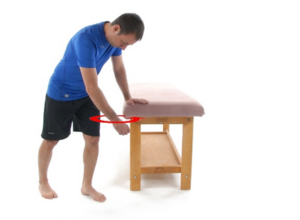
Shoulder Pendulum
Stand and bend at the waist, holding a chair or table with the unaffected arm, leaving the affected arm hanging.
Rotate your arm in a circular motion, progressively getting bigger, as comfort allows.
Repeat both clockwise and anti-clockwise.
Repeat 5 times
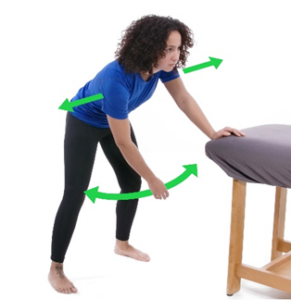
Side to side pendulum
Support yourself with your hand on a chair or table with your none operated side while keeping your knees bent and back straight.
Let your arm relax straight down by your side.
Gentle swinging arm motion (just like a pendulum) from side to side, as comfort allows.
Repeat 5 times
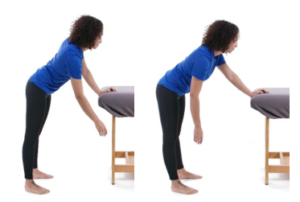
Back and forth pendulum
Support yourself with your hand on a chair or table with your none operated side while keeping back straight.
Let your arm relax straight down by your side.
Gentle swinging arm motion (just like a pendulum) from front to back, as comfort allows.
Repeat 5 times.
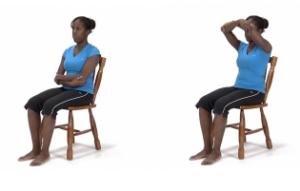
AAROM Partial Shoulder Flexion
Sit straight on a chair and cross your arms over your chest with your hands holding the opposite elbow.
Lift the arms up and away from your chest to work the range of motion. Only raise up to shoulder height.
Repeat 5 times.
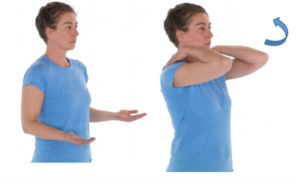
AAROM Shoulder/elbow flexion
Sit or stand. Place your hand on your shoulder. Lift your elbow up towards the ceiling as far as possible. To be carried out on operated side only.
Repeat 5 times.
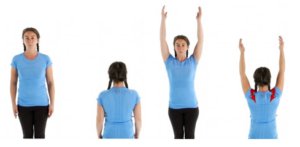
Shoulder flexion in standing
In standing, slowly lift your arm/arms directly in front of you until they are overhead.
Repeat 5 times.
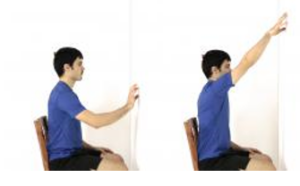
Shoulder flexion at a wall
Sit up straight in front of a wall, approximately one meter away from it.
Place your fingertips on the wall and climb up the wall slowly with your hand/fingers.
Climb up as high as you can.
Lower your hand back down.
Do not shrug your shoulder or lean to the opposite side. Keep your body straight and your shoulders level.
Repeat 5 times.
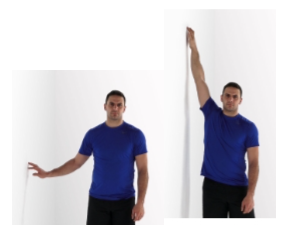
Shoulder Abduction
Sit up straight beside a wall, approximately one meter away from it.
Place your fingertips on the wall and climb up the wall slowly with your hand.
Climb up as high as you can.
Lower your hand back down by your side.
Do not shrug your shoulder or lean to the opposite side. Keep your body straight and your shoulders level.
Repeat 5 times.
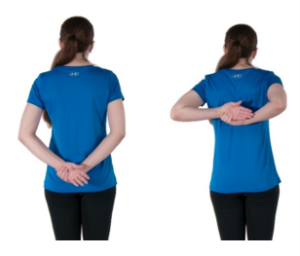
Shoulder Internal Rotation Assisted
Standing, bring one hand behind your back (operated arm) and the other hand supporting underneath (none operated arm).
Move your hand up towards your head with the help of the other supporting hand.
Slide the hand flat without twisting the wrist.
Hold and lower
If both sides have been operated on, repeat on both sides.
Repeat 5 times.

Shoulder Butterfly in lying
Lie on your back with your head on a pillow.
Bring your hands behind the bottom of your head, then let the elbows fall toward the ground on each side.
Repeat 5 times.

Shoulder Flexion in Lying
Lying on your back with knees bent and arms by your sides, palms facing the ceiling.
Slowly raise your arms straight overhead in an arc fashion as far as possible, keeping your chin tucked-in.
When you have reached as far as you can manage, hold for 20 seconds.
Repeat 5 times.
The last two exercises provided are very important as this is the position you will need to adopt during treatment if radiation therapy is required following surgery.
Useful contacts
Should you require further advice on the issues contained in this leaflet, please do not hesitate to contact:
The Breast Care Nurses on telephone number – Tel: 01482 622013 (Castle Hill Hospital)
Breast, ENT and Plastics Ward 16 – Tel: 01482 468616
If you are located on the South Bank of the Humber, and you should require any support or further advice, please contact your specialist breast nurse.
Breast Cancer Care
Kiln House
210 New Kings Road
London
SW6 4NZ
Macmillan Cancer Support
London (Head office)
The Forge, 3rd Floor, Bronze Building,
105 Sumner Street, London SE1 9HZ
Freephone – Tel: 020 7840 7840
Helpline – Tel: 0808 808 00 00
Breast Cancer Now
6th Floor
the White Chapel Building
10 Whitechapel High Street
London
England
E1 8QS
Phone: Tel: 0333 207 0300
Images – https://wibbi.com
Your feedback matters to us…
To ensure we deliver a safe and quality service and to help us understand the experience you have of the care you receive from our staff we would value your thoughts about the service you received.
You may be contacted as part of our quality assurance programme which is where we visit our teams and staff and talk to them about the care they provide to our patients or at any time during or after you have needed our services.
To collect this feedback, we would contact you using the registered telephone number we hold in your care record. This feedback will be strictly anonymous and whilst we will share the feedback as part of the process, we will not share any details which may identify you.
We will never ask you any personal questions about your health during these telephone calls.
If you do not wish to speak to us, please say this when we call, we do not want you to feel pressured.
General Advice and Consent
Most of your questions should have been answered by this leaflet, but remember that this is only a starting point for discussion with the healthcare team.
Consent to treatment
Before any doctor, nurse or therapist examines or treats you, they must seek your consent or permission. In order to make a decision, you need to have information from health professionals about the treatment or investigation which is being offered to you. You should always ask them more questions if you do not understand or if you want more information.
The information you receive should be about your condition, the alternatives available to you, and whether it carries risks as well as the benefits. What is important is that your consent is genuine or valid. That means:
- you must be able to give your consent
- you must be given enough information to enable you to make a decision
- you must be acting under your own free will and not under the strong influence of another person
Information about you
We collect and use your information to provide you with care and treatment. As part of your care, information about you will be shared between members of a healthcare team, some of whom you may not meet. Your information may also be used to help train staff, to check the quality of our care, to manage and plan the health service, and to help with research. Wherever possible we use anonymous data.
We may pass on relevant information to other health organisations that provide you with care. All information is treated as strictly confidential and is not given to anyone who does not need it. If you have any concerns please ask your doctor, or the person caring for you.
Under the General Data Protection Regulation and the Data Protection Act 2018 we are responsible for maintaining the confidentiality of any information we hold about you. For further information visit the following page: Confidential Information about You.
If you or your carer needs information about your health and wellbeing and about your care and treatment in a different format, such as large print, braille or audio, due to disability, impairment or sensory loss, please advise a member of staff and this can be arranged.