
- Reference Number: HEY1658/2026
- Departments: Infection Prevention and Control, Trustwide - Adult
- Last Updated: 31 March 2026
Introduction
This leaflet tells you how to stay clean and safe around water. We hope it answers your questions.
It does not replace speaking with your nursing or doctor team on the department. If you are worried or have more questions after reading this, please talk to your nurse, doctor or the infection prevention and control team. They are happy to help.
Why water safety matters?
Stay safe around water
Water is essential or health, but it can sometimes contain germs that live in places such as pipes, taps, showers or hot tubs.
These germs do not normally make healthy people unwell, but they can be a risk for people who are already poorly or those who have weakened immune system.
You may be at higher risk if you:
- have had an organ transplant
- are having treatment for cancer
- are in an intensive care unit (e.g. neonatal intensive care, high dependency unit)
- are undergoing dialysis
- have conditions effecting your heart, lungs or other organs
What are these germs?
There are two main germs we look for:
- Legionella: Can cause a severe chest infection
- Pseudomonas: Can a range of infections
Safe Water Usage in Healthcare Settings
How to use sinks safely?
In the hospital, we have different types of sinks. Using them correctly helps stop germs from spreading.
Clinical hand wash basins
Picture examples of clinical hand wash basins below, yet this design can slightly vary across our five hospital sites.
Bathroom sinks
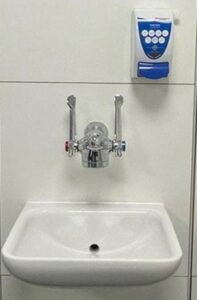
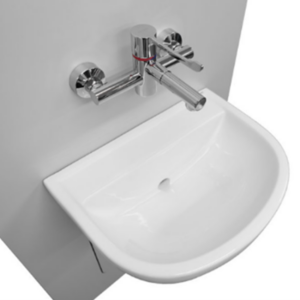
Clinical hand wash basins
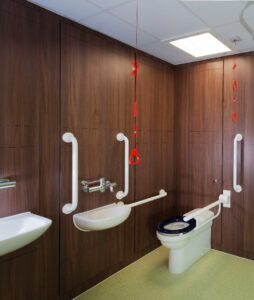
These sinks are only for washing your hands
- Do not pour drinks, food, or medicines into these sinks
- Do not leave any items on the sink
- Keep your belongings (like toothbrushes and toothpaste) at least 2 meters away from these sinks so they don’t get splashed
These sinks are typically in patient bays and cubicle rooms.
Washing and brushing your teeth
- Please use the bathroom sinks to brush your teeth
- If you cannot get out of bed, ask a nurse for help. They will bring you a wash bowl with water for brushing your teeth
- Warning: The hot water can be very hot. Please be careful
- These sinks are typically in patient bathrooms or ensuites.
Toys and baby items
- Please do not bring bath toys into the hospital. They are difficult to fully dry and can grow mould and germs inside.
- Please clean bottles and dummies/pacifiers in the parent kitchen sinks, not in clinical hand wash basins. Staff can help if needed.
Using the toilet
To keep toilets working properly, please only flush toilet paper.
Do not flush:
- Paper hand towels
- Nappies
- Sanitary pads or tampons
- Wipes
Putting these items down the toilet causes blockages and can mean dirty water leaks out, which is both bad for the environment and spreads germs. Please use the bins provided for everything except toilet paper.
How do I prepare for my care?
How to look after your tubes and wounds
If you have any tubes or drips (like a catheter or a line for medicine), you must keep them dry.
- When washing: Try to keep your tubes or wounds covered
- Don’t soak them: Do not let your tubes or wounds sit under water (like in a bath)
Tell your family
Please share this leaflet with the people looking after you. It helps them know how to keep you safe and clean when you go home.
What will happen if there is any issues?
- Tell a nurse if you see a leak, a flood or a sink that is blocked
- If the taps stop working, use hand gel or wet wipes to keep your hands clean
- Keep your things dry: Put your bags and clothes in the cupboards or lockers, away from the sinks and bathrooms
If you have any further questions
Should you require further advice on the issues contained in this leaflet, please do not hesitate to contact the Infection Prevention and Control Teams.
| Hospital Site Infection Control Team | Telephone Number |
| Hull Royal Infirmary | Tel: 01482 311551 |
| Castle Hill Hospital | Tel: 01482 623066 |
| Scunthorpe General Hospital | Tel: 0303 330 2517 |
| Diana Princess of Wales Hospital | Tel: 0303 330 4109 |
| Goole District Hospital | Tel: 0303 330 2450 |
General Advice and Consent
Most of your questions should have been answered by this leaflet, but remember that this is only a starting point for discussion with the healthcare team.
Consent to treatment
Before any doctor, nurse or therapist examines or treats you, they must seek your consent or permission. In order to make a decision, you need to have information from health professionals about the treatment or investigation which is being offered to you. You should always ask them more questions if you do not understand or if you want more information.
The information you receive should be about your condition, the alternatives available to you, and whether it carries risks as well as the benefits. What is important is that your consent is genuine or valid. That means:
- you must be able to give your consent
- you must be given enough information to enable you to make a decision
- you must be acting under your own free will and not under the strong influence of another person
Information about you
We collect and use your information to provide you with care and treatment. As part of your care, information about you will be shared between members of a healthcare team, some of whom you may not meet. Your information may also be used to help train staff, to check the quality of our care, to manage and plan the health service, and to help with research. Wherever possible we use anonymous data.
We may pass on relevant information to other health organisations that provide you with care. All information is treated as strictly confidential and is not given to anyone who does not need it. If you have any concerns please ask your doctor, or the person caring for you.
Under the General Data Protection Regulation and the Data Protection Act 2018 we are responsible for maintaining the confidentiality of any information we hold about you. For further information visit the following page: Confidential Information about You.
If you or your carer needs information about your health and wellbeing and about your care and treatment in a different format, such as large print, braille or audio, due to disability, impairment or sensory loss, please advise a member of staff and this can be arranged.