
- Reference Number: HEY1580/2025
- Departments: Emergency Department, Paediatric Medicine, Paediatrics
- Last Updated: 31 August 2025
Introduction
This leaflet has been produced to give you general information about your condition. Most of your questions should be answered by this leaflet. It is not intended to replace the discussion between you and your doctor but may act as a starting point for discussion. If after reading it you have any concerns or require further explanation, please discuss this with a member of the healthcare team caring for you.
What is a normal after a head injury?
Your child may:
- have a mild headache (especially after watching TV or using a computer or phone)
- feel sick and not feel like eating
- have difficulty concentrating
- feel more tired than usual
What should I watch out for?
If you have any concerns or notice any of the following within 2 to 3 days, please see your GP or return to the Emergency Department:
- repeated vomiting (being sick)
- unusually sleepy or hard to wake
- confused or abnormal behaviour
- difficulty walking or problems seeing
- weakness in one or more arms or legs, or unable to hold things
- painful headache that will not go away, which painkillers don’t help
- seizures (also known as convulsions or fits)
- blood or fluid coming from ears or nose
What can I do to help my child?
- An adult should supervise your child for the next 24hrs
- Your child does not need any treatment other than paracetamol, and/or ibuprofen given according to the instructions on the bottle for at least 24hrs.
- Make sure they are drinking enough fluids.
- Your child can play as normal, although calm, quiet play is advisable
- Television, computer games and mobile telephones are best avoided.
- We advise your child to avoid rough play or contact sports for at least three weeks
Concussion after a head injury
Concussion can result from a minor head injury and can cause a range of symptoms in the time after injury. The vast majority of children who receive this advice leaflet will not develop signs of concussion. However, if signs of concussion are apparent after the first 24 hours, please use the following guidance.
Expected signs of concussion:
- Persistent headaches, nausea, dizziness
- Difficulty concentrating or being involved in an activity for a longer time period
- Change in personality, for example being more irritable or angry in the period after having a head injury
- Vision problems (focusing/blurring of vision)
- Being more sleepy or tired than normal
The symptoms can come and go for a few weeks, but, importantly, the symptoms will improve with time and rest in most cases.
After Concussion Return to Normality
The traffic light system below gives a step-by-step guide on how to manage the expected signs of concussion detailed below.
- You can move forward to the next stage when you have been symptom free for 24 hours.
- If symptoms re-appear then please move back to the previous stage to help relieve symptoms.
- If symptoms become worse at any point, then please contact either your GP, NHS24 (111) or, if urgent care required, call 999.
- If you still have symptoms after 2 weeks, please see your own GP
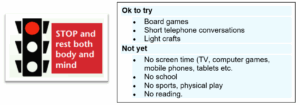

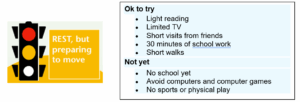

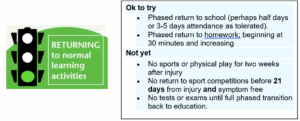

For return to sport, we recommend a minimum of 2 weeks rest. You can access this guidance from “If in doubt, sit them out” (QR code for further info)

General Advice and Consent
Most of your questions should have been answered by this leaflet, but remember that this is only a starting point for discussion with the healthcare team.
Consent to treatment
Before any doctor, nurse or therapist examines or treats your child, they must seek your consent or permission. In order to make a decision, you need to have information from health professionals about the treatment or investigation which is being offered to your child. You should always ask them more questions if you do not understand or if you want more information.
The information you receive should be about your child’s condition, the alternatives available for your child, and whether it carries risks as well as the benefits. What is important is that your consent is genuine or valid. That means:
- you must be able to give your consent
- you must be given enough information to enable you to make a decision
- you must be acting under your own free will and not under the strong influence of another person
Information about your child
We collect and use your child’s information to provide your child with care and treatment. As part of your child’s care, information about your child will be shared between members of a healthcare team, some of whom you may not meet. Your child’s information may also be used to help train staff, to check the quality of our care, to manage and plan the health service, and to help with research. Wherever possible we use anonymous data.
We may pass on relevant information to other health organisations that provide your child with care. All information is treated as strictly confidential and is not given to anyone who does not need it. If you have any concerns please ask your child’s doctor, or the person caring for your child.
Under the General Data Protection Regulation and the Data Protection Act 2018 we are responsible for maintaining the confidentiality of any information we hold about your child. For further information visit the following page: Confidential Information about You.
If you need information about your child’s (or a child you care for) health and wellbeing and their care and treatment in a different format, such as large print, braille or audio, due to disability, impairment or sensory loss, please advise a member of staff and this can be arranged.