
- Reference Number: HEY1284/2025
- Departments: Orthopaedics, Physiotherapy
- Last Updated: 30 September 2025
Introduction
This leaflet has been produced to give you general information about your condition and treatment. Most of your questions should be answered by this leaflet. It is not intended to replace the discussion between you and your doctor but may act as a starting point for discussion. If after reading it you have any concerns or require further explanation, please discuss this with a member of the healthcare team caring for you.
What is a digital nerve?
There are 2 digital nerves in each of your fingers and thumb. They are positioned one on each side of the finger on the palm side of the hand. These nerves pass messages to your brain about what you can feel. They tell you when something is hot, cold, sharp, blunt, hard or soft. They also help you recognise objects by touch, without seeing it, for example feeling for keys in your pocket.
What happens when the digital nerve is injured?
When the nerve is injured, the most obvious thing you will notice is numbness. If only one nerve is affected, the fingertip will be numb on one side, but not the other.
What happens during surgery (digital nerve repair)?
The nerve is like a tiny electric cable, with an outer tube and thousands of thin fibres running through it. The surgeon will repair the outer tube, but the tiny fibres inside will die off from the level of the cut to the fingertip. If the nerve is not repaired, it will not recover and may form a very painful lump called a neuroma.
What happens following surgery (nerve recovery)?
Initially following surgery, the wound will heal and form a scar.
A few weeks after the nerve has been repaired, the tiny fibres will very slowly begin to regrow. It may take many months for the fibres to reach the fingertip, so the finger is likely to remain numb for quite some time after the operation. You may also experience some strange sensations in your hand, such as pins and needles, tingling or electric type shooting pains. All these sensations are normal after a nerve repair.
Wound management following surgery
Following your visit to trauma clinic a follow up appointment may have been arranged for you to attend the trauma clinic at HRI or the plastics dressing’s clinic at CHH. If not, you will have been advised to attend at your own GP practice for the nurse present to redress your wound. This appointment should take place 7 days following the date of your surgery.
Signs and symptoms of infection to look out for
If the wound is swollen, red, or hot to touch, or has any discharge or a foul smell coming from it you may have an infection. In these cases, we advise you seek medical attention from either a walk-in centre or your GP, particularly if this is associated with you feeling unwell. Alternatively, you can contact the trauma clinic at HRI on tel: 01482 674509.
Swelling post-surgery
Swelling is a normal response to injury and surgery but can cause pain and limit movement. To help reduce this:
- Try to keep your hand elevated as much as possible, at least for the first 5 days.
- Try to keep your fingers and thumb moving as much as you can, within the dressing.
The swelling may persist several months; this is a normal part of the healing process. You should keep your fingers elevated where possible and complete your exercises in this elevated position.
Scar massage and desensitisation
Once the wound has healed it is important to massage the scar:
- Firmly massage the scar with unperfumed cream. Massage across the scar line in circular movements using deep and firm pressure. This ensures that the scar does not stick to the underlying surface and helps the structures under the skin to move freely, as well as helping the scar to soften and flatten.
- Massage the scar 4 times a day for about 5 minutes.
- If you are experiencing any scar sensitivity or abnormal sensations, scar massage is especially important and helpful.
- Touching, tapping and exposing the scar to different textures can help to normalise the sensation as the numbness recovers and should help to reduce any sensitivity.
Please note while you have a lack of sensation in your hand, you will need to be very careful when cooking and holding sharp objects not to burn or cut your fingers.
Exercise and function post-surgery
The digital nerves do not directly affect your movement and therefore should not affect your ability to use the affected finger in everyday activities.
If there are no other injuries (e.g. to a tendon) then you should recover your normal movement, however in the early stages you may be limited by discomfort from stitches and swelling.
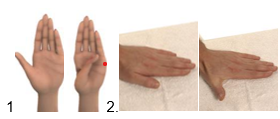
Exercises to complete are as follows:
kind permission of Wibbi
Start with your hand and fingers straight and in line with your forearm.
Without moving your wrist do the following movement and reset your fingers to the starting position between each:
- flex the two last knuckles of your fingers
- curl your fingers to form a fist (without the thumb)
- flex your metacarpophalangeal joint only to form an angle of 90 degrees between your fingers and your hand
- flex the fingers straight to form a 90 degree angle with the hand then flex between the first and second phalanx so the tip of your fingers come straight in the palm of the hand. Keep the second and third phalanx in a straight line.
Repeat 5 to 10 times every 2 or 3 hours
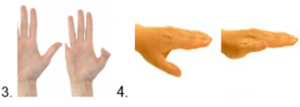
Kind permission of Wibbi
- Sitting up straight. Touch the base of each of your fingers with the tip of your thumb. Relax your hand.
- Bring your thumb up and back to straighten it as much as you can. Bring your thumb towards your index finger. Relax your thumb.
- Position your thumb away from your palm and bend and straighten only the joint at the thumb tip.
- Align your thumb with your index finger and then bring it straight up and away from your palm. Bend your thumb to bring the tip of it as close to the centre of your index finger as you can.
Repeat 5 to 10 times every 2 or 3 hours
When should I call for a Patient Initiated Follow Up (PIFU) appointment?
As discussed, it is normal to feel some discomfort as the wound heals and this can take several weeks. Changes in sensation is also normal and can take up to 6 months. However, you should contact for a PIFU appointment at any time:
- If you feel your pain or swelling is worsening
- If you feel your movement or function is worsening
Or 4 to 6 weeks post-surgery
- If you have pain that is persistent, and you rate this between 7 to 10 out of 10 with 0 being no pain and 10 being the maximum.
- If you have heightened sensation to light touch/course touch/vibration or deep pressure that is not the same as the unaffected side
- If you have not regained full range of movement of the affected finger and this is impacting on your ability to complete everyday activities.
Details of how to book a PIFU appointment can be found in the PIFU leaflet which you will have received alongside this leaflet. If we do not hear from you 3 months following your surgery date, we will assume that you no longer require any further intervention and will be discharged from the PIFU pathway. If you have further problems with your hand after this date, please contact your GP practice
Should you require further advice on the information contained in this leaflet, please contact the Physiotherapy Department on telephone: 01482 674880.
Information about you
We collect and use your information to provide you with care and treatment. As part of your care, your information will be shared between members of the healthcare team, some of whom you may not meet. Your information may also be used to help train staff, to check the quality of our care, to manage and plan the health service and to help with research. Wherever possible we use anonymous data.
We may pass on relevant information to other health or social organisations that provide you with care. All information is treated as strictly confidential and is not given to anyone who does not need it. If you have any concerns please ask your doctor, or the person caring for you.
Under the General Data Protection Regulation and the Data Protection Act 2018 we are responsible for maintaining the confidentiality of any information we hold about you. For further information visit the following page: Confidential Information about You. www.hey.nhs.uk/privacy/data-protection
If you or your carer needs information about your health and wellbeing and about your care and treatment in a different format, such as large print, braille or audio, due to disability, impairment or sensory loss, please advise a member of staff and this can be arranged.
Should you require further advice on the issues contained in this leaflet, please do not hesitate to contact the Hand Therapy, Castle Hill Hospital on tel: 01482 622296.
General Advice and Consent
Most of your questions should have been answered by this leaflet, but remember that this is only a starting point for discussion with the healthcare team.
Consent to treatment
Before any doctor, nurse or therapist examines or treats you, they must seek your consent or permission. In order to make a decision, you need to have information from health professionals about the treatment or investigation which is being offered to you. You should always ask them more questions if you do not understand or if you want more information.
The information you receive should be about your condition, the alternatives available to you, and whether it carries risks as well as the benefits. What is important is that your consent is genuine or valid. That means:
- you must be able to give your consent
- you must be given enough information to enable you to make a decision
- you must be acting under your own free will and not under the strong influence of another person
Information about you
We collect and use your information to provide you with care and treatment. As part of your care, information about you will be shared between members of a healthcare team, some of whom you may not meet. Your information may also be used to help train staff, to check the quality of our care, to manage and plan the health service, and to help with research. Wherever possible we use anonymous data.
We may pass on relevant information to other health organisations that provide you with care. All information is treated as strictly confidential and is not given to anyone who does not need it. If you have any concerns please ask your doctor, or the person caring for you.
Under the General Data Protection Regulation and the Data Protection Act 2018 we are responsible for maintaining the confidentiality of any information we hold about you. For further information visit the following page: Confidential Information about You.
If you or your carer needs information about your health and wellbeing and about your care and treatment in a different format, such as large print, braille or audio, due to disability, impairment or sensory loss, please advise a member of staff and this can be arranged.