
- Reference Number: HEY1607/2026
- Departments: Speech and Language
- Last Updated: 31 January 2026
Introduction
This leaflet has been produced to give you general information about swallowing problems. Most of your questions should be answered by this leaflet. It is not intended to replace the discussion between you and your Speech and Language Therapist (SLT) but may act as a starting point for discussion. If after reading this you have any concerns or require further explanation, please discuss this with your SLT.
What is EMST
EMST is a rehabilitation approach which uses a device to exercise and increase the maximal pressure of the expiratory muscles. These muscles are important for breathing out forcefully, coughing, and swallowing. The muscles are exercised by blowing into the device until you generate enough pressure to open the spring-loaded valve (described below).
Why have I been advised to perform EMST?
A speech and language therapist (SLT) has assessed your swallowing and identified that you may benefit from EMST to make your swallowing easier, safer or more efficient.
When you swallow, the voice box (larynx) needs to move upwards to protect your airway and reduce the risk of food or drink ‘going down the wrong way’. If your airway is not fully protected when you swallow, it could put you at risk of ‘aspiration’ (food or drink entering the airway and possibly entering your lungs).
The movement of the larynx is important in helping to open the entrance to your oesophagus (food pipe). This allows food and drink to enter your stomach and reduce the risk of food and drink remaining in your throat (pharynx) after swallowing.
A high pressure needs to be generated when swallowing to ensure all the food and drink is cleared through your throat and does not fall into your airway.
Cough strength is also important in protecting your airway. If any food or drink does enter the airway a strong cough will help to clear it back out and help stop it reaching your lungs.
Benefits of EMST
EMST protects your airway during swallowing by focusing on improving:
- cough strength, which helps clear any food and drink from the airway
- the movement and strength of your swallowing muscles to help clear food and drink through the throat
- the upwards lift of the larynx during swallowing
Reduced airway protection increases the risk of aspiration. EMST aims to try and reduce this risk.
How to use the EMST Device
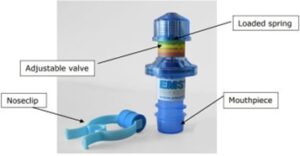
EMST device
To begin
- Turn the knob (adjustable valve) of the EMST 150 all the way to the left (counter-clockwise).
- Remove the cap from the mouthpiece and insert the mouthpiece in the EMST 150.
- Put on the nose clip.
- Take a deep breath in and insert the mouthpiece of the EMST device behind your teeth forming a tight seal (use your free hand to secure your lips around the device if needed).
- Breathe out hard and fast so air rushes through the device.
- If air went through, turn the knob one full turn to the right and repeat step five.
- Continue to increase the pressure by one full turn until you can’t blow any more air through.
- Turn the knob back one quarter turn to the left; this is your maximum expiratory pressure and where you will begin training.
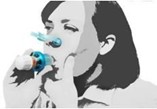
Training to use a EMST device
While training
- Set aside 20 to 30 minutes each day.
- Sit or stand during your session (sitting is recommended).
- Place the nose clip on your nose.
- Take a deep breath in, hold it, and place the mouthpiece in your mouth forming a tight seal.
- Breathe out hard and fast.
- Rest for at least 15 to 20 seconds.
- Repeat this exercise five times, then take a one-minute break, this completes one set.
- Complete five breath sets for a total of 25 training breaths.
- Aim to complete breath training sessions five days a week.
At the end of each week, turn the knob to the right by a quarter turn. After five weeks, you can switch to a maintenance programme of training three days a week using the final knob setting achieved in week five.
If you feel lightheaded, stop your breath training session.
How long do I use the device for?
The SLT will provide guidance on how long you should continue with these exercises. Usually, they will recommend you use the device for five weeks; five repetitions (‘reps’), five sets per day, five days per week.
At this stage, the SLT may reassess you’re swallowing to see if the device has helped. Some people may need to use the device for longer periods; you will be advised on this depending on how effective it has been for you.
Make sure you continue with any other rehabilitation exercises the SLT may have set for you (in addition to the EMST) unless advised otherwise.
The SLT will advise on a maintenance programme if this is indicated. This is usually five reps, five sets per day, three days per week.
How to clean the device?
We recommend the trainer be cleaned monthly. The mouthpiece should be removed before cleaning. The mouthpiece is the only removable part of the trainer; to remove it, pull gently until loosened.
Use washing up liquid and warm water to rinse the trainer. Air dry before re-using.
Do not use harmful cleaning agents such as bleach, and do not share your EMST 150 trainer with anyone else.
RISKS
You may feel lightheaded during your EMST sessions. If this happens, sit or lie down until the dizziness passes, then get up slowly and carefully. When able, report this to your SLT who may be able to adjust the programme for you.
Should you require any further advice on the issues contained in this leaflet, please contact the Speech and Language Therapy Department on telephone number: Tel: 01482 626700 or Tel: 01482 875875 ext. 23155
* With kind thanks to the Speech and Language Therapy Department, Cambridge University Teaching Hospitals NHS Trust, for allowing us to base the contents of this leaflet on one that they have produced.
General Advice and Consent
Most of your questions should have been answered by this leaflet, but remember that this is only a starting point for discussion with the healthcare team.
Consent to treatment
Before any doctor, nurse or therapist examines or treats you, they must seek your consent or permission. In order to make a decision, you need to have information from health professionals about the treatment or investigation which is being offered to you. You should always ask them more questions if you do not understand or if you want more information.
The information you receive should be about your condition, the alternatives available to you, and whether it carries risks as well as the benefits. What is important is that your consent is genuine or valid. That means:
- you must be able to give your consent
- you must be given enough information to enable you to make a decision
- you must be acting under your own free will and not under the strong influence of another person
Information about you
We collect and use your information to provide you with care and treatment. As part of your care, information about you will be shared between members of a healthcare team, some of whom you may not meet. Your information may also be used to help train staff, to check the quality of our care, to manage and plan the health service, and to help with research. Wherever possible we use anonymous data.
We may pass on relevant information to other health organisations that provide you with care. All information is treated as strictly confidential and is not given to anyone who does not need it. If you have any concerns please ask your doctor, or the person caring for you.
Under the General Data Protection Regulation and the Data Protection Act 2018 we are responsible for maintaining the confidentiality of any information we hold about you. For further information visit the following page: Confidential Information about You.
If you or your carer needs information about your health and wellbeing and about your care and treatment in a different format, such as large print, braille or audio, due to disability, impairment or sensory loss, please advise a member of staff and this can be arranged.