
- Reference Number: HEY1630/2026
- Departments: Emergency Department, Major Trauma
- Last Updated: 30 April 2026
Introduction
This leaflet has been produced to give you general information about your injury and to back up the advice given to you when you attended the emergency care department. If you have any further queries or concerns, please use the contact details at the end of this leaflet.
What is a Fracture of the Triquetrum?
The triquetral is one of the eight small carpal bones in the hand. A triquetral fracture is often caused by a fall onto an outstretched hand. Usually, a small flake of bone called an avulsion, is pulled away by the ligament the attaches to the bone.
How should it be treated?
This injury can be treated in a wrist splint for 3 weeks; this will provide the support needed for the fracture to heal and will help relieve any pain you may feel. After 3 weeks, it can be removed without requiring a further review.
To manage your pain, we advise that you regularly take simple pain relief, which can be bought over the counter. If you have allergies or conditions, which prevent the use of pain-relieving medication, please seek advice from your doctor or a pharmacist.
Smoking
It is important to note that smoking will delay the healing process and so should be avoided. Talk to your GP, go to Quit smoking – NHS or download the app for more information
What should I do in the first few days?
Complete rest is not advisable. Whilst in the splint, it is important that you try to use your hand normally when doing everyday tasks like dressing and eating. If you are careful and it is comfortable to do so, you can remove the splint to wash yourself. Once your hand is fully dried, reapply the splint as instructed.
Arm exercises are very important; you should move your shoulder, elbow and fingers regularly to prevent stiffness at these joints. The exercises below can be performed 4 times daily.
Support your elbow on a table with your wrist straight and fingers pointing towards the ceiling.
Bend your fingers into your palm as tightly as you can. Hold the stretch 10 seconds.
Now stretch your fingers as wide as you can. Hold the stretch for 10 seconds.

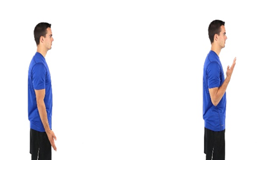
Straighten the arm down by your side.
Now bend the elbow as much as possible.
Repeat 10 times slowly in each direction
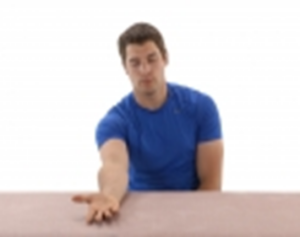
Bend your elbow and tuck it into your side
Turn your palm as far as possible upwards without moving your elbow. Feel the stretch and hold for 10 seconds.
Now turn your hand back over so your palm faces downwards, feel the stretch and hold for 10 seconds.
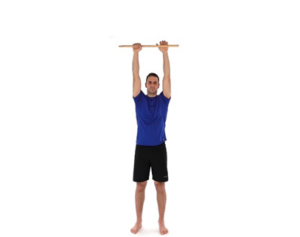
Shoulder flexion
Hold a long stick in both your hands.
Allow your unaffected arm to help your affected arm lift forward and upward as high as possible.
In the early stages, you may find this easier laid down.
If you continue to have swelling in your wrist or hand, you can reduce this by sitting on a chair and placing your elbow on cushions so that it is level or slightly higher than your shoulder. In this position, point your hand towards the ceiling, open and close your fingers slowly for 10 minutes (like in exercise 1 above).
When can I start driving again?
You will not be insured to drive whilst you are in wearing a splint. It is always good to check with your insurance company however we advise it should be safe to return to driving when:
- You are no longer wearing the cast or splint
- You can comfortably grip the steering wheel, move the gear stick, pull up the hand brake and activate the indicators.
- You can perform an emergency stop
What exercises can I do once the splint has been removed?
Rest your forearm on a table with your hand over the edge. Using your wrist only, move your hand down towards the floor.
Hold the stretch for 10 seconds.
Now move your hand towards the ceiling. Repeat 10 times each direction
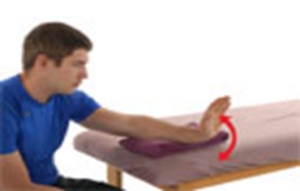
Sit with your elbow tucked in by your side and your thumb upper most. Now keeping your thumb upper most move your fingers down towards the floor. Hold 10 seconds.
Next move your fingers back up towards the ceiling. Hold 10 seconds.
Movement should occur at the wrist only
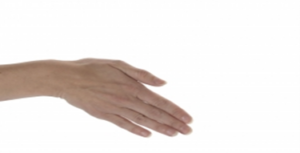
Bend your elbow and tuck it into your side.
Turn your palm as far as possible upwards without moving your elbow. Feel the stretch and hold for 10 seconds.
Now turn your hand back over so your palm faces downwards, feel the stretch and hold for 10 seconds.
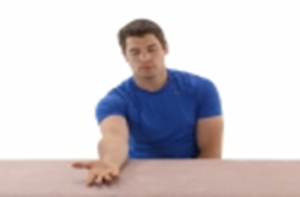
Support your elbow on a table with your wrist straight and fingers pointing towards the ceiling.
Bend your fingers into your palm as tightly as you can. Hold the stretch 10 seconds.
Now stretch your fingers as wide as you can. Hold the stretch for 10 seconds.
This exercise you will have practised whilst in the splint, but it is important to do out of the splint as you may now gain further movement.

All photos with kind permission of ©Physiotec™
Exercises should be practiced 10 times, 3 to 4 times per day. Initially you will be stretching the muscles around the wrist that have become stiff whilst you have been in a splint. As a result, you may experience more discomfort when you start the exercises, however this is normal and does not mean you should stop. If your symptoms remain worse for more than two hours after the exercises, then you should decrease the number of each exercise that you do and build up again slowly.
After the splint has been removed when should I start increasing my activity?
Repetitive wrist and hand movements and lifting objects heavier than a cup of water should be avoided to begin with. However, as your movement improves and pain reduces, little by little you can increase the amount of weight that you are able to lift. Progressing quickly from lifting a cup of water to a heavy shopping bag for example would not be advisable, as is likely to result in overloading of the soft tissue and could consequently delay your recovery.
If you participate in an active hobby, then it is advisable that you do not return to this until you have full strength and full range of movement.
If you play a sport, you can practice sports specific activities; like throwing or catching. Build up these exercises gradually from around 6 weeks, to help regain strength and flexibility, before returning to full training sessions and competition.
Do I require a follow up?
Does my child require Physiotherapy?
Most of the time, a referral to Physiotherapy is not needed and the advice in this leaflet is enough to help them recover.
However, if you have any concerns, are unable to follow the advice in this leaflet, or if they still have reduced movement, strength or function after 6 weeks, East Riding GP patients can contact the East Riding MSK Physiotherapy service on Tel: 01377 208300 or complete a self-referral form on https://www.chcpmsk.org.uk/self-referral-form-introduction.
Patients with a Hull GP should contact Cora Health on Tel: 01482 300003.
However, it is important you seek urgent medical attention for your child if they experience any of the following
- Severe pain, despite taking pain killers, that is worsening rather than improving
- Significant swelling that continues to increase despite elevation
- Numbness, tingling or unexpected weakness in hand or affected arm.
- The arm becomes cold, pale or blue
- Signs of infection such as fever or increasing redness and warmth
If you are concerned regarding any of your child’s symptoms, please attend your local Urgent Treatment Centre or call NHS111 who will direct you to the most appropriate place and may give you a specific appointment time.
Your feedback matters to us…
To ensure we deliver a safe and quality service and to help us understand the experience you have of the care you receive from our staff we would value your thoughts about the service you received.
You may be contacted as part of our quality assurance programme which is where we visit our teams and staff and talk to them about the care they provide to our patients or at any time during or after you have needed our services.
To collect this feedback, we would contact you using the registered telephone number we hold in your care record. This feedback will be strictly anonymous and whilst we will share the feedback as part of the process, we will not share any details which may identify you.
We will never ask you any personal questions about your health during these telephone calls. If you do not wish to speak to us, please say this when we call, we do not want you to feel pressured.
General Advice and Consent
Most of your questions should have been answered by this leaflet, but remember that this is only a starting point for discussion with the healthcare team.
Consent to treatment
Before any doctor, nurse or therapist examines or treats you, they must seek your consent or permission. In order to make a decision, you need to have information from health professionals about the treatment or investigation which is being offered to you. You should always ask them more questions if you do not understand or if you want more information.
The information you receive should be about your condition, the alternatives available to you, and whether it carries risks as well as the benefits. What is important is that your consent is genuine or valid. That means:
- you must be able to give your consent
- you must be given enough information to enable you to make a decision
- you must be acting under your own free will and not under the strong influence of another person
Information about you
We collect and use your information to provide you with care and treatment. As part of your care, information about you will be shared between members of a healthcare team, some of whom you may not meet. Your information may also be used to help train staff, to check the quality of our care, to manage and plan the health service, and to help with research. Wherever possible we use anonymous data.
We may pass on relevant information to other health organisations that provide you with care. All information is treated as strictly confidential and is not given to anyone who does not need it. If you have any concerns please ask your doctor, or the person caring for you.
Under the General Data Protection Regulation and the Data Protection Act 2018 we are responsible for maintaining the confidentiality of any information we hold about you. For further information visit the following page: Confidential Information about You.
If you or your carer needs information about your health and wellbeing and about your care and treatment in a different format, such as large print, braille or audio, due to disability, impairment or sensory loss, please advise a member of staff and this can be arranged.