
- Reference Number: HEY1693/2026
- Departments: Dietetics, Nutrition Support
- Last Updated: 31 October 2026
Introduction
You have been given this diet sheet because the dietitian and/or your doctor suspects you may be suffering from a collection of symptoms known as dumping syndrome. Additionally, you may have had a procedure which increases your chances of developing dumping syndrome. These are listed below.
The aim of this diet sheet is to:
- Describe the causes and symptoms of dumping syndrome
- To provide you with an awareness of dumping syndrome
- Give practical ideas on how you can change dietary habits to reduce your risk of experiencing dumping syndrome
- Give practical ideas on food you can introduce to help reduce your risk of experiencing dumping syndrome
What is dumping syndrome?
Dumping syndrome is a set of symptoms that can occur after eating carbohydrate rich foods. It is more likely to happen if you have had surgery to your oesophagus (food pipe) and or stomach. These surgeries may include:
- total gastrectomy
- partial gastrectomy
- oesophagogastrectomy
- roux-en-y gastric bypass or sleeve gastrectomy – please talk to your dietitian if you have had this procedure
- oesophagectomy
After some surgeries to the stomach or food pipe, the valve that controls the movement of food from the stomach into the small intestine can be bypassed or removed meaning that food can move much more quickly from the stomach to the small intestine. As a result, you may experience dumping syndrome.
There are two types of dumping syndrome
| Early Dumping | Late Dumping |
| This can happen within 30 minutes of eating. The symptoms can last about one hour. | This can happen 1 to 3 hours after eating and symptoms are related to a rapid change in blood sugars from high to low. |
| Symptoms include | Symptoms include |
| Stomach cramps | Sweating |
| Diarrhoea | Shakiness |
| Sweating | Confusion |
| Palpitations | Hunger |
| Bloating | Feeling faint |
| Loud stomach sounds | Tiredness |
| Nausea and vomiting |
What’s happening in my stomach and intestine during dumping syndrome?
Carbohydrates are broken down to sugar (glucose) during digestion. If this sugar moves too quickly from your stomach to your intestines it will absorb water from the surrounding tissues. The amount of water absorbed can be up to 1.5 litres (3 pints). This movement of water from the tissues can cause your blood pressure to drop causing a feeling of faintness. Water moving from the tissues to the intestines can cause loud stomach sounds, bloating, cramps and diarrhoea.
The large amounts of glucose from food can be absorbed very quickly into the blood stream. This can trigger the release of the hormone insulin (the role of insulin is to move the glucose from the blood to the tissue and cells where it is uses as energy). In response to large volumes of glucose the body can produce a lot of insulin causing blood glucose levels to fall low very quickly. If this happens you can feel tired, hungry, sweaty, shaky and faint.
Will I always get dumping syndrome?
Dumping will be most noticeable soon after your operation and will be made worse by larger meals. As time passes, the symptoms may become less.
How do I cope with the symptoms of dumping syndrome?
Unfortunately, there is not an immediate ‘quick fix’ for the symptoms of dumping syndrome whilst it is happening. Symptoms will pass after approximately 30 minutes to 3 hours. The best course of action is to try and reduce your risks of experiencing dumping syndrome in the first place.
Can any food help reduce my chances of getting dumping syndrome?
Yes. Certain foods can help reduce the risk of you experiencing dumping syndrome
- Choose complex carbohydrates, such as whole grain rice and pasta, seeded breads, potatoes with skins, beans, pulses and lentils
- Avoid refined carbohydrates, such as white bread, pitta and wraps, white pasta, peeled potato, white rice and sugary breakfast cereals
- Eat starchy carbohydrates with protein rich foods as this will slow the rate of digestion. Protein rich foods include meat, fish, beans, pulses, lentils, meat substitutes and dairy products (cheese, milk, yogurts)
- Limit high fat and fried foods
- Use sweetener in hot drinks rather than sugar
A fibre supplement may be helpful. Your dietitian or doctor can discuss this with you. They will be able to advise on how to introduce these supplements and which dose to aim for.
How do I avoid dumping syndrome?
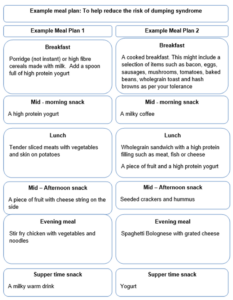
- Eat small and frequent meals – avoid having 3 large meals a day, have smaller portions with snacks in between. The following page has a suggested meal plan which you might find helpful
- Only drink between meals – avoid drinking 30 minutes before and after a meal
- Avoid temperature extremes (food being too hot or very cold)
- Chew food well and eat slowly, take time to relax after a meal
- If you are underweight seek advice from a dietitian regarding your dietary intake
- Some people find high sugar foods such as syrup, sweets and non-diet fizzy drinks cause symptoms so you may want to reduce or avoid high sugar foods
What if I feel that I am doing everything right but still experiencing the symptoms above?
Speak to your GP, specialist nurse, consultant surgeon or doctor to establish if there is an alternative cause for your symptoms.
What if I have questions about my diet when I am discharged home?
It is very normal for questions to arise about diet when you are at home as you will be exploring new food textures. You can contact the dietitian; the telephone numbers are listed below (the dietitians office hours are 8:00 am to 4:00 pm Monday to Friday). If your dietitian is away from the office, we ask that you leave a message and we will return your call. If it is urgent please contact your GP or NHS 111. In an emergency contact 999 or attend an A&E Department.
Before you are discharged from hospital your dietitian will discuss with you your options for ongoing dietetic follow up care when you are at home. Your dietitian will arrange this for you if required.
- Castle Hill Hospital Dietitians: Tel: 01482 461941
- Queens Oncology Centre Dietitians: Tel: 01482 461135
- Hull Royal Infirmary Dietitians: Tel: 01482 674490
If you have any additional dietary requirements, please discuss this with your dietitian who may be able to advise you.
Information about you
Hull University Teaching Hospitals NHS Trust collects, stores and uses large amounts of personal data every day, such as medical records, personal records and computerised information. This data is used by many people in the course of their work. We take our duty to protect your personal information and confidentiality very seriously and we are committed to taking all reasonable measures to ensure the confidentiality and security of personal data for which we are responsible, whether computerised or on paper. For further information and to view the trusts privacy statement and policy regarding personal and confidential information please visit www.hey.nhs.uk
General Advice and Consent
Most of your questions should have been answered by this leaflet, but remember that this is only a starting point for discussion with the healthcare team.
Consent to treatment
Before any doctor, nurse or therapist examines or treats you, they must seek your consent or permission. In order to make a decision, you need to have information from health professionals about the treatment or investigation which is being offered to you. You should always ask them more questions if you do not understand or if you want more information.
The information you receive should be about your condition, the alternatives available to you, and whether it carries risks as well as the benefits. What is important is that your consent is genuine or valid. That means:
- you must be able to give your consent
- you must be given enough information to enable you to make a decision
- you must be acting under your own free will and not under the strong influence of another person
Information about you
We collect and use your information to provide you with care and treatment. As part of your care, information about you will be shared between members of a healthcare team, some of whom you may not meet. Your information may also be used to help train staff, to check the quality of our care, to manage and plan the health service, and to help with research. Wherever possible we use anonymous data.
We may pass on relevant information to other health organisations that provide you with care. All information is treated as strictly confidential and is not given to anyone who does not need it. If you have any concerns please ask your doctor, or the person caring for you.
Under the General Data Protection Regulation and the Data Protection Act 2018 we are responsible for maintaining the confidentiality of any information we hold about you. For further information visit the following page: Confidential Information about You.
If you or your carer needs information about your health and wellbeing and about your care and treatment in a different format, such as large print, braille or audio, due to disability, impairment or sensory loss, please advise a member of staff and this can be arranged.