
- Reference Number: HEY1092/2026
- Departments: Emergency Department, Paediatrics
- Last Updated: 28 February 2026
Introduction
This leaflet has been produced to give you general information about your child’s condition. This leaflet should answer most of your questions. It is not intended to replace discussion with you and your child’s doctor but may act as a guide. If after reading it you have any concerns or require further explanation, please discuss this with a member of the healthcare team caring for your child.
What is Constipation?
Constipation means opening bowels less than 3 times a week, or having hard, dry poo (stools) that may be large or come out as tiny pellets. Constipation is common and can be more likely to occur at specific times of change such as when introducing formula milk, weaning to semi-solids, toilet training and starting school. Constipation should be picked up early and treated promptly.
Treatment
It can be easily treated with laxatives (using age-related doses), alongside other measures such as:
– Increasing fluid intake – Increasing dietary fibre intake
– Reward systems – Scheduled toileting to establish patterns
Impaction
Impaction is very bad constipation where poo builds up and can become immobile in the intestines. The child may pass very small stools every few days or have very infrequent bowel movements. They may also have overflow diarrhoea, which is when watery poo ‘leaks’ around harder poo, sometimes causing soiling.
Disimpaction Regime
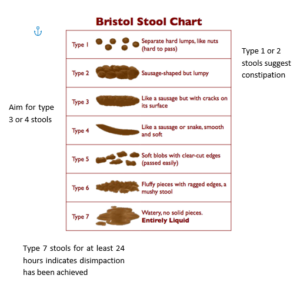
The aim of disimpaction is to clear the bowel of the hard, immobile poo. This can take 7 to 14 days of disimpaction treatment. We know disimpaction has happened when your child has stools which are loose and watery for at least 24 hours (type 7 on the Bristol Stool Chat – see over page).
The laxative of choice in children is Macrogol 3350 + electrolytes, which includes the brand names Movicol or Laxido. It works by retaining water in the bowels, which softens the stool. A disimpaction regime involves giving gradually increasing doses until all the poo has become liquid and comes out as diarrhoea. It is then necessary to continue on a smaller dose for 3 to 6 months to allow the bowels to recover and to prevent constipation returning.
Disimpaction is treated with the number of paediatric Movicol sachets as follows:
| Day 1 | Day 2 | Day 3 | Day 4 | Day 5 | Day 6 | Day 7 | |
| Child under 1 | ½ to 1 | ½ to 1 | ½ to 1 | ½ to 1 | ½ to 1 | ½ to 1 | ½ to 1 |
| Child 1 to 5 years | 2 | 4 | 4 | 6 | 6 | 8 | 8 |
| Child 5 to 12 years | 4 | 6 | 8 | 10 | 12 | 12 | 12 |
Children over 12 years should be treated with the adult preparation – the laxative is exactly the same but there is twice as much in the sachet:
| Day 1 | Day 2 | Day 3 | Day 4 | Day 5 | Day 6 | Day 7 | |
| Child over 12 | 4 | 6 | 8 | 8 | 8 | 8 | 8 |
If disimpaction takes longer than 14 days make an appointment to see your child’s GP as they may add in a ‘stimulant’. Stimulant laxatives increase the muscular squeezing of the bowel, speeding up bowel emptying. Due to the way they work they may also cause abdominal cramps. Stimulant laxatives include Senna, Sodium Picosulphate or Bisacodyl.
Maintenance
Once disimpaction is achieved (24 hours of loose, watery stool), reduce the number of sachets to a ‘maintenance’ dose. This will be half the disimpaction dose, up to a maximum of 4 paediatric sachets daily.
| Maintenance Dose | |
| Child aged less than a year | ½ to 1 sachet / day |
| Child aged 1 to 5 years | ½ to 3 sachets / day |
| Child aged 5 to 12 years | 1 to 4 sachets / day |
| Child aged over 12 years | 1 to 2 adult sachets / day |
The aim is for regular soft but formed stools (type 3 or 4). Your child may need to stay on laxatives for many months or even years. Long-term use will not hurt your child, but poorly controlled constipation will.
If you require additional information, please contact your child’s doctor or call the Emergency Department on Tel: 01482 482108
If you need information in a different format, such as large print, braille, or audio, please advise a member of staff and this can be arranged.
General Advice and Consent
Most of your questions should have been answered by this leaflet, but remember that this is only a starting point for discussion with the healthcare team.
Consent to treatment
Before any doctor, nurse or therapist examines or treats your child, they must seek your consent or permission. In order to make a decision, you need to have information from health professionals about the treatment or investigation which is being offered to your child. You should always ask them more questions if you do not understand or if you want more information.
The information you receive should be about your child’s condition, the alternatives available for your child, and whether it carries risks as well as the benefits. What is important is that your consent is genuine or valid. That means:
- you must be able to give your consent
- you must be given enough information to enable you to make a decision
- you must be acting under your own free will and not under the strong influence of another person
Information about your child
We collect and use your child’s information to provide your child with care and treatment. As part of your child’s care, information about your child will be shared between members of a healthcare team, some of whom you may not meet. Your child’s information may also be used to help train staff, to check the quality of our care, to manage and plan the health service, and to help with research. Wherever possible we use anonymous data.
We may pass on relevant information to other health organisations that provide your child with care. All information is treated as strictly confidential and is not given to anyone who does not need it. If you have any concerns please ask your child’s doctor, or the person caring for your child.
Under the General Data Protection Regulation and the Data Protection Act 2018 we are responsible for maintaining the confidentiality of any information we hold about your child. For further information visit the following page: Confidential Information about You.
If you need information about your child’s (or a child you care for) health and wellbeing and their care and treatment in a different format, such as large print, braille or audio, due to disability, impairment or sensory loss, please advise a member of staff and this can be arranged.