
- Reference Number: HEY132/2025
- Departments: Ophthalmology Department
- Last Updated: 30 September 2025
Introduction
This leaflet has been produced to give you general information about Choroidal Naevi.
Most of your questions should be answered by this leaflet. It is not intended to replace the discussion between you and the healthcare team but may act as a starting point for discussion. If after reading it you have any concerns or require further explanation, please discuss this with a member of the healthcare team.
What is a Choroidal Naevus?
A Choroidal naevus is a darkly coloured (pigmented) patch which can be seen at the back of your eye. It is like a mole or freckle on the skin. Often, they are identified during a routine eye examination. They usually cause no symptoms.
They are like skin naevi (moles) that are present in other parts of the body and are probably present at birth, growing mainly in childhood and rarely beyond puberty. Just like in the skin, the eyes contain cells which produce pigment, and these cells can cause these “moles” to develop inside the eye. The choroidal Naevi are present in about 6 in 100 of the general population.
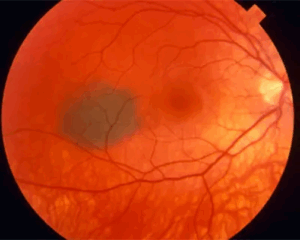
Image 1: Picture of the back of a right eye, with choroidal naevus (dark patch). ¹
Does it need to be monitored?
Most choroidal naevi are harmless (common mole) and remain the same over time.
Your doctor will check for specific features that can make the naevus higher risk, such as a large size, thickness, whether there is fluid accumulating nearby or any unusual colour of the naevus. If you have a naevus with high-risk characteristics, you will be monitored at regular intervals in eye clinic with serial fundus photographs (photograph of retina). There are specific features of naevi which can be a warning sign of the possible development of early Choroidal Malignant Melanoma. The presence of these would require a further referral to a regional centre (Sheffield) for further assessment. This is a rare event.
Can a Choroidal Naevus be harmful?
Like moles on the skin, they can change and grow. In rare instances, they can become cancerous. When this happens, the most common type of cancer is choroidal melanoma. This is uncommon, but it is why monitoring is important.
What will happen during my visit in eye clinic?
You will have a photograph taken so we can keep a record of its size and location. We may need to make some measurements of the naevus using an OCT scan or sometimes using an ultrasound scan machine. It is helpful for future reference (if you move house/ change opticians) if we have a photograph of your naevus. If you have a choroidal Naevus with no risk features (common mole) we will be discharge you back to your optician who will be able to monitor your eye for changes. We advise that you visit an optician on a yearly basis. We do not need to follow you up in the Eye Clinic unless you have another eye problem.
Reference
- de Alba-Campomanes, A.G. (2024) Nevus (Eye Freckle), American Academy of Ophthalmology. Available at: https://www.aao.org/eye-health/diseases/what-is-nevus (Accessed: 31 August 2025).
- The Royal College of Ophthalmologists Feb 2025, The referral pathways for ocular tumours.
General Advice and Consent
Most of your questions should have been answered by this leaflet, but remember that this is only a starting point for discussion with the healthcare team.
Consent to treatment
Before any doctor, nurse or therapist examines or treats you, they must seek your consent or permission. In order to make a decision, you need to have information from health professionals about the treatment or investigation which is being offered to you. You should always ask them more questions if you do not understand or if you want more information.
The information you receive should be about your condition, the alternatives available to you, and whether it carries risks as well as the benefits. What is important is that your consent is genuine or valid. That means:
- you must be able to give your consent
- you must be given enough information to enable you to make a decision
- you must be acting under your own free will and not under the strong influence of another person
Information about you
We collect and use your information to provide you with care and treatment. As part of your care, information about you will be shared between members of a healthcare team, some of whom you may not meet. Your information may also be used to help train staff, to check the quality of our care, to manage and plan the health service, and to help with research. Wherever possible we use anonymous data.
We may pass on relevant information to other health organisations that provide you with care. All information is treated as strictly confidential and is not given to anyone who does not need it. If you have any concerns please ask your doctor, or the person caring for you.
Under the General Data Protection Regulation and the Data Protection Act 2018 we are responsible for maintaining the confidentiality of any information we hold about you. For further information visit the following page: Confidential Information about You.
If you or your carer needs information about your health and wellbeing and about your care and treatment in a different format, such as large print, braille or audio, due to disability, impairment or sensory loss, please advise a member of staff and this can be arranged.