
- Reference Number: HEY1621/2026
- Departments: Physiotherapy
- Last Updated: 28 February 2026
Common Beliefs
Some believe that coming to hospital means time on bed rest to get better. However, this applies to only a very small number of individuals such as after certain fractures/broken bones. You will be informed by a doctor if you require to stay on a bed rest.
For most, inactivity leads to DECONDITIONING or your body becoming weaker and less efficient. It can feel like ‘out of shape’, getting tired, out of breath easily, higher risks of falling, lacking motivation, feeling low and having trouble doing daily tasks like walking or climbing stairs.
In older adults, deconditioning can start just hours after entering the hospital. This means, prolonged inactivity can cause harm to your physical, mental health and wellbeing. Staying in bed for 10 days can age an older person’s muscles by 10 years.
It is however REVERSIBLE and can be AVOIDED by following some of steps in this leaflet.
Benefits of Being Active
There are plenty of ways you will benefit by staying active in hospital, they include:
- Able to be discharged from hospital sooner and cope at home easier – maintain your independence
- Improve your appetite, sleep and mood
- Reduce risk of sores, pain, muscle weakness and fatigue.
How to Prevent Deconditioning
The best way to fight deconditioning is to keep moving and stay active as much as possible even whilst recovering from an illness. Below are certain steps you can do to help yourself or your family member who is in hospital.
Keep the Normal Routine and Activity
Complete your normal daily activities such as:
- Get out of bed, get washed and dressed and change into own clothes.
- Have your meals sat in a chair or sat up in bed.
- Stay hydrated.
- Remain engaged: do puzzles, read or chat with others, ask questions about your plans if hospital – we are here to help and answer.
- Regularly walk around the ward/unit either with your ‘normal’ walking aid or as advised by the therapist (physiotherapist or occupational therapist). If you require an assistance, ask member of staff to support you.
- Complete exercises in this handout as able.
Information for Relatives and Families
How you can support your relative whilst they are in hospital:
Encourage Independence: Support them in getting out of bed and dressed in their own clothes.
Active Mealtimes: Encourage upright posture either in bed, edge of the bed or sat on the chair.
Eat and Drink: Encourage to eat and drink, unless advised by health care staff otherwise.
Keep Moving: Take short walks on the ward together or with staff support.
Stay Strong: Remind them or join in with exercises in this leaflet.
If you have any questions or require any support, please ask member of staff.
Movements You Can Do
You may find these movements helpful to do whilst in hospital. These are NOT formal prescribed exercises. You do not need to complete all exercises at once, little and often is the best approach.
Please do not continue exercises if you experience pain or discomfort and let health care staff know straight away.
Bed Based Exercises
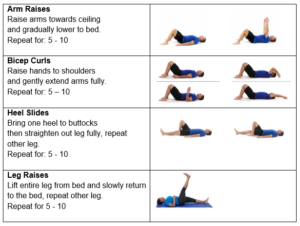
If you feel you can do more repetitions, then please do so!
Chair Based Exercises
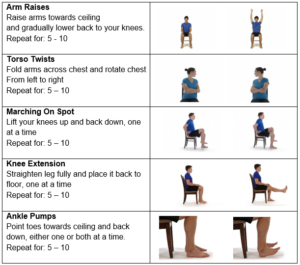
If you feel you can do more repetitions, then please do so!
Let’s Get You Home
Our priority is to get you ready to go home.
We will establish how you were moving and managing prior to coming to hospital. The healthcare team will start discussions about your discharge from hospital with you and your family straight away. This will help you, your relatives and family plan for a transition back home. We may identify and refer you to community services that will help support you at home. You will be at the centre of these conversations.
Contact details
If you or your family have any further questions about being active in the hospital, the team will be more than happy to answer these.
We are also always looking for ways to improve our services so if you have any feedback or suggestions.
We would be grateful for your comments on our friends and family feedback forms. Thank you for your support.
General Advice and Consent
Most of your questions should have been answered by this leaflet, but remember that this is only a starting point for discussion with the healthcare team.
Consent to treatment
Before any doctor, nurse or therapist examines or treats you, they must seek your consent or permission. In order to make a decision, you need to have information from health professionals about the treatment or investigation which is being offered to you. You should always ask them more questions if you do not understand or if you want more information.
The information you receive should be about your condition, the alternatives available to you, and whether it carries risks as well as the benefits. What is important is that your consent is genuine or valid. That means:
- you must be able to give your consent
- you must be given enough information to enable you to make a decision
- you must be acting under your own free will and not under the strong influence of another person
Information about you
We collect and use your information to provide you with care and treatment. As part of your care, information about you will be shared between members of a healthcare team, some of whom you may not meet. Your information may also be used to help train staff, to check the quality of our care, to manage and plan the health service, and to help with research. Wherever possible we use anonymous data.
We may pass on relevant information to other health organisations that provide you with care. All information is treated as strictly confidential and is not given to anyone who does not need it. If you have any concerns please ask your doctor, or the person caring for you.
Under the General Data Protection Regulation and the Data Protection Act 2018 we are responsible for maintaining the confidentiality of any information we hold about you. For further information visit the following page: Confidential Information about You.
If you or your carer needs information about your health and wellbeing and about your care and treatment in a different format, such as large print, braille or audio, due to disability, impairment or sensory loss, please advise a member of staff and this can be arranged.