
- Reference Number: HEY1275/2025
- Departments: Orthopaedics, Physiotherapy
- Last Updated: 30 June 2025
Introduction
This leaflet has been produced to give you general information about your injury. Most of your questions should be answered by this leaflet. If after reading it, you have any concerns or require further explanation, please do not hesitate to contact the physiotherapy team. Contact details are available at the end of this leaflet.
What is an Anterior Shoulder Dislocation?
The shoulder is a ball and socket joint, which can be injured during a dislocation. The ball of the shoulder joint is made up of your upper arm bone (humerus), and a socket attached onto the shoulder blade (scapula). A dislocation occurs when the ball of the joint excessively moves forward out of the socket.
Anterior shoulder dislocations mainly occur due to traumatic events, forcing the arm bone forward. It usually occurs when people fall with an arm out to the side or falling onto an outstretched hand. It takes approximately 6 weeks for the soft tissues to heal following this type of injury.
How should it be treated
During your attendance at the Emergency Department your shoulder will have been relocated (put back into joint). At your Virtual Fracture Clinic appointment an orthopaedic consultant will have viewed your x-rays and confirmed the shoulder is well reduced, meaning it is back in joint.
We suggest a sling should be worn for 1 week, including in bed at night, following the dislocation to allow the soft tissue structures around the shoulder to begin to heal and to help manage the pain. The sling can be removed for washing, dressing and performing your exercises.
If you find that pain is an issue we advise simple pain relief, which can be bought over the counter. If you have allergies or conditions, which prevent the use of pain-relieving or anti-inflammatory medication, please seek advice from your doctor or a pharmacist.
Additionally in the first 72 hours, using ice packs on the injured area may help with pain. It can be applied for 10 to 15 minutes every 2 to 3 hours. This will also help to reduce any swelling.
There are many ways in which ice can be applied however crushed ice, in the form of frozen peas for example, is the most effective. Whichever method you choose it is important that you wrap the ice in a damp towel, to prevent it from ‘burning’ the skin.
Remember however, you should:
- Only use an ice pack on areas that have normal skin sensation i.e. where you can feel hot and cold
- Not apply ice to an open wound
- Not apply an ice pack to an area that has poor circulation
- Check the skin every five minutes and stop using it if:
- the area becomes white, blue or blotchy
- the area becomes excessively painful, numb or tingles
What to avoid
It will take approximately 6 weeks for your soft tissues to heal. You should not lift your arm above shoulder height for the first 3 weeks and avoid any heavy lifting for 6 weeks.
To help prevent any further dislocations of your shoulder for the next 6 weeks, avoid taking your arm out to the side at the same time as rotating it backwards i.e. over arm throwing position or putting your hand behind your head.
Dressing
It is easier to use front button shirts and pull-up trousers with an elastic waistband in the first few weeks. When dressing put the injured arm into sleeves first and when undressing takes the un-injured arm out first, followed by the injured arm.
Armpit Hygiene
To wash under your arm. Gently take your arm out of the sling and straighten your arm. Now lean forwards slightly so that your arm hangs slightly away from your body. You should then be able to wash and apply deodorant.
Driving
You will not be insured to drive whilst you are wearing a sling. It is always good to check with your insurance company; however, we advise it should be safe to return to driving when:
- You are no longer using the sling
- You can comfortably grip the steering wheel, move the gear stick, pull up the hand brake and activate the indicators
Can I do any exercises to help?
The hand, wrist, elbow and neck can be moved gently through their full range as comfort allows from day one of your injury. This will prevent stiffness developing in these joints while your shoulder is in a sling. You can stop these once your sling is no longer required. Below is some guidance on the exercises you can do, all of them can be practised 4 to 5 times per day.
Finger flexion and extension: Whilst in your sling make a tight fist with your affected hand and now spread your fingers out as far as possible. Repeat 10 times
Wrist flexion and extension: Whilst remaining in your sling support your forearm with the unaffected arm. Using your wrist only, move your hand down towards the floor.
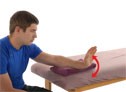
- Hold the stretch for 10 seconds
- Now move your hand towards the ceiling
- Repeat 10 times each direction
Elbow Flexion/Extension: Remove the arm from the sling and straighten it fully.


- Now bend the elbow as much as possible
- Repeat 10 times slowly in each direction
Neck Rotation

- Sit upright in a chair and turn your head and neck as far to left as possible
- Hold 5 seconds and return to start
- Now repeat to the right as far as possible. Hold 5 seconds to return to the start
- Repeat 10 times slowly in each direction
Neck Side Flexion

- Sit upright in a chair and drop your ear down to your left shoulder as far as possible without lifting the shoulder
- Hold 5 seconds and return to start
- Now repeat to the right as far as possible
- Hold 5 seconds to return to the start
- Repeat 10 times slowly in each direction
At 2 weeks and once your pain is under control, you can start regular pendular exercises. Do not feel you have to wean off analgesia too soon, as it is better to regain some movement first.
Pendular Exercises:
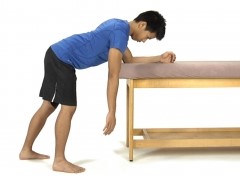
- Rest your unaffected arm on a table and let the affected arm hang down freely.
- Try to write each letter of the alphabet using this arm.
- Do not force the movement
All photos with kind permission of ©Physiotec™
Do not feel you have to wean off analgesia too soon, as it is better to regain some movement first.
Do I require a follow up?
Physiotherapy follow up
Physiotherapy rehabilitation should commence around 3 weeks after your injury. It is common for a shoulder dislocation to re-dislocate and therefore attending your arranged physiotherapy session is essential. Your shoulder will also be assessed to ensure there is no muscle damage or stiffness occurring. Physiotherapy will enable you to regain full range of movement and strength, stabilise the shoulder and return to full function.
A referral will have been sent to Physiotherapy for this on the day of your Virtual Fracture clinic appointment. If you have not received an appointment within one week after your fracture clinic phone call, please contact the physiotherapy department on tel: 01482 674880 between the hours 8.00am to 4.00pm Monday to Friday. If there is no answer, please leave a message and your call will be returned within the same working day.
When should I start increasing my activity?
Repetitive shoulder movements and lifting objects heavier than a glass of water should be avoided to begin with. However, from 3 weeks you can return to light activities, as your movement improves and pain reduces. Little by little you can increase the amount of weight that you are able to lift. Progressing quickly from lifting a glass of water to a heavy shopping bag for example would not be advisable, as is likely to result in overloading of the soft tissue and could consequently lead to further injury.
From 6 weeks you should be back to most of your normal activities but be guided by pain or discomfort as heavier or overhead activities may still be uncomfortable.
If you participate in an active hobby, then it is advisable that you do not return to this until you have full strength and full range of movement. Your physiotherapist will be able to advise you regarding this.
Who to contact if you require further support
Should you require further advice on the issues contained in this leaflet, please do not hesitate to contact the Physiotherapy Department on tel: 01482 674880.
Your feedback matters to us…
To ensure we deliver a safe and quality service and to help us understand the experience you have of the care you receive from our staff we would value your thoughts about the service you received.
You may be contacted as part of our quality assurance programme which is where we visit our teams and staff and talk to them about the care they provide to our patients or at any time during or after you have needed our services.
To collect this feedback, we would contact you using the registered telephone number we hold in your care record. This feedback will be strictly anonymous and whilst we will share the feedback as part of the process, we will not share any details which may identify you.
We will never ask you any personal questions about your health during these telephone calls.
If you do not wish to speak to us, please say this when we call, we do not want you to feel pressured.
General Advice and Consent
Most of your questions should have been answered by this leaflet, but remember that this is only a starting point for discussion with the healthcare team.
Consent to treatment
Before any doctor, nurse or therapist examines or treats you, they must seek your consent or permission. In order to make a decision, you need to have information from health professionals about the treatment or investigation which is being offered to you. You should always ask them more questions if you do not understand or if you want more information.
The information you receive should be about your condition, the alternatives available to you, and whether it carries risks as well as the benefits. What is important is that your consent is genuine or valid. That means:
- you must be able to give your consent
- you must be given enough information to enable you to make a decision
- you must be acting under your own free will and not under the strong influence of another person
Information about you
We collect and use your information to provide you with care and treatment. As part of your care, information about you will be shared between members of a healthcare team, some of whom you may not meet. Your information may also be used to help train staff, to check the quality of our care, to manage and plan the health service, and to help with research. Wherever possible we use anonymous data.
We may pass on relevant information to other health organisations that provide you with care. All information is treated as strictly confidential and is not given to anyone who does not need it. If you have any concerns please ask your doctor, or the person caring for you.
Under the General Data Protection Regulation and the Data Protection Act 2018 we are responsible for maintaining the confidentiality of any information we hold about you. For further information visit the following page: Confidential Information about You.
If you or your carer needs information about your health and wellbeing and about your care and treatment in a different format, such as large print, braille or audio, due to disability, impairment or sensory loss, please advise a member of staff and this can be arranged.