
- Reference Number: HEY1211/2026
- Departments: Emergency Department, Paediatrics
- Last Updated: 30 April 2026
Introduction
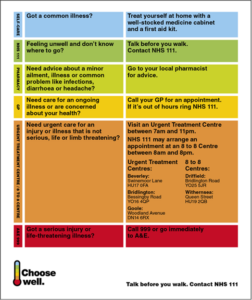
This leaflet aims to explain some of the alternative services that you may wish to consider instead of the Emergency Department. The Emergency Department is not the best place for many conditions, which are often better managed at other places and in other ways. The Emergency Department is, however, the best place for managing emergency illness and injury.
Telephone advice
NHS 111 is the best way to get advice over the telephone. The team are trained to use your symptoms to guide them and will give you the most appropriate advice and information to help you manage your condition. They may arrange for you to speak to a doctor or nurse, may advise that you visit a pharmacy or your doctor, a Walk-In Centre or Minor Injuries Unit or, if your problem is an emergency, they may direct you to the Emergency Department.
If you are not sure whether you need to come to the Emergency Department,
call 111.
Staff at the hospital, including the Emergency Department, are not trained in giving advice over the telephone, so will not be able to answer questions about your symptoms if you ring. We are also unable to give out waiting times – all patients are triaged on arrival to the department, so how long you wait depends on the injury or illness you have come with, as well as how busy we are.
In an emergency, call Tel: 999
Your doctor
Your doctor knows your medical history and is often best placed to manage a wide variety of illness, both long-term and new.
Urgent Treatment Centres
Block 51, Anlaby Road, Hull, HU3 2JZ
7 days a week, 7.00am to 11.00pm.
Beverley Urgent Treatment Centre
East Riding Community Hospital, Swinemoor Lane, Beverley, East Yorkshire, HU17 0FA
7 days a week, 365 days a year, 8.00am to 8.00pm. The last booking is 7.30pm.
The X-ray is open 8.00am to 8.00pm, 7 days a week. The last booking is 7.45pm.
The X-ray does not cover the following: hip X-rays, chest X-rays, facial X-rays, neck or back or pelvic X-rays.
Bransholme Urgent Treatment Centre
Goodhart Road, Bransholme, Hull, HU7 4DW
7 days a week, 365 days a year, 7.00am to 11.00pm. The last booking is 10.30pm.
X-Ray opening times: Monday to Friday: 8.00am to 5.00pm (Last arrival 16.45pm). Weekends and Bank Holidays: 10.00am to 6.00pm (Last arrival 5.45pm)
Bridlington Urgent Treatment Centre
Entrance A, Bridlington Hospital, Bessingby Road, Bridlington, YO16 4QP
7 days a week, 365 days a year, 8am to 8pm. The last booking is 7.30pm.
Due to Coronavirus X ray opening times have changed. Monday 9.00am to 6.00pm – Friday and Saturday / Sunday 10.00 to 2.00pm.
Goole and District Hospital, Woodland Avenue, Goole, DN14 6RX
7 days a week, 365 days a year, 8.00am to 8.00pm. The last booking is 7.30pm.
The X-ray is open 8.0am to 8.00pm, 7 days a week. The last booking is 7.45pm

GP Urgent Out of Hours
Provides urgent medical care between 6.30pm and 8.00am on weekdays and around the clock at all weekends and bank holidays.
This service is appointment only. You need to ring NHS 111 to access this service.
Pharmacy
Patients can now get treatment fir 7 common conditions directly from their local pharmacy without the need for a GP appointment or prescription.
The conditions pharmacists can manage are:
- Acute otitis media – 1 to 17yrs
- Impetigo – 1year and over
- Infected insect bite – 1year and over
- Shingles – 18years and over
- Sinusitis – 12years and over
- Sore throat – 5years and over
- Uncomplicated urinary tract infections – women 16 to 64years
You can get treatment by walking into the pharmacy or by referrals from GPs or NHS 111.
Appointment-based 8 to 8 centres
You cannot just walk-in to these centres, you will need to call 111 first, who will make you an appointment if this is appropriate.
Driffield 8 to 8 Centre
Alfred Bean Community Hospital, Bridlington Road, Driffield, East Riding of Yorkshire, YO25 5JR
Withernsea 8 to 8 Centre
Withernsea Hospital, Queen Street, Withernsea, HU19 2QB
Patients in Withernsea and the surrounding area can call your local doctor’s practice on Tel: 0333 332 4242 where you will hear an option to press 4 if you have a minor injury.
General Advice and Consent
Most of your questions should have been answered by this leaflet, but remember that this is only a starting point for discussion with the healthcare team.
Consent to treatment
Before any doctor, nurse or therapist examines or treats you, they must seek your consent or permission. In order to make a decision, you need to have information from health professionals about the treatment or investigation which is being offered to you. You should always ask them more questions if you do not understand or if you want more information.
The information you receive should be about your condition, the alternatives available to you, and whether it carries risks as well as the benefits. What is important is that your consent is genuine or valid. That means:
- you must be able to give your consent
- you must be given enough information to enable you to make a decision
- you must be acting under your own free will and not under the strong influence of another person
Information about you
We collect and use your information to provide you with care and treatment. As part of your care, information about you will be shared between members of a healthcare team, some of whom you may not meet. Your information may also be used to help train staff, to check the quality of our care, to manage and plan the health service, and to help with research. Wherever possible we use anonymous data.
We may pass on relevant information to other health organisations that provide you with care. All information is treated as strictly confidential and is not given to anyone who does not need it. If you have any concerns please ask your doctor, or the person caring for you.
Under the General Data Protection Regulation and the Data Protection Act 2018 we are responsible for maintaining the confidentiality of any information we hold about you. For further information visit the following page: Confidential Information about You.
If you or your carer needs information about your health and wellbeing and about your care and treatment in a different format, such as large print, braille or audio, due to disability, impairment or sensory loss, please advise a member of staff and this can be arranged.