
- Reference Number: HEY1638/2026
- Departments: Ophthalmology Department
- Last Updated: 30 April 2026
Introduction
This leaflet has been produced to give you general information about your procedure. Most of your questions should be answered by this leaflet. It is not intended to replace the discussion between you and your doctor but may act as a starting point for discussion. If after reading it you have any concerns or require further explanation, please discuss this with a member of the healthcare team caring for you.
What is Alcohol Delamination?
You have probably been troubled by some symptoms. Following discussion with your doctor they have advised an alcohol delamination operation. Alcohol delamination involves applying alcohol to loosen the epithelial (outer most) cells of the cornea, making them easier to remove. The procedure may be used to treat recurrent corneal erosions or surface irregularities/scarring
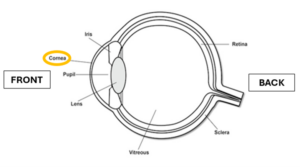
What is the Cornea?
The cornea is the clear dome shaped surface at the front of your eye. It helps focus light so you can see clearly. If it becomes scarred, swollen or losses its clarity, vision becomes blurry or distorted. It has 5 layers, alcohol delamination involved removing the outside most layer.
Why do I need Alcohol Delamination?
You may have persistent signs and symptoms such as blurred vision, severe pain or irritation and recurrent erosions.
Alcohol delamination procedure aims to:
- Reduce recurrence of corneal erosions
- Promote healing of the corneal surface
Alternative treatments include ongoing medical therapy, bandage contact lenses or laser therapy
Can there be any complications or risks?
CXL is generally a safe procedure. However, as with any surgical treatment, there are possible complications and risks that must be considered carefully:
- Infection
- Scarring
- Delayed healing of the corneal surface
- Recurrent erosions
- Reduced vision
How do I prepare for Alcohol Delamination?
Please read the information leaflet. Share the information it contains with your family (if you wish) so that they can be of help and support. There may be information they need to know, especially if they are taking care of you following this examination.
Explanation of do’s and don’ts before procedure. Continue you regular eye medication unless instructed otherwise and bring your glasses as normal if you require them
What will happen?
You will attend the eye hospital at your scheduled time, although there may be some waiting. On arrival, you will be seen by nursing staff in the Eye Unit who will guide you through the process. The procedure is usually performed under local anaesthetic using numbing eye drops, so you will remain awake but should not feel pain. At the end of the procedure, a bandage contact lens will be placed on the eye to aid healing and improve comfort. Pain relief is typically managed with the anaesthetic eye drops and over-the-counter painkillers afterwards.
What actually takes place during an Alcohol Delamination
- Alcohol is applied to your cornea
- Alcohol left for ~30 seconds to loosen the epithelium (outer layer of cornea)
- Epithelium is gently removed
- Bandage contact lens is inserted to protect and comfort the eye
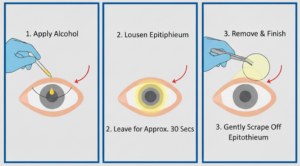
Procedure duration: ~15 to 30 minutes
What happens afterwards?
After surgery, your eye may feel sore, watery, and sensitive to light. Some discomfort is normal in the first few days, use pain relief as advised. A protective contact lens may be placed to help healing. The surface of the eye usually heals within 3 to 7 days, with vision improving over the following 1 to 2 weeks.
Use all prescribed eye drops as directed and do not stop without advice. Avoid rubbing your eye, and avoid swimming, eye makeup, and dusty environments for at least 2 weeks.
You will usually have a follow-up appointment 1 to 2 weeks after surgery, with further reviews if needed. Additional treatment will be discussed if required.
Possible Complications / When to seek help
Contact the Eye Unit immediately if you experience:
- Pain that doesn’t improve or worsens following the first 48 hours post op
- Sudden drop in vision
- Redness, swelling, or green/yellow discharge
- Eye injury
Emergency: attend Eye Casualty or nearest A&E if out-of-hours
Should you require further advice on the issues contained in this leaflet, please do not hesitate to contact the Ophthalmology Department Monday to Friday 08:30AM to 18:00PM on Tel: 01482 608788 / Tel: 01482 816658 or Tel: 01482 604385 if out of hours.
General Advice and Consent
Most of your questions should have been answered by this leaflet, but remember that this is only a starting point for discussion with the healthcare team.
Consent to treatment
Before any doctor, nurse or therapist examines or treats you, they must seek your consent or permission. In order to make a decision, you need to have information from health professionals about the treatment or investigation which is being offered to you. You should always ask them more questions if you do not understand or if you want more information.
The information you receive should be about your condition, the alternatives available to you, and whether it carries risks as well as the benefits. What is important is that your consent is genuine or valid. That means:
- you must be able to give your consent
- you must be given enough information to enable you to make a decision
- you must be acting under your own free will and not under the strong influence of another person
Information about you
We collect and use your information to provide you with care and treatment. As part of your care, information about you will be shared between members of a healthcare team, some of whom you may not meet. Your information may also be used to help train staff, to check the quality of our care, to manage and plan the health service, and to help with research. Wherever possible we use anonymous data.
We may pass on relevant information to other health organisations that provide you with care. All information is treated as strictly confidential and is not given to anyone who does not need it. If you have any concerns please ask your doctor, or the person caring for you.
Under the General Data Protection Regulation and the Data Protection Act 2018 we are responsible for maintaining the confidentiality of any information we hold about you. For further information visit the following page: Confidential Information about You.
If you or your carer needs information about your health and wellbeing and about your care and treatment in a different format, such as large print, braille or audio, due to disability, impairment or sensory loss, please advise a member of staff and this can be arranged.