
- Reference Number: HEY1502/2024
- Departments: Day Surgery (DSU), Paediatrics
- Last Updated: 30 November 2024
Introduction
This leaflet has been produced to give parents information and advice following an ACL/MPFL reconstruction. It is not intended to replace the discussion between you and your Child’s Doctor. If after reading it, you have any concerns or require further explanation, please discuss this with the relevant person who has been caring for your child.
Your Child’s Consultant is_______________________
Surgery Performed By__________________________
Should you need any further help or advice please telephone
Day Surgery Unit, CHH
Monday-Wednesday 8am to 18:00, Tel: 01482 624780
Acorn Ward, Women and Children’s Hospital, HRI,
Telephone: tel: 01482 382609 or tel: 01482 382679.
Or contact the Paediatric Community Team Telephone tel: 01482 344075
Should you require further advice on the issues contained in this leaflet, please do not hesitate to contact the Day Surgery Unit, Monday-Wednesday 08:00 to 18:00 on Tel: 01482 624794.
Follow Up
- The Community Paediatric Team has been contacted and will contact you to see if a wound check is needed.
- If an appointment is needed to be seen by the consultant/surgeon this will be arranged for you and sent to you in the post.
School/Nursery
- Your Child will need to be off school or nursery two weeks.
- If you feel that your child needs a little longer to recover, we are happy for you to use your personal judgement.
- Return to sport and exercise – This will depend on the specific details of your child’s operation and should be discussed with the consultant.
After the Surgery
- Occasionally stitches may be used, these are usually dissolvable and do not need removing. If they do need removing or trimming you will be informed at discharge.
- The bandage and padding can be removed after 48 hours but the small dressings/plasters must be kept in place until your clinic appointment. If the dressing/plasters become loose, please cover with a normal plaster.
- The dressings/plasters must be kept clean and dry.
- If your child has been given exercises by the surgeon, nurse or physiotherapist please encourage them to follow the exercises.
Swelling Control
Please read the information leaflet. Share the information it contains with your family (if you wish) so that they can be of help and support. There may be information they need to know, especially if they are taking care of you following this examination.
Explanation of do’s and don’ts before procedure. Include: whether the patient should be taking medication prior to procedure; eating and drinking prior to procedure; any other applicable advice, e.g. you will need to bring your nightwear and slippers.
To walk normally
- Providing your child is well enough, your child will be taught how to walk with crutches by a physiotherapist a few hours after your operation.
- Your child should use the crutches to help them walk normally. You will receive instructions about how much weight to bear through the knee by your surgeon.
- On some occasions, your child may require a knee brace. You will be informed about its adjustments and how long your child will require this for.
- Being on your feet with your knee below the level of your heart will cause the knee to swell.
- This swelling will reduce the movement at your knee and so slow your recovery and delay your rehabilitation.
- Therefore, we recommend that for the first week following your surgery, your child should elevate their leg at all times except when they are exercising or going to the bathroom.
Begin exercising
- Although your knee will be painful and stiff, it is important that you begin your exercises to regain your movement as soon as possible. The specifics of the exercise will be relayed to you by the physiotherapist. Each child will need a tailored programme depending on what limits have been placed by the surgeon to allow for healing.
- If movement is not regained in the early stages, scar tissue will build up around the graft preventing the knee from fully straightening.
- It is also very important that you perform only the exercises advised below.
- Overstressing the graft with inappropriate exercises will increase the risk of the surgery being unsuccessful.
- The exercises below should be performed during the day, every 2 hours, as soon as possible after your surgery.
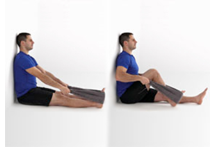
Sit down on your bed, stretch your legs straight out in front of you.
Wrap a scarf or towel around your heel so that you can pull both ends with your hands to help you as you bend your knee.
Then straighten the knee out and try to touch the back of the knee to the bed. Pull the scarf and lift the heel off the bed to assist this movement. Do not allow the knee to lift off. Repeat 10 times.
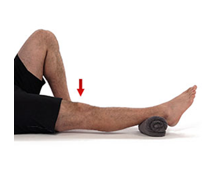
Place your ankle on a thick rolled up towel, so that your knee is as straight as possible.
Now tense your thigh muscle by pushing the back of the knee down towards the bed. Hold for 5 seconds and repeat 10 times.
Keep your ankle on the thick rolled up towel, lay down and allow your knee to sag fully straight. Applying ice while resting in this position may make it feel more comfortable.
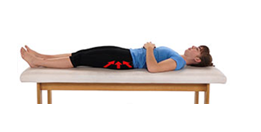
Lay flat on your bed. Squeeze your buttocks together tightly. Hold for 10 seconds and repeat 10 times.
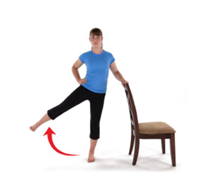
Stand and hold onto something stable. Lift your operated leg out to the side and hold for 5 seconds. Repeat 10 times.
Stand and hold onto something stable, spread your weight equally over both feet. Push up onto your toes and hold for 5 seconds
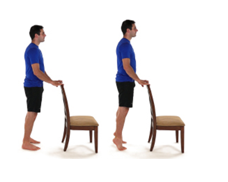
(All photos courtesy of Physiotec™)
It is common for your child to experience pain following their reconstruction, so ensure that their pain levels are adequately controlled by taking your medication regularly as prescribed. This will allow you to perform your exercises and walk as normally as possible.
Rehabilitation after the first week
On discharge from hospital a physiotherapy appointment will be arranged for your child, usually 7 to 10 days following surgery.
After your first physiotherapy appointment your physiotherapist will decide how often they would like to see your child. This may be more often at the beginning when they need more support and advice, but less often as they become more active and confident with their exercises.
Attendance at your child’s physiotherapy appointments is important to ensure that they are progressing through the programme that was agreed by your consultant, to achieve the best outcomes. If your child does not attend your appointment your consultant will be informed.
The role of the physiotherapist is to guide your child through what to do and what not to do, as well as monitor their progress. Physiotherapy is vitally important to ensure a successful outcome following your child’s ACL reconstruction; however, the main responsibility lies with your child. Your child will need to be highly motivated and committed to their physiotherapy both during their physiotherapy sessions and at home.
You should inform their physiotherapist of each consultant appointment so that they can give you a process report to take with you.
General Advice and Consent
Most of your questions should have been answered by this leaflet, but remember that this is only a starting point for discussion with the healthcare team.
Consent to treatment
Before any doctor, nurse or therapist examines or treats your child, they must seek your consent or permission. In order to make a decision, you need to have information from health professionals about the treatment or investigation which is being offered to your child. You should always ask them more questions if you do not understand or if you want more information.
The information you receive should be about your child’s condition, the alternatives available for your child, and whether it carries risks as well as the benefits. What is important is that your consent is genuine or valid. That means:
- you must be able to give your consent
- you must be given enough information to enable you to make a decision
- you must be acting under your own free will and not under the strong influence of another person
Information about your child
We collect and use your child’s information to provide your child with care and treatment. As part of your child’s care, information about your child will be shared between members of a healthcare team, some of whom you may not meet. Your child’s information may also be used to help train staff, to check the quality of our care, to manage and plan the health service, and to help with research. Wherever possible we use anonymous data.
We may pass on relevant information to other health organisations that provide your child with care. All information is treated as strictly confidential and is not given to anyone who does not need it. If you have any concerns please ask your child’s doctor, or the person caring for your child.
Under the General Data Protection Regulation and the Data Protection Act 2018 we are responsible for maintaining the confidentiality of any information we hold about your child. For further information visit the following page: Confidential Information about You.
If you need information about your child’s (or a child you care for) health and wellbeing and their care and treatment in a different format, such as large print, braille or audio, due to disability, impairment or sensory loss, please advise a member of staff and this can be arranged.