
- Reference Number: HEY1650/2026
- Departments: Radiotherapy
- Last Updated: 31 July 2026
Introduction
This leaflet has been produced to give you general information about Stereotactic Ablative Body Radiotherapy (SABR) to the Prostate. Most of your questions should be answered by this leaflet. It is not intended to replace the discussion between you and your doctor but may act as a starting point for discussion. If after reading it you have any concerns or require further explanation, please discuss this with a member of the healthcare team caring for you.
Where is the Prostate?
The prostate is a walnut sized gland found only in men that lies just below the base of the bladder, and in front of the rectum.
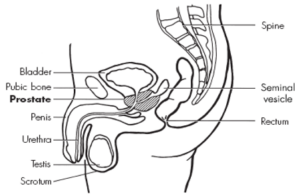
Figure 1. Sagittal cross section of pelvis. Image acquired from MacMillan Cancer Support
What is Stereotactic Radiotherapy?
Radiotherapy is the use of high energy X-rays (radiation) to treat cancer. It damages cancer cells (sometimes also called tumours) to stop them from growing or causes them to die. The purpose of radiotherapy is to destroy the cancer cells whilst causing as little damage as possible to normal cells.
Stereotactic Radiotherapy or SABR is an effective way of giving focused radiotherapy, increasing the chance of controlling the tumour whilst sparing normal tissue.
It does this by using:
- Fewer treatment session (5 sessions for Prostate Cancer)
- Smaller, more precise radiation fields.
- Higher doses of radiation.
SABR is different from conventional forms of prostate radiotherapy which usually involves either 20 or 37 treatment sessions but is just as effective with similar effects on your body.
Radiotherapy itself is painless. It does not make you radioactive. It is perfectly safe for you to be with other people, including children and pregnant women, during your treatment.
Preparation and Planning your treatment
Before starting your treatment, you will need to come for a Computed Tomography (CT) planning scan in the Radiotherapy department, and a planning Magnetic Resonance Imaging (MRI) which will be done in the Radiology department. These scans will both take place on the same day.
A member of the radiotherapy team will talk with you before any procedure is carried out to obtain your consent to continue with this process. Possible side effects of treatment and how they can be managed will also be discussed. Specialist machines called a CT scanner, and an MR scanner will be used to assist in planning your treatment, these machines take images in slices whilst you lie on a couch that moves through the opening of the machines, as shown in Figure 2 below.
Your Clinical Oncologist or Consultant Radiographer should have given you a prescription for micro enemas at your clinic appointment. We would ask that you administer one of these at home for 2 days before your CT planning scan, as well as 1 in the morning before you attend for your CT.
We would also ask that you have a comfortably full bladder for your planning scans, to do this we will provide you with a 500ml bottle of water that we would like you to finish roughly 30 minutes before your CT scan. Prior to your scan we will use a Bladder Ultrasound scanner to ensure your bladder is full enough.
It is important to have a comfortably full bladder and empty rectum during your planning and treatment, to protect these organs from high doses of radiation and reduce the chance of side-effects.
In the CT room, you will be helped into the correct position on the treatment couch, and although you be asked to loosen or remove any clothing covering your pelvis, we will ensure your genitalia are covered. In the MRI room you will be given a gown to change into.
You will not require tattoos for treatment, as we will be using Surface Guided Radiotherapy (SGRT) which uses motion cameras in the treatment room to know if you are in the correct position.
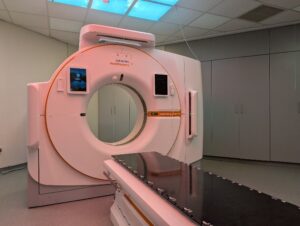
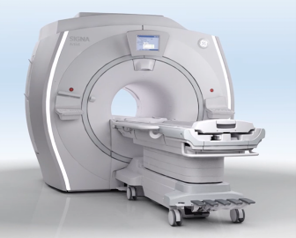
Figure 2. Image of the Siemens CT scanner (left) in the Radiotherapy Department, and the GE SIGMA Artist 1.5T MRI scanner (right) seen in Radiology. Images acquired directly from the Radiotherapy department and from GE Healthcare website.
After your CT planning scan has been completed you can empty your bladder to feel more comfortable. You will then be escorted round to the Radiology department for your MRI by one of the radiographers.
You may have already had a CT or MRI scan for diagnostic purposes; however, this scan is necessary to produce your individual treatment plan. The CT staff will confirm your treatment start date before you leave.
What will happen on the first day?
Please book in at the radiotherapy reception desk for each of your appointments. You will be asked to take a seat in the main waiting area or directed to a specific waiting area. On your first day, one of the radiographers will come and collect you from the waiting area and advise you to start drinking. The radiographers will not inform you to do this daily, so please adhere to the follow instructions at every visit:
- Stay well hydrated in the days coming up to your CT planning scan and radiotherapy treatments. Drink 2 litres of clear fluid such as water, cordial or juice.
- Similar to at CT planning scan, please self-administer a microenema at home for 2 days before starting treatment, as well as giving yourself one in the morning before attending for each treatment.
- Arrive 45 minutes before your appointment time to allow enough time to fill your bladder. Empty your bladder upon arrival to the department.
- Drink 500ml of water (1 full bottle). You should have been provided with a bottle at your CT planning scan. This should be drunk over 15 minutes unless you have been informed otherwise by a member of staff.
- It takes approximately 30 minutes for the water you drink to reach your bladder; therefore, ensure you have finished your bottle of water 30 minutes before your appointment time.
- Some days the department may be very busy, and your appointment may be delayed. Any delays on your treatment machine will be displayed on the screens in the waiting area; this should be taken into consideration when filling your bladder.
- If you feel unable to hold your bladder or have any other questions, please speak with one of the radiographers.
It is very important that you can have a comfortably full bladder and empty rectum for treatment as this will help to deliver lower dose to these other organs as well as reduce the risk of side effects from the treatment.
What happens during treatment?
Prostate SABR is given as 5 treatments on alternate days, over a period of 2 weeks (for example, 5 treatments would be given on days: Monday, Wednesday, Friday, then the following Tuesday and Thursday).
Radiotherapy is painless and takes up to 15 minutes to deliver. There are two types of Linear Accelerator (Linac) machines in the department. They look different but deliver treatment in the same way.
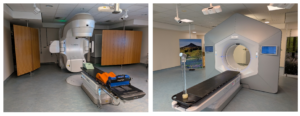
Figure 3. Images taken from the Castle Hill Radiotherapy department showing a TrueBeam Linac (left) and a Halcyon Linac (right).
Before you go for treatment the radiographers may call you through into a side room to use a bladder ultrasound machine to check how full your bladder is. If you do not feel like your bladder is full, please make the staff aware. If it isn’t full enough then we may ask you to drink some more water before attempting treatment.
The radiographers will escort you into the treatment room and assist you into the correct treatment position on the couch, as you were for your planning appointment. Once you are in the correct position the staff will leave the room.
The Linac will be controlled by the radiographers, it will not touch you, and you will not see or feel anything during treatment. We will take a quick scan called a Cone Beam CT (CBCT) before each treatment to ensure that your internal organs are positioned well for treatment. During treatment it is very important that you stay as still as possible and breathe normally.
The radiographers can see you at all times during your treatment on closed circuit TV monitoring (CCTV) to ensure that you are safe and comfortable during treatment. They will also be able to hear you and talk to you through an intercom. If you need to get the radiographers attention, please raise your voice, do not move, as this can affect the delivery of your treatment.
You will have regular reviews with the radiographers as your progress through your treatment to assess how you are coping with any side effects. You may be referred to one of our clinical nurse specialists (CNS) if further medical advice or intervention is required.
What are the potential side effects of treatment?
You may experience some side effects and reactions as you progress through your treatment. You are not guaranteed to have side effects, and every individual is different. Side effects can occur at various levels – these are normal and temporary. You can speak with the Radiotherapy team and get reassurance and advice on how you can possibly control the side effects. In some circumstances, we may be able to prescribe medications to help with side effects.
Your Clinical Oncologist or Consultant Therapeutic Radiographer will discuss the risk of potential side effects with you in detail. You will then sign a consent form for the radiotherapy at your clinic appointment before being planned for treatment. The following information is based on the Royal College of Radiologists (RCR) consent form.
https://www.rcr.ac.uk/our-services/management-service-delivery/national-radiotherapy-consent-forms/
Early side effects: Start during radiotherapy or shortly after completing radiotherapy and usually resolve within two to six months after finishing radiotherapy. These include:
- Tiredness, hair loss (in the treatment area) and skin change: redness in white skin tones and subtle darkness, yellow/purple/grey appearance in brown and black skin tones.
- Bladder Changes: Expected (50 to 100%); passing water more often, with more urgency and slower flow. Less common (<10%); pain or discomfort when you urinate or passing blood (usually mild). Rarely (less than 1 in 100 men); not being able to pass urine which may result in needing a urinary catheter or urinary incontinence including leaking.
- Bowel Changes: Common (10 to 50%); opening your bowels more often than normal, sudden urge to open your bowels, looser stools with more mucous or wind compared to normal. Less common (<10%); Rectal pain/discomfort due to inflammation, feeling of not completely emptying your bowels, bleeding from your bowel (usually mild).
Possible late or long-term side-effects: With the use of modern planning techniques, there is a low chance of late side effects from happening, however, this may happen many months or years after radiotherapy and may be permanent, and will be discussed in detail with you by your Clinical Oncologist, these include:
- Infertility (50 to 100%), Changes in sexual function (10 to 50%).
- Bladder Changes: Common (10-50%); Long-term mild urinary symptoms of passing urine more often and with more urgency. Less common (<10%); pain, incomplete emptying or reduced bladder capacity, a narrowing of the water pipe (urethra), and bleeding. Rare (<1%); Urinary incontinence and leaking, risk of damage requiring surgical intervention.
- Bowel Changes: Common (10 to 50%); sudden urge to open bowels, looser stools with more wind or mucous. Less common (<10%); opening your bowels more often than normal, swelling in the back passage, causing discomfort when passing, bleeding, and intermittent discomfort in the abdomen. Rare (<1%); risk of damage requiring surgical intervention.
- Thinning of the bones and risk of second cancer in the treatment area (Rare <1%).
What happens at the end of treatment?
Once you have completed your treatment, you will receive a follow-up appointment in the post or via the NHS app to see your Clinical Oncologist or Consultant Radiographer at the hospital where you were previously seen. This is usually 4 to 8 weeks after treatment has finished, as this allows any side-effects you may have experienced to clear. Your Clinical Oncologist or Consultant Radiographer will review you and discuss the follow-up procedure and future appointments.
Hormone Therapy
Hormone therapy (also referred to as Androgen Deprivation Therapy) may be given in addition to radiotherapy – this is known as adjuvant therapy. Hormones control the growth and activity of normal cells and are naturally produced in the body.
Your Clinical Oncologist or Consultant Radiographer may advise that you could benefit from hormone therapy. Hormone therapy works by either stopping testosterone from being produced or stopping testosterone from reaching cancer cells. Testosterone alone does not normally cause any problems, but if you have prostate cancer, this can accelerate growth.
It may not be necessary that you have hormone therapy, but if you have any questions please discuss with your Clinical Oncologist or Consultant Radiographer.
Hormone therapy can either be given as a course of tablets to be taken daily, or via an injection under the skin of the abdomen (subcutaneously). The injections can be given either 4-weekly or 12-weekly and will be given at your own GP practice.
If you do require Hormone therapy, then your Clinical Oncologist or Consultant Radiographer will discuss how long they would like you to remain on this. The potential side effects of hormone treatment are outlined below; some people may experience side effects more than others. If you have any concerns, please discuss with your Urology Clinical Nurse Specialist (CNS) team.
- Common (10 to 50%); Hot flushes, weight gain, fatigue and sexual dysfunction.
- Less common (<10%); Skin rashes and breast tenderness (gynecomastia).
- Rare (<1%); Osteoporosis, sore joints.
Radiotherapy Staff
Clinical Oncologist, Consultant Therapeutic Radiographers, Registrars
They are experts in radiotherapy and will be managing your treatment. They will take responsibility for deciding what dose and how many treatments will be best for you; they will oversee the planning of your treatment. You may see them or a member of their team at your initial clinic appointment, and you can see them during your treatment if you have any problems or queries.
Therapeutic Radiographers
Radiotherapy is delivered by male and female therapeutic radiographers who are specialist healthcare professionals trained to plan and deliver radiotherapy treatment and to use the specialist equipment. You will usually see the same team of radiographers during your treatment, and they will assist you with any questions or problems or refer you to a more appropriate person.
Radiotherapy Support Team
The team consists of clinical nurse specialists and clinical support workers (CSWs), who are based within the radiotherapy department where they provide specialist care, actively support, and advise patients before, during and after radiotherapy treatment.
Physicists, Planning Dosimetrists and Machine Technicians
Medical physicists are specialist scientists who have a key role in the individual planning of your treatment, along with the Planning Dosimetrists. They may also have an input into the arrangement of your treatment. They work together with the machine technicians to ensure that the treatment machines are reliable and working accurately.
Students
At some point during your treatment, you may encounter student radiographers. Everything they do is supervised fully. If you would prefer for our students to not be present during your planning or treatment, then please let a member of staff know at your initial planning appointment.
Other members of staff
During your course of treatment, you may also meet our receptionists, porters and volunteer workers. All are working together to provide you with high quality care.
Research
The Trust is research-active with a research strategy that includes cancer treatment and care. The radiotherapy department participates in national and international research studies to improve treatments to make them safer, more effective, and reduce side effects. We also develop patient-centred local research to improve your radiotherapy experience to benefit you and your family. We would like to encourage you to provide feedback about your experiences and ideas to help us research the areas that are important to you. Your treatment will not be affected in any way should you not want to take part.
Advice and Support Services
Please read through this leaflet and your clinic letter, share the information it contains with your partner and family (if you wish), so that they can be of help and support. There may be information they need to know, especially if they are taking care of you.
Radiotherapy Information and Support Team
Should you require further advice on the information contained within this leaflet, please do not hesitate to contact the Radiotherapy Information and Support Team on Tel: 01482 461206
Email: hyp-tr.radiotherapy.information@nhs.net
Alternatively, contact your urology specialist nursing team on telephone numbers:
Hull: Tel: 01482 622178
York/Scarborough: Tel: 01723 385246
NLaG: Tel: 03033 304401
Radiotherapy Booking Office
If you need to speak with a member of staff regarding your appointments, please contact the Radiotherapy Booking Office on telephone number(s):
Tel: 01482 461187 / Tel: 01482 461188 / Tel: 01482 461189 / Tel: 01482 461225 / Tel: 01482461138
Cancer Psychological Service
The primary aim of our psychological service is to support patients (and family) with emotional and psychological well-being during and after oncological and haematological treatment. The service is located in the Queen’s Centre at Castle Hill Hospital, HU16 5JQ.
Contact times are Monday to Friday, 8:00am to 4:00pm.
Tel: 01482 461060 / Tel: 01482 461061
Alternatively, please contact your Specialist Nursing team on:
Hull: Tel: 01482 622178
York/Scarborough: Tel: 01723 385246
NLaG: Tel: 03033 304401
MacMillan Cancer Support
Aim to provide expert information and advice on all aspects of cancer and its treatment, and on the practical and emotional aspects of living with cancer.
The MacMillan Cancer Information Centre at the Queen’s Centre is open Monday-Thursday, 8:00am to 6:00pm. You can drop-in or call on Tel: 01482 461154
For Scunthorpe and Grimsby, they are open Tuesday to Thursday – opening hours are subject to change. Tel: 03033 305302
Alternatively, to speak to a MacMillan advisor, call the free national helpline Tel: 0808 808 0000, available 7 days a week between 8:00am and 8:00pm.
Online: http://www.macmillan.org.uk
PALS (Patient Advice and Liaison Service)
Provide confidential advice and support, helping you resolve and concerns you have about the service you have received.
Tel: 01482 623065. Monday-Friday, 8:30am to 4:30pm.
Email: hyp-tr.pals.mailbox@nhs.net
Online Resources:
MacMillan: https://www.macmillan.org.uk/cancer-information-and-support/prostate-cancer
Prostate Cancer UK: https://prostatecanceruk.org/prostate-information-and-support
Infopool: https://www.theinfopool.co.uk/