
- Reference Number: HEY1594/2025
- Departments: Physiotherapy, Therapies
- Last Updated: 30 September 2025
Introduction
Following an injury or an operation you might develop a scar. This leaflet explains how scars are formed and what you can do to help.
What is a Scar?
A scar (or scar tissue) is an area of fibrous tissue that replaces normal skin after an injury. Scars result from the biological process of wound repair in the skin, as well as in other organs, and tissues of the body.
How are scars formed?
Scars form because of the natural healing process of the skin. Sometimes, as a scar forms it becomes hard, red, raised and thick. It may adhere (stick) to underlying tissues and it may itch or be sensitive to touch.
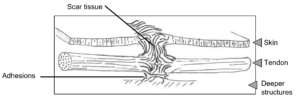
Image source: St George’s University Hospitals NHS Foundation Trust
Scars which run across or close to a joint may limit movement (for example bending your wrist or fingers). Everyone’s skin is different, and some people are more prone to problems with their scars.
Scar Management
Scar massage is a treatment to improve the look of your scar and reduce any pain or soft tissue adherence (sticking). You will be given advice from your Hand Therapist on when to the start scar massage.
The following massage techniques can help to soften the scar tissue and make it flatter, paler and smoother. Use an un-perfumed moisturising cream or lotion (e.g. Aveeno, E45, Vaseline Intensive Care).
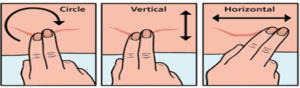
Image source: The Leeds Teaching Hospitals NHS Trust
- Start with small circles along the length of the scar either with your thumb or first two fingers.
- Begin with a light pressure, progressing to deeper and firmer pressure, as you can tolerate.
- Next, work vertically (up and down) along the length of the scar.
- Then work horizontally (left to right) across the scar, in small movements.
- Massage the scar and any tight or hard areas lying close to the scar.
You should do this for at least 10 minutes, 2 or 3 times a day.
It may take several months to achieve a flat and moveable scar. A scar can take up to 18 months to mature fully.
Stop massaging and contact your GP or Consultant if you experience any of the following: redness, bleeding, the scar feels warmer than the skin around it, more pain than usual at the site of the scar.
Sun Exposure
- Scars are extremely sensitive to sunlight.
- Exposure to the sun without sufficient protection will mean scars burn easily and could cause long term damage, darkening the scar which could be irreversible
We recommend a high factor sun cream both UVA and UVB protection on scarred areas for two years post injury and covering them with clothing where possible to increase the protection
Silicone Gel Therapy
Silicone can work well combined with treatments such as pressure, scar massage and other therapeutic methods in reducing the appearance of problematic scars.
Silicone gel/sheet may hydrate the scar tissue and reduce the production of collagen fibres. It has also been shown to reduce redness and to make the scar flatter, softer and paler. Your Hand Therapist will explain on how to use these and where to get the silicone products from. This will depend on the scar presentation.
What happens if I do not do anything?
Your scar could become hard and inflexible, or adhesions may form. Scars that cross a joint could stop you being able to bend or straighten the joint (a contracture). This may cause a deformity or may mean you have more limited movement which may affect the way you can use your hand.
Contact details:
Should you require further advice on the issues contained in this leaflet, please do not hesitate to contact the following:
Hand Therapy Castle Hill Hospital Tel: 01482 622296 (Monday to Friday)