
- Reference Number: HEY1092/2026
- Departments: Emergency Department, Paediatrics
- Last Updated: 28 February 2026
Introduction
This leaflet has been produced to give you general information about your child’s condition. This leaflet should answer most of your questions. It is not intended to replace discussion with you and your child’s doctor but may act as a guide. If after reading it you have any concerns or require further explanation, please discuss this with a member of the healthcare team caring for your child.
What is Constipation?
Constipation means opening bowels less than 3 times a week, or having hard, dry poo (stools) that may be large or come out as tiny pellets. Constipation is common and can be more likely to occur at specific times of change such as when introducing formula milk, weaning to semi-solids, toilet training and starting school. Constipation should be picked up early and treated promptly.
Treatment
It can be easily treated with laxatives (using age-related doses), alongside other measures such as:
– Increasing fluid intake – Increasing dietary fibre intake
– Reward systems – Scheduled toileting to establish patterns
Impaction
Impaction is very bad constipation where poo builds up and can become immobile in the intestines. The child may pass very small stools every few days or have very infrequent bowel movements. They may also have overflow diarrhoea, which is when watery poo ‘leaks’ around harder poo, sometimes causing soiling.
Disimpaction Regime
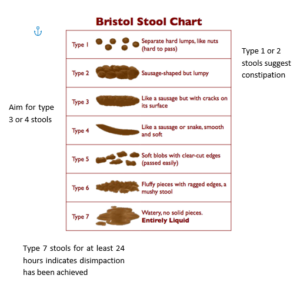
The aim of disimpaction is to clear the bowel of the hard, immobile poo. This can take 7 to 14 days of disimpaction treatment. We know disimpaction has happened when your child has stools which are loose and watery for at least 24 hours (type 7 on the Bristol Stool Chat – see over page).
The laxative of choice in children is Macrogol 3350 + electrolytes, which includes the brand names Movicol or Laxido. It works by retaining water in the bowels, which softens the stool. A disimpaction regime involves giving gradually increasing doses until all the poo has become liquid and comes out as diarrhoea. It is then necessary to continue on a smaller dose for 3 to 6 months to allow the bowels to recover and to prevent constipation returning.
Disimpaction is treated with the number of paediatric Movicol sachets as follows:
| Day 1 | Day 2 | Day 3 | Day 4 | Day 5 | Day 6 | Day 7 | |
| Child under 1 | ½ to 1 | ½ to 1 | ½ to 1 | ½ to 1 | ½ to 1 | ½ to 1 | ½ to 1 |
| Child 1 to 5 years | 2 | 4 | 4 | 6 | 6 | 8 | 8 |
| Child 5 to 12 years | 4 | 6 | 8 | 10 | 12 | 12 | 12 |
Children over 12 years should be treated with the adult preparation – the laxative is exactly the same but there is twice as much in the sachet:
| Day 1 | Day 2 | Day 3 | Day 4 | Day 5 | Day 6 | Day 7 | |
| Child over 12 | 4 | 6 | 8 | 8 | 8 | 8 | 8 |
If disimpaction takes longer than 14 days make an appointment to see your child’s GP as they may add in a ‘stimulant’. Stimulant laxatives increase the muscular squeezing of the bowel, speeding up bowel emptying. Due to the way they work they may also cause abdominal cramps. Stimulant laxatives include Senna, Sodium Picosulphate or Bisacodyl.
Maintenance
Once disimpaction is achieved (24 hours of loose, watery stool), reduce the number of sachets to a ‘maintenance’ dose. This will be half the disimpaction dose, up to a maximum of 4 paediatric sachets daily.
| Maintenance Dose | |
| Child aged less than a year | ½ to 1 sachet / day |
| Child aged 1 to 5 years | ½ to 3 sachets / day |
| Child aged 5 to 12 years | 1 to 4 sachets / day |
| Child aged over 12 years | 1 to 2 adult sachets / day |
The aim is for regular soft but formed stools (type 3 or 4). Your child may need to stay on laxatives for many months or even years. Long-term use will not hurt your child, but poorly controlled constipation will.
If you require additional information, please contact your child’s doctor or call the Emergency Department on Tel: 01482 482108
If you need information in a different format, such as large print, braille, or audio, please advise a member of staff and this can be arranged.